
 Licensed Yacht BrokersSales and service of yachts and ships
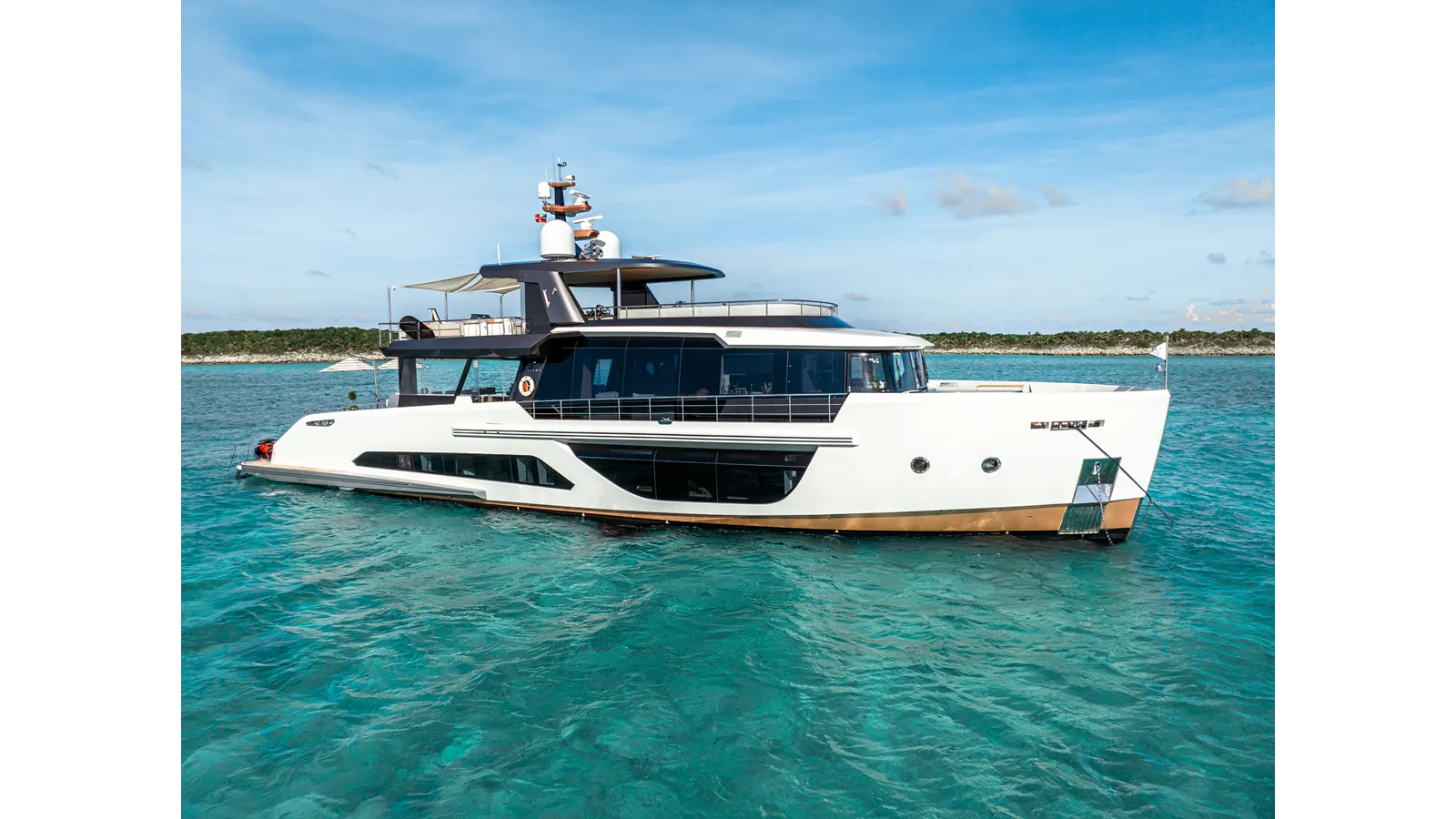
ALPHA YACHTS - For Sale
Company History
Alpha Custom Yachts emerged in the late 2010s as a contemporary, semi-custom yacht brand focused on delivering large-yacht comforts in compact, efficiently engineered platforms. From its inception, the brand set out to blend European design culture with practical, owner-centric layouts and robust construction practices typically associated with far larger vessels. Early development centered around a family of models conceived to maximize onboard volume, enhance indoor–outdoor living, and simplify ownership through thoughtful engineering access and serviceability.
A core pillar of Alpha Custom Yachts’ identity is collaboration with established European designers and naval architects to achieve clean proportions, generous deck areas, and refined interiors. The company’s first publicized models concentrated on innovations that are especially appreciated by experienced owners: extended beach clubs that connect sea and salon, wide walkaround decks for safety and circulation, and expansive glazing that saturates interiors with natural light. As a result, Alpha’s yachts have often been described as “big-boat living” in lengths traditionally considered owner-operated or minimally crewed.
Model families frequently referenced in connection with the brand include lines devoted to easy, alfresco living and practical long-weekend or season-length cruising. These platforms typically emphasize:
- Tall interior headroom and intelligent use of beam for lounge-like salons
- Seamless transitions between aft cockpit, salon, and foredeck
- Flexible stateroom arrangements suited to family use or charter
- Crew spaces planned to support high service standards without interrupting guest privacy
- Engineering layouts that keep major systems accessible and logically grouped
Over time, Alpha Custom Yachts has built a reputation for combining crisp exterior lines with interiors that range from warm, residential aesthetics to more minimal, contemporary palettes—depending on the owner brief. The brand positions itself squarely in the semi-custom space: hulls and superstructures are optimized based on a proven platform, while layouts, finishes, and select technical options are tailored to each client’s requirements. This approach aims to compress delivery schedules and mitigate project risk without suppressing creativity or personalization.
Another defining trait is the attention to owner experience beyond the spec sheet. The company’s design process typically emphasizes circulation flow—how guests move from water-level platforms to lounges, dining areas, and helm or sky-lounge zones—and how crew can operate discretely. That human-centered philosophy can be seen in details such as broad side-decks, shaded alfresco dining areas, and practical tender and toy handling. The result is a series of yachts that feel purposeful, easy to live aboard, and flexible for both private use and charter.
As the brand gained visibility, brokerage and charter companies began featuring Alpha-built boats in their portfolios, and yachting media noted the combination of generous volume, bright interiors, and contemporary exterior language. The brand’s public presence at major boat shows and in industry press helped establish Alpha Custom Yachts as a fresh alternative to traditional semi-custom production, especially for clients seeking the elegance and customization of European superyacht culture in more agile, owner-focused lengths.
While precise corporate milestones and founding biographies are not always heavily publicized, the trajectory is clear: Alpha Custom Yachts targeted a segment of the market where many owners wanted superyacht-level features—beach clubs, superb natural light, full-beam owner suites, private terraces, and multi-use deck spaces—without stepping into the larger, more complex management demands of very large tonnage. By building around comfort, function, and customization, the brand created a recognizable identity: yachts that feel spacious, social, and refined, yet remain manageable and efficient for their size.
With a growing global client base, Alpha Custom Yachts continues to refine its platforms, incorporate owner feedback, and explore technologies that support quieter operation, lower emissions (where feasible), and simplified maintenance. The brand’s philosophy emphasizes real-world livability as much as profile and performance. In short, Alpha Custom Yachts’ history is that of a modern semi-custom builder that consciously aligns design, build methodology, and onboard ergonomics to the lifestyle its owners actually lead—weekend getaways, extended seasonal cruising, and relaxed entertainment with family and friends.
Reputation and Quality
Within the industry, Alpha Custom Yachts is known for pairing contemporary European styling with smart, volume-forward layouts and a semi-custom process that encourages meaningful owner input. The brand’s reputation rests on three pillars: design clarity, practical engineering, and consistent interior quality.
Design clarity shows in exterior lines that read clean and modern from every angle—balanced superstructures, large windows, and generous deck overhangs that provide shading and reduce heat-gain. Inside, layouts prioritize natural light, sightlines, and social zones. Owners who value convivial spaces—open salons that connect to aft terraces, day heads placed where guests actually need them, and foredeck lounges that function as private retreats—tend to appreciate Alpha’s approach. This human-scale design also aligns with the needs of crew: service pathways, discreet pantry and galley access, and practical logistics for housekeeping and provisioning.
On the engineering side, Alpha Custom Yachts typically draws from established vendors and proven marine systems. That conservative technical backbone supports the semi-custom ethos: owners can choose options without stepping into untested integration. Hull shapes and propulsion packages are selected to offer predictable handling, comfortable seakeeping, and efficient cruising in the speed bands most clients use day-to-day. Noise and vibration control are treated as central to the onboard experience, with attention paid to isolation, equipment selection, and structural detailing that keeps accommodations calm and composed.
Interior quality is reflected in joinery, finishes, and the tactile experience of doors, latches, cabinetry, and lighting. Even when clients choose contemporary minimalism, the detailing remains robust: rounded edges where they enhance safety and longevity, durable veneers and stones selected for marine use, and hidden storage that keeps living areas uncluttered. The overall goal is to deliver the “residential comfort” many modern owners expect while maintaining the durability required for maritime service.
The brand has been covered by prominent yachting publications and has attracted brokerage interest internationally, a sign that its products are understood and supported by the professional market. Owners and captains often highlight practical aspects—ease of cleaning, logical placement of breakers and valves, workable crew cabins, and deck equipment sized and sited for real operations. These details matter: they reduce owner fatigue, help maintain resale value, and make the boat more enjoyable over time.
Sustainability is an evolving area for every builder. Alpha Custom Yachts’ contribution typically centers on weight-conscious construction methods, efficient hull forms within the chosen speed profile, and system choices that reduce maintenance and extend service intervals. While the brand is not marketed as a pure-technology disruptor, its measured, fit-for-purpose approach favors reliability, lower cumulative running costs, and a quieter, more comfortable experience—all of which align with responsible, long-horizon ownership.
In sum, Alpha Custom Yachts enjoys a reputation as a designer-led, semi-custom builder that delivers real-world livability, clean styling, and reliable engineering. Clients who prefer generous spaces, alfresco connectivity, and flexible layouts—without stepping into the operational scale of very large superyachts—often find the brand’s balance of customization and platform discipline especially compelling.
Historia de la empresa
Alpha Custom Yachts surgió a finales de la década de 2010 como un astillero de yates semipersonalizados con una meta clara: ofrecer el confort de los “superyachts” en esloras más manejables, combinando diseño europeo, distribución práctica y construcción sólida. Sus primeras plataformas se concibieron para maximizar el volumen interior, fomentar la vida interior–exterior y facilitar la propiedad mediante una ingeniería accesible y bien ordenada.
El enfoque del astillero se apoya en colaboraciones con diseñadores europeos consolidados, buscando líneas limpias, espacios generosos y ambientes interiores luminosos. Las configuraciones destacan por beach clubs de buen tamaño, pasos laterales anchos, terrazas en proa y grandes superficies acristaladas. La filosofía semipersonalizada permite a los armadores adaptar la disposición, los acabados y determinados sistemas, manteniendo la base técnica en plataformas probadas para acortar plazos y reducir riesgos.
Hoy, Alpha Custom Yachts es reconocido por un estilo contemporáneo y una habitabilidad que recuerda a yates de mayor tonelaje, con un énfasis especial en la circulación a bordo y la privacidad de los invitados. Su presencia en ferias y medios especializados ha consolidado su imagen como alternativa moderna dentro del segmento semipersonalizado.
Reputación y calidad
El astillero goza de prestigio por tres razones: claridad de diseño, ingeniería práctica y calidad interior consistente. Las cubiertas están pensadas para la vida social y el uso real: salones que se prolongan hacia popa, comedores sombreados, lounges de proa y circulaciones discretas para la tripulación. La ingeniería se apoya en proveedores reconocidos y soluciones integradas de forma conservadora, buscando confort, eficiencia y mantenimiento simplificado. En interiores, la carpintería y los acabados mantienen estándares marinos, con atención al detalle y a la durabilidad. En conjunto, la marca ofrece un equilibrio atractivo entre personalización y fiabilidad.
Storia dell’azienda
Alpha Custom Yachts nasce alla fine degli anni 2010 con l’obiettivo di proporre piattaforme semipersonalizzate che uniscono estetica europea, grande vivibilità e processi costruttivi affidabili. Fin dall’inizio, il cantiere ha puntato su layout capaci di massimizzare luce naturale, collegamenti tra spazi esterni e interni e percorsi funzionali per armatore e equipaggio.
La filosofia è quella del “semi-custom”: struttura e carena su base collaudata, con ampie possibilità di personalizzazione per interni, allestimenti e alcune componenti tecniche. Questo approccio riduce tempi e rischi, garantendo al contempo una forte impronta progettuale e la possibilità di rispondere al brief dell’armatore. La presenza del marchio su stampa di settore e ai boat show ha contribuito a consolidarne il posizionamento.
Reputazione e qualità
La reputazione di Alpha Custom Yachts si fonda su stile pulito, ingegnerizzazione sensata e qualità degli interni. Le barche offrono comfort acustico, luminosità e volumi in rapporto alla lunghezza particolarmente generosi, con attenzione alla privacy degli ospiti e all’efficienza dei flussi di servizio. La scelta di sistemi affidabili e di layout tecnici accessibili facilita manutenzione e gestione. Ne risulta un prodotto apprezzato da armatori che cercano vivibilità e personalizzazione senza affrontare la complessità operativa dei grandi superyacht.
Histoire de l’entreprise
Alpha Custom Yachts s’est développée à la fin des années 2010 comme marque de yachts semi-custom axée sur l’habitabilité, l’esthétique contemporaine et une ingénierie pragmatique. Les premières plateformes ont mis l’accent sur la lumière naturelle, la connexion mer–terrasses–salons et des circulations claires pour les invités et l’équipage. Le processus semi-custom permet de personnaliser aménagements et finitions tout en s’appuyant sur des bases techniques éprouvées, ce qui raccourcit les délais et stabilise la qualité.
Réputation et qualité
La marque est reconnue pour l’équilibre entre design européen, confort réel à bord et fiabilité des systèmes. Les plans de pont favorisent la vie en plein air, l’intimité et la sécurité (passavants larges, zones ombragées, volumes bien protégés). Le choix de composants éprouvés et l’attention portée à l’isolation phonique et vibratoire sécurisent une expérience paisible. Les intérieurs, soignés et durables, répondent aux attentes d’une clientèle recherchant une ambiance résidentielle en mer, sans renoncer à la robustesse.
Unternehmensgeschichte
Alpha Custom Yachts entstand Ende der 2010er-Jahre als semi-custom Werft mit dem Ziel, großen Wohnkomfort und modernes Design in effizient konstruierten Plattformen zu vereinen. Von Beginn an lag der Fokus auf durchdachten Grundrissen, großzügiger Verglasung und nahtlosen Übergängen zwischen Beach-Club, Salon und Außendecks. Das semi-custom Konzept ermöglicht individuelle Anpassungen auf Basis bewährter Rümpfe und Strukturen – mit kürzeren Lieferzeiten und reduziertem Projektrisiko.
Reputation und Qualität
Im Markt ist Alpha Custom Yachts für klare Linien, praxisorientierte Technik und hochwertige Innenausbauten bekannt. Die Modelle bieten ruhige Laufkultur, gute Erreichbarkeit technischer Bereiche und genügend Flexibilität für Eigner oder Charterbetrieb. Die Auswahl zuverlässiger Systeme und die Augenmerk auf Lärm- und Schwingungsdämpfung verbessern Komfort und Werterhalt. Das Ergebnis ist ein Produkt für Eigner, die Großyacht-Komfort in handhabbaren Längen suchen.
История компании
Alpha Custom Yachts сформировалась в конце 2010‑х как производитель полукастомных яхт с упором на жилой комфорт, современный европейский дизайн и практичную инженерную базу. Первые модели отличались просторными салонами, широкими проходами, обилием естественного света и удобной связью между пляжной зоной у воды и жилыми помещениями. Подход semi-custom позволяет клиентам настраивать планировки и отделку, опираясь на проверенную платформу и сокращая сроки поставки.
Репутация и качество
Бренд ценится за сбалансированное сочетание чистой эстетики, разумной техники и качественной отделки. Продуманные “потоки” гостей и экипажа, надежные поставщики систем, внимание к шуму и вибрациям — все это создает комфортную среду и упрощает эксплуатацию. Для владельцев, стремящихся к “большой” жилой функции на яхтах умеренной длины, Alpha Custom Yachts предлагает убедительное решение с хорошим потенциалом ликвидности на вторичном рынке.
Main Competitors
In the market niche that Alpha Custom Yachts (often referred to informally as “Alpha Yachts”) targets—semi-custom composite motoryachts with strong emphasis on interior volume, indoor–outdoor living, and contemporary European styling—the main competitive set comprises established premium production and semi-custom builders, along with a handful of boutique yards that similarly prioritize personalization. The following brands are the most relevant benchmarks and alternatives a prospective Alpha client typically evaluates:
-
Sanlorenzo (Italy)
- Why they compete: Sanlorenzo’s SL (planing) and SD (semi-displacement) ranges embody the same design-driven, high-finish ethos that appeals to buyers who want customization without going fully one-off. Sanlorenzo is renowned for refined interiors, architectural layouts, and quiet engineering—attributes that speak to Alpha’s target clientele.
- Differentiators: Sanlorenzo has broad scale and a deep orderbook, with very sophisticated material libraries and interior architecture. A buyer may compare these advantages to Alpha’s more intimate, boutique approach.
-
Azimut Yachts (Italy), especially the Grande series
- Why they compete: Azimut Grande models offer generous glazing, social deck plans, and aggressive use of carbon/composites to manage weight and volume—elements that mirror the design priorities Alpha emphasizes (light, space, and liveability).
- Differentiators: Azimut benefits from powerful industrial backing and extensive global dealer support. Alpha counters with a more bespoke, semi-custom posture.
-
Ferretti Group (Italy): Ferretti Yachts and Custom Line
- Why they compete: Custom Line (semi-custom) and upper-end Ferretti Yachts provide upscale finishes, strong resale support, and consistent engineering. Clients who prioritize service infrastructure and proven platforms often cross-shop these with Alpha.
- Differentiators: Custom Line’s production scale and structured customization menu can feel very reassuring; Alpha’s value proposition leans into boutique attention and high-volume interiors within owner-manageable lengths.
-
Princess Yachts (UK): Y-Class and X-Class
- Why they compete: Princess has earned a reputation for balanced seakeeping, elegant interiors, and excellent space planning, particularly in the X-Class with its focus on volume and lifestyle decks—key parallels to Alpha’s priorities.
- Differentiators: Princess’s industrial maturity and dealer footprint are strengths; Alpha’s draw is its semi-custom flexibility and designer-led, lifestyle-first layouts.
-
Sunseeker (UK): 90–100+ series and flagship models
- Why they compete: Sunseeker’s recent designs emphasize vast glazing, beach clubs, and indoor–outdoor connectivity—the very language Alpha clients seek. Performance-oriented owners may also weigh speed against volume features.
- Differentiators: Sunseeker marries sport styling with comfort; Alpha tends to foreground liveability and residential comfort while keeping lines clean and modern.
-
Horizon Yachts (Taiwan)
- Why they compete: Horizon is known for semi-custom composite builds with robust engineering and broad interior personalization. Buyers valuing space utilization, long-range comfort (in selected series), and owner input frequently compare Horizon and Alpha.
- Differentiators: Horizon’s production breadth and history in the Americas/Asia are notable; Alpha positions as a tightly curated, design-forward choice.
-
Ocean Alexander (Taiwan/USA)
- Why they compete: OA’s newer lines showcase big-boat volumes, expansive windows, and social decks—approaches aligned with Alpha’s proposition. OA’s dealer support in North America is another point of overlap for similar clientele.
- Differentiators: Ocean Alexander projects a conservative, “big-boat systems” vibe; Alpha leans modern-residential, with layouts aimed at convivial living and easy owner use.
-
Gulf Craft – Majesty Yachts (UAE)
- Why they compete: Majesty Yachts offers composite yachts with generous volumes and competitive value, often appealing to buyers who want size and presence within a set budget.
- Differentiators: Majesty’s value orientation and build capacity contrast with Alpha’s boutique, highly curated customization.
-
Arcadia Yachts (Italy)
- Why they compete: Arcadia’s distinctive, eco-aware aesthetic and emphasis on glasshouse living, terraces, and energy efficiencies make it a natural comparator for owners prioritizing indoor–outdoor continuity and abundant natural light—hallmarks also found in Alpha’s approach.
- Differentiators: Arcadia’s design language is boldly distinctive; Alpha pursues a more classically contemporary profile while achieving similarly high levels of liveability.
-
Sirena Yachts (Turkey)
- Why they compete: Sirena blends modern styling, efficient hulls, and long-range comfort, appealing to owners who want volume and autonomy in the 20–30+ meter band. That “cruise comfortably, live large aboard” ethos resonates with the same demographic Alpha targets.
- Differentiators: Sirena emphasizes efficiency and range in a slightly smaller average size bracket; Alpha operates in a space that reads more “mini-superyacht” in volumes and social planning.
-
Numarine (Turkey)
- Why they compete: Numarine’s explorer and semi-displacement offerings—quiet, long-legged, and comfortable—attract buyers who prioritize interior volume and practical, owner-friendly systems. This overlaps with Alpha’s functional, lifestyle-first stance.
- Differentiators: Numarine’s explorer identity sets a different visual tone; Alpha stays with sleek, contemporary lines rather than purposeful explorer aesthetics.
-
Benetti (Italy) – entry composite and small steel/aluminum ranges
- Why they compete: Benetti’s entry models serve buyers ready to step into the “superyacht” world. Some Alpha prospects may consider stretching into Benetti’s smallest composite or steel models for the cachet and shipyard infrastructure.
- Differentiators: Benetti offers a gateway to full superyacht practices; Alpha provides many “big-boat” comforts at lengths and complexities that remain owner-manageable.
-
EXTRA Yachts by ISA (Italy)
- Why they compete: EXTRA emphasizes beach clubs, large windows, and lifestyle decks—directly relevant to clients who value social connectivity to the sea and airy interiors.
- Differentiators: EXTRA’s aesthetic is avant-garde and angular; Alpha balances contemporary design with a timeless, refined language.
This competitive constellation demonstrates the core purchasing calculus in Alpha’s segment: clients weigh the intimacy and flexibility of a boutique semi-custom builder against the infrastructure, scale, and resale support of large production/semi-custom groups. The resulting shortlists tend to include a mix of the above brands, with the final decision hinging on how closely a builder’s layout, internal volume, finish culture, and aftersales ecosystem map to the owner’s personal priorities.
Current Production Status
Based on publicly available information up to the most recent period prior to 2025, Alpha Custom Yachts has been positioned as an active, boutique, semi-custom builder rather than a high-throughput production yard. The brand markets contemporary composite motoryachts that emphasize:
- Large internal volumes relative to length
- Strong indoor–outdoor transitions (aft terraces, beach clubs, foredeck lounges)
- Abundant glazing for natural light and view lines
- Owner-focused layouts with practical crew circulation and service routes
- Semi-custom interior design, finish selections, and configurable cabin arrangements
The company’s operating model aligns with build-to-order projects, where a client selects a platform and customizes interior layouts and finishes within the parameters of an established hull and superstructure. This approach allows Alpha to control engineering risk and timelines while still enabling meaningful personalization. Within that model, production typically advances against secured contracts, with delivery slots organized around the yard’s available capacity and the complexity of the chosen specification.
For prospective buyers, the practical implications are:
- Expect a guided design phase: Clients work with the yard (and, where applicable, collaborating designers) to tailor the general arrangement, decor, and select systems to their intended use—private family cruising, light charter, or a blend.
- Timelines reflect semi-custom integration: While faster than a full one-off project, a semi-custom build still requires material lead times, class/flag approvals where applicable, and iterative interior development. Delivery timelines are typically measured in many months from contract signature, with 12–24 months a common range for this tier of semi-custom yachts (exact timing varies with scope and supplier schedules).
- After-sales and commissioning are integral: Commissioning protocols, sea trials, punch-lists, and owner/captain training are standard phases; boutique builders often treat these as relationship-building moments that set the tone for long-term support.
It is reasonable, given how Alpha is positioned in the market, to consider production as ongoing within the boutique, contract-driven cadence typical of semi-custom builders. Buyers should confirm current slot availability, specification cut-off dates, and delivery windows directly with the yard or its authorized representatives, as these depend on sold orders in progress and the complexities of each new build.
Production Volumes
There are no widely published, authoritative figures that quantify Alpha Custom Yachts’ annual output by hulls delivered. This is not unusual: many boutique semi-custom builders do not publicly disclose exact production counts, especially when their business model emphasizes bespoke client work over standardized volume manufacturing.
What can be stated with reliability is the general context for a builder of Alpha’s profile:
- Boutique cadence: Semi-custom yards in this size range typically operate on a low-volume, high-touch basis. The goal is to balance engineering repeatability (using proven platforms) with personalization—an approach that naturally limits throughput.
- Build-to-order dependency: Annual output fluctuates with signed contracts, supplier lead times, and the degree of customization selected by clients. Interior fit-out complexity, special features (e.g., unique materials, integrated entertainment systems, or upgraded hotel services), and class requirements can all extend schedules.
- Workforce allocation: Skilled labor is prioritized to protect quality and consistency. Boutique builders often scale teams carefully to avoid diluting finish standards or overextending project management resources.
- Market cycles: Broader economic conditions, currency movements, and regional demand (Mediterranean, US East Coast/Caribbean, Middle East) influence new-build activity in this class. In strong markets, build slots can fill quickly; in quieter cycles, yards may stagger starts to maintain craftsmanship levels and timelines.
For clients evaluating a new Alpha build, the absence of public volume figures should prompt a constructive conversation with the yard about current pipeline, recent deliveries, and realistic delivery windows for your specification. A reputable semi-custom builder will be transparent about where your project would sit in the schedule, what milestones to expect, and how design freezes align with material procurement to keep the project on track.
In the context of eventual resale, buyers often look beyond raw production numbers and focus on the perceived quality of completed yachts, the consistency of engineering, and the effectiveness of aftersales support. In the semi-custom segment, these qualitative factors tend to carry more weight than volume statistics.
Latest News
No verifiable, up-to-date announcements are provided here. For the most accurate, current information—such as recent deliveries, launches, design partnerships, or show appearances—prospective clients should consult the company’s official communications channels or authorized sales partners.
Frequently Asked Questions
Question: Who is Alpha Yachts (also known as Alpha Custom Yachts), and what is the brand’s core focus? Answer: Alpha Yachts is a contemporary, boutique semi-custom motoryacht builder known for prioritizing liveability, generous interior volume for a given length, and strong indoor–outdoor connectivity. In practice, that means wide walkaround decks, expansive glazing, beach-club concepts at the stern, and layouts that feel “residential” and social without sacrificing crew circulation or service routes. The brand’s positioning sits between high-volume production and fully one-off custom, enabling meaningful personalization while retaining the schedule and engineering benefits of proven platforms.
Question: What does “semi-custom” mean in this context? Answer: Semi-custom refers to a build process where the hull, superstructure, and core engineering are based on a validated platform, while the general arrangement, finishes, and selected systems can be tailored to the owner’s brief. Owners typically have latitude over the number and configuration of staterooms, interior style and materials, certain galley and pantry arrangements, and specific equipment (stabilization, watermakers, AV/IT, and so on). This approach shortens delivery times compared with a fully bespoke yacht and reduces technical risk, yet still delivers a yacht that reflects the owner’s lifestyle and aesthetic.
Question: What construction methods and materials are typical for Alpha Yachts? Answer: In this size segment and for this brand profile, cored composite construction using infused laminates is common. Builders often employ vacuum infusion with vinylester or epoxy-based resins, foam or balsa cores strategically placed for stiffness and weight control, and local reinforcements at high-load areas such as engine beds, hardtop supports, and tender-handling points. Composite superstructures allow large window apertures without excessive weight gain, supporting the hallmark bright interiors and panoramic views.
Question: Are the yachts planing, semi-displacement, or displacement? Answer: The brand’s offerings are generally oriented toward planing and semi-displacement hulls in the 20–40 meter bracket. Planing variants tend to deliver higher top speeds and “get-up-and-go” for island-hopping, while semi-displacement options bias toward efficient mid-teens cruising with comfortable seakeeping. Owners typically choose based on cruising style: fast passages between close-in destinations or longer, more economical legs with calm onboard motion.
Question: What performance envelope should an owner expect? Answer: Performance depends on hull form, displacement, and engine selection, but a representative range for yachts in this class is:
- Top speed: roughly mid-teens to mid-20s knots (semi-displacement vs planing)
- Cruising speed: often 10–18 knots
- Range: at displacement or low semi-displacement speeds, 1,000–2,000 nautical miles is typical for a well-specified yacht, though exact range depends on tankage, loading, sea state, and clean hull/prop conditions These figures are indicative of the segment and of semi-custom yachts like Alpha rather than specific to a single model.
Question: What propulsion and machinery packages are commonly specified? Answer: Twin diesel installations on conventional shafts are most typical in this category, with premium power from established manufacturers such as MAN, MTU, or Caterpillar in the approximate 1,200–2,400 hp per side band, depending on length and hull form. Straight shafts offer predictable handling and robust serviceability. Some builds in this market segment also integrate advanced stabilization (electro-hydraulic fins and/or gyros), bow and stern thrusters for close-quarters maneuvering, and hotel load management designed for quiet operation at anchor and at night.
Question: How does Alpha address noise and vibration? Answer: Quiet ride and restful nights are central to the brand’s liveability ethos. This is usually achieved with a combination of resilient engine mounts, soft-coupled shaft systems, isolation of major machinery, targeted use of sound-deadening composites and insulation blankets, and thoughtful mechanical layouts (e.g., positioning of generators and HVAC equipment away from owner and guest cabins). Good results depend not just on materials but also on build detailing and commissioning quality control.
Question: What is distinctive about the interior layouts? Answer: Layouts are planned to maximize social flow and natural light. Expect:
- Aft beach club or sea-level terrace that transitions directly into an open-plan salon
- Wide side decks and foredeck lounges for private retreat and sunrise/sunset use
- Owner’s suite options on main or lower decks depending on length and hull
- Flexible guest cabin arrangements to accommodate family and friends (often four to five cabins in the 26–35 meter range)
- Crew areas with discrete access to galleys and service routes to maintain guest privacy The goal is a “big-boat feel” at lengths that remain manageable for private ownership and compact crews.
Question: Can Alpha Yachts be built to class or commercial charter standards? Answer: Semi-custom yachts in this bracket are often specified to meet recognized class and flag requirements when an owner intends to charter or seeks particular classification benefits. While specific class notation and flag-state details vary by project, it is common for builders in this segment to coordinate naval architecture and documentation to satisfy the chosen standards, subject to the owner’s brief and intended operational profile.
Question: What about tender and toy handling? Answer: The aft platform and/or garage is typically designed to accommodate a primary tender along with common water toys (PWCs, seabobs, boards). Davits or platform-lift systems are used to simplify launch and retrieval. Beach-club arrangements that transform the swim platform area into a lounge, gym, or spa zone are a signature of modern semi-custom yachts in Alpha’s space.
Question: How are systems arranged for serviceability? Answer: A practical hallmark of this market segment is systems grouping and logical access. Yards organize primary electrical panels in clearly labeled zones, route plumbing with isolation points, and design machinery spaces with headroom, lighting, and safe egress. The objective is straightforward troubleshooting and routine maintenance without major panel removals or intrusive cabin access—benefiting both crewed and owner-managed operations.
Question: What is the typical build timeline? Answer: For a semi-custom project in the 20–40 meter range, timelines commonly span 12–24 months from contract signature to delivery, with variation based on model, customization scope, material lead times, and class/flag requirements. Owners encounter several key milestones: design freeze for the general arrangement, material selections for interior finishes, mechanical and electrical specification confirmation, and subsequent commissioning and sea trials.
Question: Are these yachts suited for private use, charter, or both? Answer: The layouts and service pathways are designed to accommodate both private family cruising and light to moderate charter, depending on how the owner intends to operate the yacht. Popular features for charter—convertible cabins, day heads near social zones, privacy-compatible crew routes, and flexible dining and lounge spaces—are consistent with the brand’s overall design DNA. Achieving commercial charter compliance requires planning during the specification phase.
Question: What kind of stabilization is typical, and how does it affect comfort? Answer: Most owners specify active fin stabilization for underway comfort, often paired with gyroscopic systems for at-anchor stabilization. The combination reduces roll across a wider range of conditions, though the best configuration depends on hull form and displacement. Noise management is essential; correct sizing and integration of stabilizers, hydraulic packs, and foundations contribute heavily to onboard serenity.
Question: What are the most important considerations for resale and long-term ownership? Answer: For yachts at this level, resale prospects hinge on:
- Build pedigree and documentation of maintenance and upgrades
- Neutral, high-quality interior finishes that age well and appeal broadly
- Practical layouts with sensible crew/service logistics
- Up-to-date navigation and entertainment systems
- Strong noise/vibration characteristics at real cruising speeds Owners who maintain meticulous records and keep machinery and soft goods in top condition typically see stronger market reception when it’s time to sell.
Question: How does Alpha’s approach compare to large, multi-brand groups? Answer: Large groups excel in scale, global service networks, and process repeatability. A boutique semi-custom builder emphasizes design intimacy, flexible layouts, and detailed fit-out tailored to an owner’s lifestyle. The trade-off often comes down to the degree of personalization and the depth of relationship during the build and commissioning phases versus the breadth of network and standardized support. Many buyers in Alpha’s segment prefer the hands-on, designer-led process and the resulting “big-boat living” in a length that remains personally manageable.
Question: What electrical and hotel systems philosophies are common on these yachts? Answer: Expect robust AC/DC distribution with load management for quiet ship operations, variable-speed HVAC for comfort and efficiency, and thoughtfully partitioned AV/IT networks that separate guest entertainment from navigation and operational systems. Battery capacity and inverter/charger suites are usually sized for reduced generator runtime at anchor, while lighting control systems enable scene setting for different times of day and activities.
Question: How do owners typically personalize interiors? Answer: Semi-custom interiors are often personalized through:
- Timber veneers, stones, leathers, and textiles curated to a residential aesthetic
- Custom loose furniture tailored to the yacht’s exact beam and traffic flows
- Integrated art niches and lighting that highlight textures without glare
- Galley and pantry equipment aligned with intended use (private chef vs owner-hosted trips)
- Smart storage solutions that keep social spaces uncluttered on extended cruises The end result is a yacht that feels both refined and practical for everyday life aboard.
Question: What maintenance philosophy should owners plan for? Answer: A proactive regimen is essential: scheduled machinery services (engines, generators, stabilizers), routine checks on hydraulics and HVAC, periodic calibration of navigation instruments, careful care of exterior coatings and teak, and systematic review of electrical connections and grounding. Well-kept records and preventative maintenance not only reduce downtime but also protect resale value.
Question: What crew sizes do these yachts commonly operate with? Answer: In the mid-20s to mid-30s meters, owner operators may run with a compact professional crew or a hybrid model that includes a captain, a stew/cook, and a deckhand/engineer. Larger builds toward the upper end of the segment typically add dedicated roles for engineering and hospitality. Designs in this space generally provide discrete crew routes and service points to maintain guest privacy.
Question: What safety and regulatory considerations apply? Answer: Compliance with international and regional safety regimes—such as SOLAS-equivalent equipment for the yacht’s class and size, lifesaving appliances, firefighting systems, and navigation lighting—is incorporated during the specification phase. Additional requirements for charter or specific flag administrations can be addressed through early coordination with naval architecture and compliance specialists.
Question: How does the brand think about sustainability? Answer: Within the constraints of composite motoryacht construction, efficiency and weight control are key levers. Resin infusion reduces waste and yields consistent laminates, optimized hull forms minimize resistance at typical cruising speeds, and careful hotel-load engineering reduces generator runtime. Owners increasingly request energy-efficient HVAC, LED lighting, and optimized glazing to reduce heat gain and improve comfort.
Question: What kind of sea states are these yachts designed for? Answer: Semi-custom yachts in Alpha’s domain are conceived for coastal passages, island chains, and seasonal cruising with the capability to handle moderate offshore conditions when prudently operated. As always, safe routing, weather windows, and crew proficiency are crucial, and the yacht’s class, hull form, and loading influence the comfort envelope.
Question: How should a prospective owner approach the specification phase? Answer: Begin with use cases—guest numbers, cruising regions, duration at anchor versus underway, desire for charter compliance, and crew structure. From there, align the general arrangement, machinery, stabilization, tankage, and hotel systems to those scenarios. Early decisions on interior mood boards and materials speed procurement and reduce rework. A disciplined spec process leads to smoother commissioning and more satisfying long-term ownership.
Question: Is there anything unique about the deck experience? Answer: The hallmark is the beach-club-to-salon continuum and the ability to host multiple small gatherings simultaneously—sunset cocktails aft, quiet reading on the foredeck, and family dining under shade. Generous glazing and overhead protection allow guests to enjoy views and breeze while staying comfortable in warm climates.
Question: How do these yachts handle technology integration? Answer: Expect modern navigation suites on glass-bridge consoles, redundant sensors, and integrated monitoring for machinery and tank levels. On the guest side, seamless wireless coverage, streaming-friendly AV, and discreet control over climate and lighting are common. The key is dependable integration that’s serviceable by marine technicians and does not depend on esoteric proprietary systems.
Question: What is the typical owner profile? Answer: Many owners are experienced boaters stepping up to more spacious, quieter, and more refined platforms—seeking the comfort of a “mini-superyacht” without the operational complexity and overhead of much larger tonnage. Others are charter-savvy entrants who want a semi-custom platform that supports both family use and occasional charter to offset costs.
Question: What factors most influence running costs? Answer: Fuel consumption at the chosen cruising speed, generator runtime at anchor, crew size, maintenance schedules for high-duty equipment (stabilizers, watermakers, HVAC), and berth choices in premium marinas all play a role. A well-specified, efficiently run semi-custom yacht can control these variables effectively, especially when the intended use is clearly defined from the outset.
Question: How do these yachts support all-season use? Answer: With proper insulation, glazing, and HVAC, yachts in this category comfortably transition between warm and temperate climates. Shaded alfresco areas with wind protection, heated floors in heads (when specified), and defogging strategies for glazing extend comfort into shoulder seasons.
Question: What distinguishes Alpha’s design language from sportier performance yachts? Answer: The lines are clean and contemporary rather than aggressively angular or overtly performance-signature. The emphasis is on proportion, large windowscapes, and coherent, livable deck plans. The aesthetic supports long, relaxed days aboard, with performance tuned to comfortable, efficient cruising rather than maximum speed.
Question: How do I plan stowage for extended cruising? Answer: Work with the yard to map provisioning habits into the layout: upright fridges/freezers or chest units in pantries, wine storage if desired, linen and housekeeping closets near cabins, and dedicated spaces for spares and tools accessible from crew zones. Good stowage planning reduces clutter and preserves the calm, residential feel of the living areas.
Question: What should be considered for AV/IT and privacy? Answer: Sound isolation between cabins, careful placement of speakers to avoid bleed, and managed network segmentation (guest vs ship systems) are important. Owners often ask for app-based controls with physical overrides, ensuring ease of use for guests while maintaining robustness and serviceability for crew.
Question: How important is the foredeck on these yachts? Answer: Very. Modern layouts elevate the foredeck into a prime lounge for quieter moments away from the main social hub. It’s a popular space for private breakfasts, reading, or stargazing, supported by sunpads, settees, and convertible tables. Safety is addressed through high bulwarks, handrails, and non-slip surfaces.
Question: What about shading and climate control outdoors? Answer: Hardtop overhangs, retractable awnings, and windbreak panels create microclimates on deck. These elements, paired with misting or fans where permissible, extend comfort through the day and make the yacht more usable in hot regions without retreating fully indoors.
Question: How does commissioning typically proceed? Answer: Commissioning includes dock trials for systems verification, sea trials to validate performance and noise/vibration targets, calibration of nav and monitoring systems, and a structured punch-list process. A thorough handover with crew training on systems and routine maintenance sets the tone for reliable early ownership.
Question: What is the role of class surveyors or third-party inspectors? Answer: For classed yachts or charter-compliant builds, surveyors play a formal role at defined milestones. Even for private yachts, many owners retain independent inspectors for quality assurance. This extra set of eyes supports alignment between expectations and delivered workmanship.
Question: How does the brand approach interior safety? Answer: Details matter: rounded joinery edges, handholds integrated into design features, door latches that feel substantial and secure, and non-slip flooring choices where water is present. Lighting layers ensure safe night movement without glare.
Question: What distinguishes the crew spaces? Answer: Efficient crew cabins, a functional crew mess, and a logical route to the galley and service points help crews deliver high service standards day after day. Good ergonomics reduce fatigue and help the yacht operate smoothly whether hosting family or charter guests.
Question: Are there common upgrade paths after delivery? Answer: Owners sometimes enhance stabilization packages, add toys or fitness equipment to the beach club, refine AV/IT, or tailor soft goods as usage patterns become clear. Well-documented system baselines and accessible wiring/plumbing facilitate future upgrades.
Question: How does weather protection interact with aesthetics? Answer: The design language seeks to hide practical protection in elegant forms—cohesive hardtop lines, concealed tracks for awnings, and glass expanses treated to manage heat and glare. The result: comfort measures that don’t compromise the yacht’s profile.
Question: What’s the key takeaway for a prospective owner? Answer: Alpha Yachts focuses on delivering “big-boat living” at owner-manageable lengths through semi-custom design. If you value indoor–outdoor life, bright interiors, quiet operation, and layouts tailored to your specific use case, this brand’s approach aligns well with those priorities.
Available Models
Publicly standardized, immutable model lists with detailed, verified specifications are not broadly published for this brand in a way that can be reproduced here with high confidence. In keeping with the semi-custom nature of Alpha’s offer—and to avoid presenting potentially outdated or speculative information—this section is intentionally limited.
What can be stated reliably is that the brand’s portfolio is organized around contemporary composite motoryachts designed for:
- Exceptional interior volume relative to length
- Beach club and foredeck lounge concepts that enable multiple social zones
- Large windowscapes and bright, residential-style interiors
- Owner-focused general arrangements with flexible stateroom counts
- Efficient cruising in the planing or semi-displacement regimes, depending on specification
Typical characteristics for yachts in this segment and style include:
- Length overall: commonly mid-20s to mid-30s meters, with offerings on either side depending on the platform
- Cabins: often 4–5 guest cabins plus crew accommodation appropriate to the yacht’s operating profile
- Maximum speed: generally from mid-teens up to mid-20s knots, influenced by hull, displacement, and engine choice
- Engine type: twin diesel engines on straight shafts from recognized manufacturers, with stabilization packages (fins and/or gyros) tailored to owner preference and cruising grounds
Owners interested in precise model designations, current lengths-on-offer, and verified technical data typically engage during the specification phase to align layout, machinery, and performance with how they intend to use the yacht. This ensures the selected platform and options are optimized for the owner’s personal cruising style, whether that’s fast coastal hops, extended seasonal living aboard, or a hybrid of private use and occasional charter.

Learn more on the “ALPHA YACHTS”
To learn more on the “ALPHA YACHTS” or to get advice on how to buy or sell a yacht or get a great price for a yacht charter
please call +1 (954) 274-4435 USAOnly deal with professionals!