
 Licensed Yacht BrokersSales and service of yachts and ships
N/A - For Sale
Leopard
Company History
Leopard is the global retail brand for the range of sailing and power catamarans designed for private ownership and premium charter use, built exclusively by the South African shipyard Robertson and Caine and marketed worldwide through Travelopia’s marine division (including The Moorings and Sunsail). Not to be confused with the Italian “Leopard Yachts” monohull superyacht marque, the Leopard brand in this profile refers to the multihull catamarans that have come to define robust, ocean‑capable production cats with charter‑proven systems and layouts.
The industrial foundation behind Leopard is Robertson and Caine, a Cape Town–based builder founded in the early 1990s by John Robertson and Jerry Caine. In the mid‑1990s, the company entered into a strategic partnership with The Moorings—one of the world’s leading charter operators—to create durable, comfortable cruising catamarans tailored to the demands of commercial fleets. Those early boats, delivered under The Moorings name, established a reputation for rugged construction and maintainable systems, and they attracted private buyers who wanted the same reliability for personal bluewater cruising. To serve those private buyers directly, the Leopard Catamarans brand was formally introduced and began marketing Robertson and Caine’s multihulls to retail customers while sister versions continued to be configured for The Moorings and Sunsail charter fleets.
Design has been central to the evolution of Leopard. Early generations included collaborations with leading multihull naval architects, and for most of the modern era the principal design partner has been Simonis Voogd, the Dutch–South African studio known for combining comfortable interiors with seaworthy hull forms. Over successive model cycles, Leopard popularized several now‑ubiquitous multihull features. Among the most notable was the introduction of a forward cockpit on the Leopard 44 generation, complete with a saloon walk‑through door to the foredeck. This re‑imagined circulation on board, created a genuine “indoor–outdoor” living concept forward as well as aft, and influenced competitors across the category. Leopard has also been a consistent proponent of rigid biminis and hardtops that protect the helm and cockpit, practical deck ergonomics for shorthanded sailing, and systems access optimized for serviceability—reflecting decades of charter‑fleet feedback.
Through the 2000s and 2010s, Leopard rolled out a succession of boats that expanded the size range and refined the brand’s DNA:
- Mid‑2000s: The Leopard 46 and 47 series established the company in the 45–50 ft sweet spot for family and passagemaking cats.
- Around 2010–2012: The Leopard 38 and 44 generations earned international “Boat of the Year” accolades in major English‑language magazines, bringing the brand to the forefront of multihull cruising. The flagship Leopard 58 introduced flybridge living to the top end of the line.
- Late 2010s: New‑generation platforms such as the Leopard 45 and Leopard 50 modernized styling, weight distribution, and rig geometry, improving performance and comfort while maintaining the brand’s serviceable systems ethos.
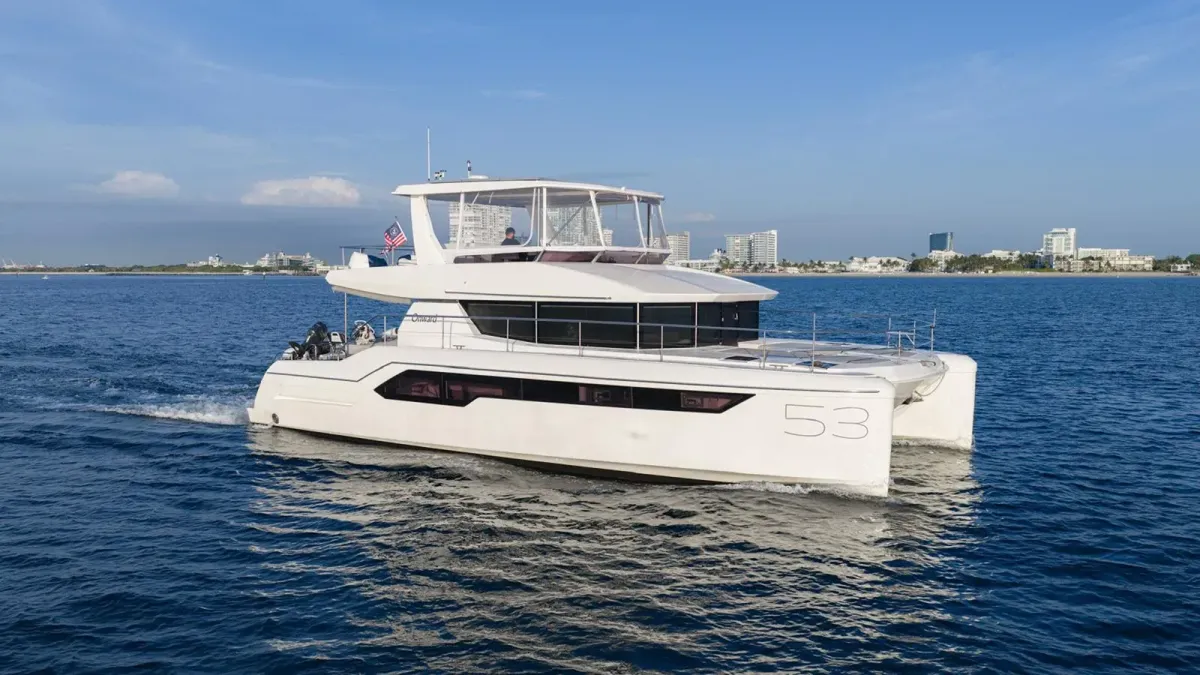
- 2010s–2020s: Leopard developed a parallel power‑cat range, starting with 39PC and 43PC, then stepping up with the 51PC and the contemporary 53PC and 46PC. These models leveraged sailing‑cat hull efficiencies without masts, delivering long‑range, economical cruising under power.
By continuously integrating operational learning from thousands of charter weeks each year, Leopard has iterated materials choices, structural engineering, and systems design to handle real‑world wear while remaining attractive to private owners. That dual focus—private ownership with the option of managed charter programs—has been a hallmark of the brand. As a result, Leopard catamarans are now a common sight in bluewater rally fleets, circumnavigation logs, and family liveaboard stories, not just in charter marinas.
Today, the Leopard lineup typically spans the mid‑30s to mid‑50s feet in sail and power, with each new generation bringing refinements in weight control, window geometry, ventilation, solar integration, lithium‑ready electrical architectures, and helm ergonomics. The boats continue to be CE‑certified and engineered for serious coastal and ocean cruising, with layouts that give equal attention to social spaces, storage, service access, and safety features such as bridgedeck clearance and well‑protected working areas. The essential through‑line is unchanged since the partnership began: durable, ocean‑capable catamarans conceived by designers who sail, built by a yard that understands tropical fleet duty, and supported by a global sales and service network that follows the boats after handover.
Country of Origin
South Africa. Leopard catamarans are built in Cape Town by Robertson and Caine, a South African shipbuilder. The retail brand is marketed internationally through Travelopia’s marine portfolio, but the manufacturing origin and technical DNA of Leopard are South African.
Manufacturing Locations
Leopard catamarans are manufactured exclusively in and around Cape Town, South Africa, at Robertson and Caine’s production facilities. The shipyard operates multiple specialized plants across Cape Town’s industrial zones for hull lamination, composite assembly, joinery, systems installation, and final fit‑out. Key characteristics of the manufacturing footprint and process include:
- Composite expertise: Hulls, decks, and structural components are fabricated using modern composite techniques, including vacuum infusion where appropriate, with resin systems and laminates designed to balance resilience and weight. Skin‑coats and barrier layers are specified to mitigate osmosis in warm‑water operation.
- Modular yet serviceable interiors: Interior modules are produced in dedicated joinery shops using CNC‑machined components and marine‑grade laminates or veneers, then installed to minimize squeaks and maximize access to plumbing and electrical runs. This modularity allows consistent quality and aids refit work years down the line.
- Systems integration suited to remote cruising: Electrical distribution, battery banks, gensets, air‑conditioning, watermakers, and fuel systems are installed with a preference for standardized, widely supported components—an approach informed by charter operations in remote archipelagos and by private owners crossing oceans.
- Rigging, commissioning, and sea trials: Sailing models are stepped, tuned, and sea‑trialed in Cape Town waters, allowing the yard to validate rig loads, sail handling, and helm ergonomics in real sea states before handover. Powercat models undergo sustained sea trials to verify range, economy, and noise/vibration levels.
- Global logistics: Finished yachts are delivered under their own power regionally, shipped as deck cargo, or sailed on their own bottoms to destinations worldwide. Sister versions configured for The Moorings and Sunsail proceed directly into charter fleets; private Leopards are handed over to owners at commissioning hubs around the world, supported by a network of technicians and parts availability.
Concentrating production in Cape Town gives Leopard economies of scale, a stable skilled workforce, and direct control over quality across all hulls, rather than outsourcing to third‑party yards. It also anchors a regional supply chain of composite specialists, metal fabricators, and marine systems vendors who understand the brand’s durability standards.
Ownership and Management
Leopard functions through a close, long‑standing partnership between three entities:
- The brand and distribution: Leopard Catamarans is the global retail brand operated within Travelopia’s marine division, alongside The Moorings and Sunsail. Travelopia is a leading experiential travel group that provides sales, marketing, after‑sales support, and owner‑program infrastructure for Leopard. Since 2017, Travelopia has been owned by investment funds managed by KKR, giving the marine division stable backing and access to long‑term capital.
- The manufacturer: All Leopard catamarans are built by Robertson and Caine, an independent, privately held South African shipyard headquartered in Cape Town. The yard focuses exclusively on multihulls, delivering sisterships both to the Leopard private line and to The Moorings/Sunsail charter fleets.
- Design partnership: The modern Leopard range is developed with Simonis Voogd Design as principal naval architects, ensuring continuity in hull forms, weight distribution, structure, and ergonomics across generations.
In practical terms, product definition is collaborative: Travelopia’s owner‑experience and charter‑fleet data feed into design briefs; Simonis Voogd translates those into naval architecture and engineering; Robertson and Caine industrializes the solution and builds the boats; Leopard’s sales and service teams deliver global owner support. This integrated structure means Leopard can evolve quickly with customer feedback while maintaining build repeatability and parts commonality across series.
Because Leopard is a brand within Travelopia and the boats are manufactured by a separate private company (Robertson and Caine), detailed executive rosters and equity stakes are not publicly consolidated at the “Leopard” level. What is material to owners, however, is that the brand has a stable parent with a global marine infrastructure, a dedicated builder with decades of multihull specialization, and a consistent design office guiding the product roadmap.
Reputation and Quality
Leopard enjoys a strong reputation for delivering bluewater‑capable production catamarans that balance durability, comfort, and serviceability. Several factors underpin that standing in the industry:
- Charter‑proven engineering: Boats that are expected to operate in fleet service for thousands of hours per year—often in tropical conditions, under multiple skippers—must be robust and easy to service. Leopard’s systems layouts, mechanical protection, hardware choices, and spares strategies were forged in that environment. Private owners benefit from the same engineering discipline: labeled wiring looms, protected plumbing runs, generous engine‑room access, and sensible machinery placement that respects maintenance realities.
- Seaworthy design with liveability: Simonis Voogd’s hulls combine good bridgedeck clearance to reduce slamming, carefully distributed weight to avoid hobby‑horsing, and rig plans sized for easy reefing and short‑handed control. Leopard cockpits, helms, and side‑decks are engineered to keep crew secure underway. At anchor, wide cockpits, sun‑lounges, and the signature forward cockpit create multiple living zones with good airflow and sightlines.
- Predictable performance and economy: Sailing Leopards are not stripped‑out racers; instead, they deliver honest passagemaking speeds under sail with conservative loads, while the powercats exploit efficient slender hulls to achieve long ranges at moderate fuel burn. Owners prize the predictability: boats that perform as advertised when fully cruising‑loaded with water, fuel, and stores.
- Global service reach: Through Travelopia’s network and independent partners, Leopard owners have access to commissioning, warranty, parts, and technical support in major cruising hubs. That network is a practical advantage for voyagers who move across regions.
- Resale and liquidity: The combination of brand recognition, charter pedigree, and systems commonality supports resale values. Many models have active owner communities and well‑documented maintenance protocols, making transactions and surveys more straightforward.
Leopard’s product has also been recognized repeatedly by the yachting press and award programs. Over the last decade‑plus, various models have earned Boat of the Year and Best Boats awards from leading titles such as Cruising World and SAIL, as well as honors from multihull‑focused outlets and boat shows. Notable examples include the Leopard 38’s recognition for cruising practicality, the Leopard 44’s awards for its forward‑cockpit innovation and cruising capabilities, and more recent distinctions for the Leopard 50 and the powercat range (including the 53 Powercat) that highlight their efficiency, space planning, and build quality. While award criteria vary, the through‑line in judges’ citations typically emphasizes ease of operation, robust construction, and owner‑friendly systems.
Quality in the Leopard context is not about exotic materials or bespoke one‑off craftsmanship; it is about repeatable, industrialized excellence suitable for ocean service. That manifests in details like:
- CE certification and international standards compliance appropriate to size and mission profiles.
- Thoughtful anchoring gear and ground‑tackle handling designed for serious cruising.
- Redundancy in power generation and distribution, with layouts increasingly optimized for solar capacity and lithium battery architectures.
- Structural attention to impact zones, watertight bulkheads, and proper bonding/grounding of metallic systems.
- Lifecycle cost considerations: access for routine tasks (impeller changes, filter swaps, steering adjustments), common spares, and documentation that supports owners and technicians over time.
In terms of brand perception within the multihull community, Leopard occupies a respected space: a high‑volume, bluewater‑capable production builder whose boats are used hard and often, by both families crossing oceans and charter guests exploring island chains. They are not the lightest or most avant‑garde performance cats, nor are they boutique custom yachts; instead, they are engineered to a pragmatic brief that values reliability, sensible performance, and real cruising utility. Many owners who have circumnavigated or crossed major oceans in Leopards cite that balance—comfortable daily runs, forgiving handling, and systems that can be understood and serviced anywhere—as the brand’s defining virtue.
Finally, the feedback loop between charter operations and private owners continues to shape Leopard’s evolution. As usage patterns shift toward more energy self‑sufficiency, bigger refrigeration loads, and longer stays off‑grid, Leopard has adapted with larger solar arrays, improved charging architectures, better ventilation, and weight‑aware interior solutions. Likewise, helm ergonomics, sailhandling aids, and hull refinements have progressed to make the boats easier for couples to manage without professional crew. Across generations, that incremental refinement, backed by a stable Cape Town manufacturing base and a global support network, sustains Leopard’s reputation as one of the most trusted names in production cruising catamarans.
Main Competitors
In the production multihull market, Leopard (Leopard Catamarans, designed by Simonis Voogd and built by Robertson & Caine in Cape Town, South Africa) competes directly with a handful of high-volume European and Asian builders as well as several specialists in power catamarans. The principal competitive set is as follows:
-
Lagoon
- Profile: The world’s largest sailing catamaran brand by volume and part of the Beneteau Group. Lagoon’s line spans compact cruising cats to superlative flybridge models, and the brand dominates the global charter fleets alongside Leopard.
- Relevance to Leopard: Lagoon and Leopard frequently appear on the same buyer shortlists because both are tuned for liveaboard comfort, ease of handling, and charter robustness. Lagoon often emphasizes interior space and lifestyle amenities, while Leopard places a strong emphasis on practical ergonomics, forward-cockpit functionality (on sail models), and sea-kindly bridgedeck clearance.
-
Fountaine Pajot
- Profile: A French multihull specialist with a strong presence in both private-owner and charter markets. The sailing range includes models roughly in the 40–67-foot bracket, and the builder fields a dedicated motor yacht (MY) line as well.
- Relevance to Leopard: Buyers weighing Leopard’s 40–50-foot sail cats often compare them to Fountaine Pajot’s Isla/Astréa/Tanna/Aura families. Fountaine Pajot tends to pursue a slightly more “owner-leaning” interior aesthetic and offers a parallel powercat lineup that competes with Leopard’s PC range.
-
Bali Catamarans (Catana Group)
- Profile: Known for the signature solid foredeck (no forward trampolines), garage-style aft door, and an emphasis on maximizing saloon volume and open-plan living.
- Relevance to Leopard: Bali competes head-on in the 40–50-foot sail-cat arena. Prospective owners choosing between Leopard and Bali typically balance Leopard’s seakeeping pragmatism and proven charter resilience against Bali’s novel layout concepts and expansive interior continuity.
-
Nautitech (Bavaria Group)
- Profile: A builder with a performance-cruising flavor and dual-helm cockpits aft. Nautitech positions itself for sailors who value feel and efficiency while retaining cruising comfort.
- Relevance to Leopard: Nautitech competes with Leopard’s mid-size sailing models and appeals to buyers seeking more helm feedback and a slightly sportier sailing experience versus Leopard’s pragmatic, systemized approach and forward-cockpit access.
-
Aquila Power Catamarans
- Profile: A powercat specialist backed by MarineMax, with production in Asia. Aquila has quickly grown into one of the most visible names in the motor catamaran segment globally.
- Relevance to Leopard: Aquila is a principal rival to the Leopard Powercat (PC) series. Both brands target buyers seeking stability, volume, economy, and flybridge-centric living. Aquila’s dealer-backed retail network is a competitive counterpoint to Leopard’s direct-sales and charter-affiliate channels.
-
Horizon Power Catamarans
- Profile: Higher-end, semi-custom power cats produced by Horizon in Asia, with considerable attention to finish and owner-driven personalization.
- Relevance to Leopard: While often at a higher price point, Horizon PC models compete with Leopard’s larger powercats for experienced owner-operators who want bluewater range and refined living spaces in a twin-hull platform.
-
Outremer, Seawind, HH (select performance-focused multi brands)
- Profile: Oriented more toward performance cruising (and, in HH’s case, high-tech carbon construction).
- Relevance to Leopard: These brands sometimes appear as “stretch” or alternative considerations for sailors who initially look at Leopard but later prioritize speed and weight over the charter-bred robustness and system familiarity Leopard is known for. They are less direct as competitors but relevant in conversations among knowledgeable multihull buyers.
-
Silent Yachts and other electric/solar-forward builders (for powercats)
- Profile: Pioneers in renewable propulsion and energy management for multihulls.
- Relevance to Leopard: In the powercat segment, eco-conscious buyers may cross-shop Leopard with solar-electric offerings. These brands are still evolving in terms of volume and global service coverage, but they shape expectations around efficiency and onboard energy independence—areas in which Leopard continues to expand optional solar and electrical packages.
In practical purchase journeys, Lagoon and Fountaine Pajot dominate as primary competitors on the sailing side, while Aquila and Horizon PC loom largest for powercats. Bali and Nautitech round out the competitive picture with distinct layout philosophies and sailing personalities that frequently appear in comparative sea trials and boat show evaluations.
Current Production Status
Production of Leopard yachts is ongoing. Leopard Catamarans are designed in collaboration with Simonis Voogd Naval Architects and built by Robertson & Caine in Cape Town, South Africa, a yard with decades of multihull experience delivering boats to private owners and to major international charter fleets. The brand is unusual in that it supports both the private ownership market (sold under the Leopard badge) and fleet programs (principally with The Moorings and Sunsail), which loops continuous operator feedback into the design and production process.
Product range and focus:
- Sailing catamarans: The core sailing range spans roughly 40 to 50 feet, with models known for forward cockpit access via a watertight saloon door, well-protected helm stations for all-weather handling, and roomy owner or charter layouts. These boats are configured for ease of use by couples or small crews while remaining straightforward for charter turnover.
- Power catamarans: Leopard’s PC series has grown rapidly in response to global demand for efficient, stable motor yachts with flybridge living. The range includes boats around 40, 46, and 53 feet. These models emphasize economy at displacement speeds, low running angles, and exceptionally large deck volumes compared to monohull counterparts of similar length.
Manufacturing approach:
- Composite construction techniques are geared toward consistency and structural reliability. The yard emphasizes weight control and stiffness while preserving the durability necessary for intensive charter service. Hulls and decks are laid up to meet or exceed international certification requirements for offshore operation appropriate to each model class.
- The engineering philosophy balances owner-operator accessibility with professional serviceability. Systems are installed with traceability and access in mind: labeled electrical runs, well-organized mechanical spaces, and standardized component choices simplify maintenance across fleets and private boats alike.
- Designs evolve iteratively. Because many Leopards operate in charter service, the yard receives a steady stream of structured feedback on systems, ergonomics, and longevity. That feedback routinely informs updates to deck hardware, sailhandling ergonomics, rig tuning windows, deck drainage, boarding and anchoring solutions, and corrosion management in tropical environments.
Design DNA and usability:
- Forward cockpit and circulation: On the sailing range, a forward cockpit accessed from the saloon has become a Leopard hallmark. This creates multiple lounging zones, improves airflow at anchor, and offers safe, direct crew movement when docking or handling ground tackle.
- Bridgedeck and seakeeping: Leopard pays particular attention to bridgedeck clearance to reduce slamming underway, especially at ocean-crossing speeds and in short, steep seas often met in trade-wind passages. The hull forms and rocker profiles are tuned for gentler motion and predictable handling.
- Helm and sailhandling: Helms are typically elevated and protected with excellent sightlines to the bows, mainsail leech, and transoms for docking. Running rigging is arranged to keep tacks, reefs, and mainsail handling within reach of the helm team, which is essential for short-handed crews and aligns with charter operational realities.
- Interior practicality: Cabinetry, finishes, and sole materials are specified for resilience in humid climates and high-traffic use. Leopard favors bright, easy-clean surfaces and pragmatic galley layouts that facilitate provisioning, meal prep at sea, and safe movement through the boat when heeled lightly or in a seaway.
Sales and delivery model:
- Direct sales and regional hubs: Leopard engages customers directly through branded sales teams and regional hubs in key markets. Sea trials and factory visits are standard parts of the buyer journey, and the brand leverages a robust network of commissioning partners and service yards near major cruising grounds.
- Charter pathway options: Many owners enter via charter ownership programs, then transition into private ownership later, or vice versa. The product is designed so that a “charter spec” boat can be easily adapted to private cruising with equipment upgrades, electronics, and soft-goods customization.
- Logistics: Yachts are either shipped on heavy-lift carriers or delivered on their own bottoms by professional crews. On arrival, commissioning teams complete final checks, install region-specific equipment, and support owner orientations.
After-sales support:
- Warranty and spares support flow through Leopard’s global network and through the charter affiliates that operate large numbers of Leopards in multiple regions. This landscape ensures parts availability and technician familiarity worldwide, from the Caribbean to the Mediterranean, Indian Ocean, and Pacific waypoints.
- Owner communities are active and well-documented, with factory documentation, checklists, and maintenance guides tailored to hands-on owners. Leopard’s widespread fleet presence means that troubleshooting knowledge and field-proven upgrades propagate quickly.
Product development direction:
- Powercat momentum: The growth of the PC segment has guided Leopard to broaden and refine the motor range. Cockpit-to-flybridge connectivity, ergonomic internal stairways, and increased flybridge shelter are ongoing design themes.
- Energy and autonomy: Larger factory solar arrays, upgraded alternator output, and lithium-ready house banks have become increasingly common options, supporting longer silent periods at anchor and reducing generator hours. System integration (charging, monitoring, and load management) reflects lessons from charter data and owner-cruiser usage patterns.
- Ergonomic refinements: Ongoing tweaks target galley storage, berthing comfort, ventilation, helmsman protection, and slip-friendly access for med-mooring or tight marina situations. The goal is to keep single- or double-handed operation stress-free, even on the largest models.
In short, Leopard’s production today is steady and market-responsive. The yard’s continuous improvement loop—fueled by charter fleet data and private owner feedback—helps maintain reliability and usability while expanding creature comforts and energy independence.
Production Volumes
Specific annual production figures are not publicly disclosed by the brand or yard. However, Leopard—via its builder Robertson & Caine—is consistently regarded as one of the highest-volume multihull producers globally. Its scale is evident in the extensive presence of Leopard models in major charter fleets and in the strong order books for both sailing and powercat ranges. The combination of private-owner deliveries and charter-fleet commitments keeps the production lines active year-round, with lead times that reflect steady global demand.
Latest News
Recent product activity has underscored two themes: the continuing rise of power catamarans and incremental, real-world upgrades to the sailing range.
-
Expansion and refinement of the Powercat (PC) lineup: The broader PC family—anchored around popular sizes in the ~40-, ~46-, and ~53-foot brackets—continues to attract owner-operators shifting from monohull motor yachts in search of greater volume, stability, and fuel efficiency. Ongoing updates have focused on helm ergonomics, flybridge shelter, cockpit usability at anchor and underway, and quiet, efficient machinery spaces. These developments align with a global migration toward longer seasonal cruising and liveaboard flexibility without sacrificing easy handling.
-
Evolution of systems for energy autonomy: Leopard has progressively expanded factory-fit solar capacity and made provisions for high-capacity house battery banks on both sail and power ranges. This trend reflects owner demand for longer quiet hours, reduced generator reliance, and robust AC loads (induction cooking, air conditioning at anchor, and high-output refrigeration). Integrations prioritize compatibility among alternators, MPPT controllers, inverter-chargers, and digital switching/monitoring platforms to streamline diagnostics and owner use.
-
Usability and durability improvements on the sailing range: Responding to feedback from fleet operations and private cruisers, the brand has introduced iterative refinements in sailhandling and deck ergonomics. Owners can expect continuous attention to handhold placement, non-skid textures, drainage paths, anchoring workflow at the foredeck, and helm enclosure options for colder or wetter climates. Interior updates emphasize lighter, resilient materials; better access to service points; and modularity in storage to support extended provisioning and bluewater passages.
-
Strong global show presence and sea-trial opportunities: Leopard routinely displays at major boat shows in North America and Europe, pairing the exhibits with structured sea trials. This cadence allows prospective buyers to compare Leopard’s layouts and handling with close competitors in real time, and it creates a clear channel for owner feedback to flow into the next cycle of design refinements.
-
Charter-fleet feedback loop remains central: The continuing partnership with large charter operators ensures that design, engineering, and materials are tested at scale in diverse climates—from the Caribbean trade winds to the gustier Mediterranean shoulder seasons. The data generated by these fleets (systems uptime, wear patterns, and guest-use behavior) remains one of Leopard’s differentiators and supports predictive maintenance guidance and specification upgrades that benefit private owners as much as fleet vessels.
While the brand’s communications focus primarily on model introductions and incremental enhancements rather than corporate announcements, the directional signals are clear: sustained investment in the PC segment, steady enhancement of the 40–50-foot sailing sweet spot, and continuous improvement in onboard energy management. For buyers, that translates to a portfolio built on pragmatic, repeatable systems; layouts that work in real-world cruising; and a support network that deeply understands the product from both owner and charter perspectives.
Frequently Asked Questions
Question:What is Leopard and what defines its yachts?
Answer:Leopard is a multihull yacht manufacturer known for bluewater-capable sailing catamarans and efficient power catamarans. The brand’s reputation rests on practical innovation: high bridgedeck clearance to reduce slamming, robust composite construction designed for ocean passages, generous volume for long stays aboard, and deck/helm ergonomics that simplify shorthanded operation. On sailing models, features like a forward cockpit linked to the saloon, wide side decks, reliable systems access, and sail plans optimized for real-world cruising conditions are hallmarks. On power models, carefully optimized semi-displacement hulls deliver strong fuel economy at cruising speeds while still offering confident acceleration and comfortable top-end performance for a multihull of their size.
Question:Where are Leopard yachts built and what construction methods are used?
Answer:Leopard yachts are produced in a modern composite boatbuilding environment with processes focused on repeatability, weight control, and structural integrity. Hulls, decks, and many structural components are vacuum-infused fiberglass with foam-cored laminates in topsides and decks to increase stiffness and reduce weight. Critical areas such as bulkhead landings, chainplate zones, and machinery foundations receive additional reinforcement. Vinylester resins are often employed in outer skins to bolster osmotic resistance. Structural bulkheads are bonded both to the hull and deck, forming a stiff monocoque. The result is a structure strong enough for ocean routes yet carefully managed in weight to preserve performance and efficiency.
Question:Are Leopard sailing catamarans suitable for bluewater cruising?
Answer:Yes, they are widely chosen for bluewater passages. Design elements supporting offshore work include substantial bridgedeck clearance to reduce wave impact, fine entry bows to prevent pounding, separated engine rooms for redundancy, and robust system installation with clear run lengths and protected wiring/plumbing. Sail handling is engineered for a small crew: efficient mainsail reefing systems, headsail handling at the raised helm, and the option for light-air sails such as a Code 0 to maintain pace in moderate conditions. Inside, abundant natural light and ventilation benefit tropical cruising, while good tankage, robust refrigeration, and energy options support long-range independence. Typical classification for sailing models targets ocean category standards, making them appropriate for tradewind crossings and extended liveaboard life.
Question:What distinguishes Leopard power catamarans from monohull motor yachts?
Answer:The twin slender hulls of a powercat produce lower resistance, allowing the boat to maintain a comfortable, efficient cruise at lower fuel burn than a similar-length monohull. The wide beam provides exceptional transverse stability and a larger platform for living and entertaining—saloon, cockpit, flybridge, and foredeck all feel like “separate rooms.” Leopard powercats pair this platform with semi-displacement hulls fine-tuned for the 16–24 knot band, often delivering a sweet spot in the high teens to low 20s where economy, ride comfort, and speed are balanced. Large engine rooms with direct inboard shafts, or in some sizes V-drives, offer simple, proven propulsion with straightforward service access.
Question:What kind of performance should I expect under sail?
Answer:Leopard sailing catamarans are optimized for cruising rather than racing, prioritizing ease, safety margins, and payload tolerance. Expect confident daily averages in the 6–9 knot range on ocean passages, with faster runs in steady trades and when using performance headsails. In moderate breeze with a Code 0 or gennaker, speeds into the low teens are realistic on larger models on reaching angles. Under engines, most sailing cats will comfortably make 7–9 knots depending on displacement, propeller selection, and sea state. While not designed to chase the last knot, they are appreciably quicker than many monohull cruisers at similar lengths, and they maintain speed better with the house loaded for liveaboard life.
Question:How are Leopard helms and deck layouts optimized for a small crew?
Answer:The hallmark is ergonomic concentration of core functions. On sailing cats, a raised helm to starboard with excellent forward sightlines keeps the skipper connected to both sail plan and crew; lines are led within reach for reefing and trimming. Wide side decks, sturdy handholds, and logical lifeline heights simplify foredeck work. Leopard’s characteristic forward cockpit, accessed from the saloon, gives crew sheltered space to handle ground tackle or relax underway without long trips to the bow. On powercats, the flybridge helm benefits from commanding visibility, with a well-arranged dash for navigation electronics, throttle controls, and engine monitoring—and ample seating so the captain isn’t isolated.
Question:What is Leopard’s approach to safety and redundancy offshore?
Answer:Safety measures include collision bulkheads forward, compartmentalized hulls, escape hatches in each bow cabin (on sailing cats), stout guard rails, aggressive non-skid, and high-capacity scuppers for rapid cockpit drainage. Systems are laid out with service loops, labeled valves, and robust chafe protection. Twin engines and separated fuel circuits provide propulsion redundancy; two independent rudders and autopilot systems (with emergency tiller provision on sailing models) support steering reliability. Electrical design typically isolates house and engine banks; charging can be diversified with solar, alternator output, and generator as selected. Many owners add satellite communications and additional bilge monitoring for bluewater passages.
Question:How quiet and comfortable are Leopard powercats at speed?
Answer:Compared with equivalent-length monohull motor yachts, Leopard powercats generally produce a softer ride and maintain level trim through acceleration due to their widely spaced hulls and buoyancy distribution. Noise and vibration control includes careful engine isolation, cored soles, and attention to propeller selection. The wide platform gives a stable base at rest, reducing roll in anchorages without fins or gyros, though some owners still fit gyro stabilization for particularly exposed moorings. A key benefit is that conversation-friendly sound levels are typically sustained at efficient cruising speeds in the high teens.
Question:What onboard energy and climate solutions are typical?
Answer:Leopard designs emphasize autonomy. Many boats are specified with substantial solar arrays integrated on hardtops or flybridges, supporting refrigeration, lighting, and electronics with minimal generator time. Battery banks are sized for liveaboard usage; some owners select lithium upgrades with appropriate battery management systems to increase usable capacity. Air-conditioning is common in warm climates and can be zoned to optimize power draw. Watermakers, high-output alternators, inverters/chargers, and careful ventilation (opening hatches, forward cockpit airflow) round out a package aimed at off-grid comfort.
Question:How customizable are Leopard interiors and layouts?
Answer:Layouts vary by model. Sailing cats usually offer an owner’s version with a full private hull (three-cabin overall) and a charter-oriented four- or five-cabin configuration. Some larger models can accommodate additional single berths in forepeaks. Powercats commonly deliver three- or four-cabin arrangements with multiple heads and separate shower stalls. Finishes focus on durability, light weight, and bright, easy-to-maintain materials. While these boats are built in series for consistency, there is room to tailor soft furnishings, some equipment selections, electronics suites, and auxiliary systems to the intended mission.
Question:What maintenance philosophy guides Leopard systems layout?
Answer:Service access is a headline priority. Engines sit in roomy, well-ventilated compartments with direct access to filters, belts, strainers, and shaft seals. Fuel manifolds and primaries are mounted at convenient heights; seacocks are labeled and reachable. Electrical panels are logically organized with clear bus layouts. On sailing models, saildrive maintenance points are straightforward; on power models, straight shafts minimize complexity. This emphasis on access reduces routine service time and cost while helping owners and crew keep close tabs on the boat’s health.
Question:Are Leopard yachts suitable for families and liveaboard use?
Answer:Absolutely. The platform stability, abundant natural light, and separation of living zones (saloon, aft cockpit, forward cockpit, flybridge on powercats) lend themselves to family life afloat. Galleys are typically up in the saloon with 360-degree sightlines, so meal prep remains social and safe under way. Storage solutions accommodate long trips: deep lockers, under-sole compartments, and dedicated technical spaces. With proper provisioning, watermaking, and energy systems, many owners comfortably live aboard full-time.
Question:What sailing and handling features reduce workload at sea?
Answer:On sailing cats, a square-top mainsail paired with a self-tacking jib yields straightforward tacking and reefing. Efficient slab reefing with clearly marked reef points, well-sized winches, and line management at the helm minimize trips to the mast. Optional downwind or reaching sails extend the performance envelope without constant trimming. For powercats, electronic throttle/shift controls, bow thrusters (where fitted), excellent sightlines, and the wide track between props make close-quarters work intuitive; the boat can pivot smartly, easing docking in tight marinas.
Question:What certifications and design standards guide Leopard yachts?
Answer:Leopard yachts are engineered to comply with widely recognized international standards for structure, stability, electrical systems, and safety gear. Sailing models are typically targeted at ocean-going category requirements, reflecting their bluewater role. Power models are commonly aligned with offshore motor yacht categories commensurate with their speed and range profiles. Compliance frameworks shape scantlings, buoyancy, escape provisions, and load-bearing structures, providing a consistent baseline for global cruising.
Question:How do Leopard yachts balance payload with performance?
Answer:Multihulls are sensitive to added weight, so Leopard shapes and structure are tuned for realistic cruising displacements. Hull volumes, bridgedeck clearance, and longitudinal weight distribution are designed around full-tank, full-cruising scenarios. Owners still benefit from thoughtful loading—keeping heavy spares low and central, managing water and fuel sensibly, and choosing equipment with care—but the boats are conceived for genuine liveaboard payloads, not just light-ship brochure numbers.
Question:What should I consider when choosing between a Leopard sailing cat and power cat?
Answer:Consider your preferred pace, routing, and onboard energy profile. Sailing cats reward wind-powered passage-making with very modest fuel usage and the satisfaction of quiet miles under canvas; under motor, they are efficient but not fast compared with dedicated powercats. Powercats deliver predictable point-to-point speed in a broad range of conditions, generous flybridge living, and excellent fuel economy relative to many monohull motor yachts, at the cost of higher overall propulsion fuel consumption versus sailing. Both platforms share volume, stability, and practical layouts—your lifestyle and cruising grounds should guide the choice.
Question:How does Leopard address ventilation, protection from sun and spray, and all-weather operation?
Answer:The design integrates large opening windows and hatches, protected by overhangs for airflow without water ingress. Hardtops and flybridge covers increase shade; clears or rigid windscreens at the helm maintain visibility. The forward cockpit on sailing cats provides a sheltered space forward of the saloon bulkhead, reducing exposure when working ground tackle or relaxing underway. Coamings are high, scuppers large, and drain paths direct water overboard rapidly. Many owners add additional enclosure panels to tailor wind and weather protection to high-latitude or shoulder-season cruising.
Question:What about resale value and market perception?
Answer:Leopard has a large global fleet, which supports a healthy secondary market and a broad community of owners, skippers, and technicians familiar with the systems and handling characteristics. The boats are perceived as honest, practical cruisers with strong liveaboard credentials. Good documentation, careful maintenance, and sensible equipment choices tend to be rewarded at resale, as informed buyers value service history and proven ocean miles.
Question:What kind of owner profile suits a Leopard best?
Answer:Owners who value practical design, real-world passage speeds, straightforward maintenance, and ample living volume are an excellent fit. Families seeking safe, level platforms with multiple social zones, couples planning to cross oceans without a large crew, and cruisers who want to balance independence with comfort commonly gravitate to Leopard. On the power side, those who favor efficient, stable, easy-to-manoeuvre platforms with excellent accommodation and a broad weather window will find a compelling solution.
Available Models
Note: Specifications can vary with options, engines, and model year; figures below represent typical configurations.
-
Leopard 50 (Sailing Catamaran)
- Length overall: approximately 15.4 m (50 ft)
- Beam: approximately 8.0 m
- Cabins: typically 3–6 (owner’s three-cabin to charter-oriented five/six with forepeak options)
- Engine type: twin inboard diesel saildrives (commonly 57–80 hp each, model year dependent)
- Maximum speed: under power typically around 9–10 knots; higher speeds achievable under sail in favorable conditions with performance headsails
-
Leopard 45 (Sailing Catamaran)
- Length overall: approximately 13.7 m (45 ft)
- Beam: approximately 7.3 m
- Cabins: typically 3 or 4
- Engine type: twin inboard diesel saildrives (commonly in the 45–57 hp range each)
- Maximum speed: under power typically around 8–9 knots; sailing speeds vary with wind and sail plan
-
Leopard 42 (Sailing Catamaran)
- Length overall: approximately 12.7 m (42 ft)
- Beam: approximately 7.0 m
- Cabins: typically 3 or 4
- Engine type: twin inboard diesel saildrives (commonly in the 45–57 hp range each)
- Maximum speed: under power typically around 8–9 knots; higher under sail in steady breeze with reaching sails
-
Leopard 40 (Sailing Catamaran)
- Length overall: approximately 12.2 m (40 ft)
- Beam: approximately 6.7 m
- Cabins: typically 3 or 4
- Engine type: twin inboard diesel saildrives (commonly around 29–40 hp each)
- Maximum speed: under power typically around 7–8+ knots; sailing speeds depend on wind strength and angle
-
Leopard 53 PC (Power Catamaran)
- Length overall: approximately 16.2 m (53 ft)
- Beam: approximately 8.5 m
- Cabins: typically 3 or 4
- Engine type: twin inboard diesel engines on shafts (commonly around 370 hp each)
- Maximum speed: typically about 24–25 knots depending on load and sea state; efficient cruise often in the high teens to low 20s
-
Leopard 46 PC (Power Catamaran)
- Length overall: approximately 14.1 m (46 ft)
- Beam: approximately 7.3 m
- Cabins: typically 3 or 4
- Engine type: twin inboard diesel engines on shafts (commonly around 370 hp each; lower-hp options may be available)
- Maximum speed: typically around 23–24 knots with higher-hp packages; efficient cruise commonly mid to high teens
-
Leopard 40 PC (Power Catamaran)
- Length overall: approximately 12.2 m (40 ft)
- Beam: approximately 6.4–6.5 m
- Cabins: typically 2 or 3
- Engine type: twin inboard diesel engines (commonly around 250 hp each, model and option dependent)
- Maximum speed: typically around 20–22 knots; efficient cruise often 15–18 knots, with notably low fuel burn for the size
These models share core Leopard DNA: efficient hulls, practical layouts, robust composite structures, and systems engineered for long service in real-world cruising. Sailing cats emphasize manageable sail plans and deck safety for shorthanded crews, while powercats deliver speed with economy and superb living space. Across the range, attention to service access, redundancy, and offshore-minded detailing make Leopard a strong choice for owners who prioritize dependable, comfortable passagemaking without unnecessary complexity.

Learn more on the “N/A”
To learn more on the “N/A” or to get advice on how to buy or sell a yacht or get a great price for a yacht charter
please call +1 (954) 274-4435 USAOnly deal with professionals!