
 Licensed Yacht BrokersSales and service of yachts and ships
N/A - For Sale
Antonini Navi
Company History
Antonini Navi is the superyacht brand of the long-established Italian industrial and shipbuilding enterprise Antonini Group. The brand was created to translate decades of heavy-duty marine fabrication and offshore engineering know-how into the world of high-quality custom and semi-custom motor yachts. Building on the group’s deep roots in the Gulf of La Spezia—an area synonymous with shipbuilding and maritime engineering—Antonini Navi set out from the early 2020s to develop steel and aluminum yachts that combine industrial-grade reliability with refined Italian design and craftsmanship.
The brand’s emergence coincided with a strategic decision by the Antonini family to expand beyond the group’s traditional energy, infrastructure, and naval fabrication segments and to invest in a modern yacht production and refit facility on the Gulf of La Spezia. That location, historically used for shipbuilding and marine engineering, provided the deep-water access, heavy-lift equipment, and covered construction halls essential for large yacht construction, while also placing Antonini Navi in the heart of Italy’s premier yachting supply chain that stretches through Liguria and northern Tuscany.
From its inception, Antonini Navi targeted a size range in which the group’s structural expertise could make the most difference: robust steel hulls and aluminum superstructures in the 30–40 meter class and above, with the capability to scale up as required by individual projects. Early in its development, the brand introduced the UP40 concept (UP standing for Utility Platform), a modular 40-meter platform designed to de-risk and accelerate the build process for owners. The concept emphasized advanced naval architecture paired with a flexible superstructure and interior approach, enabling owners to select different stylistic and functional directions—such as explorer, crossover, or pure motoryacht—later in the build cycle than is typically possible. This platform strategy drew on the Antonini Group’s core strengths: precision plate work, structural integration, and process-driven fabrication learned in the most demanding sectors of the marine industry.
Key milestones in the brand’s early years include:
- The launch of Antonini Navi as the superyacht face of the Antonini Group and the public presentation of the UP40 modular platform.
- Establishment and modernization of the dedicated yacht facility on the Gulf of La Spezia for new-build, refit, and after-sales work.
- Strategic collaborations with leading Italian design and naval architecture studios to match engineering substance with sophisticated exterior and interior design sensibilities.
- Showcasing concepts and capabilities at major international yachting events, where the brand attracted attention for its blend of industrial pedigree and owner-focused customization.
While Antonini Navi is a relatively young name in luxury yachting, it stands on the shoulders of a group with decades of maritime fabrication experience. That background includes work under stringent industrial and classification standards, an emphasis on certified welding and materials traceability, and a culture of process control that carries through to the brand’s yacht-building methodology. The translation of this industrial DNA into yacht projects—combined with partnerships with recognized Italian designers—has shaped Antonini Navi’s technical and aesthetic identity: purposeful yet elegant yachts that are engineered for long-range cruising, with meticulous attention to systems, noise and vibration control, and serviceability from day one.
Country of Origin
Italy. Antonini Navi was founded and is headquartered in the Gulf of La Spezia in Liguria, a region with one of the highest concentrations of maritime engineering talent, suppliers, and classification society resources in the Mediterranean.
Manufacturing Locations
Antonini Navi builds and services yachts on the Gulf of La Spezia, Liguria, Italy. The shipyard location offers:
- Direct deep-water access for launching, sea trials, and commissioning in a naturally sheltered gulf known for year-round yard activity.
- Large covered halls suitable for steel and aluminum construction, painting, and outfitting, enabling simultaneous work on multiple hull sections and superstructure modules.
- Heavy-lift and logistics capacity inherited from the group’s broader industrial operations, ensuring safe handling of large prefabricated blocks, engines, and major equipment packages.
- Proximity to the Tuscan-Ligurian marine supply chain, including Viareggio, Pisa, and Carrara, which provides specialized subcontractors for teak decking, interior cabinetry, upholstery, electronics integration, and custom metalwork. This proximity reduces lead times and eases quality supervision, while facilitating rapid problem-solving during the critical outfitting stages.
The group’s broader industrial footprint in the area supports the yacht yard with metal fabrication, blasting and coating, and engineering resources as needed. That integration lets Antonini Navi keep core structural and mechanical competencies in-house, a significant advantage for steel-and-aluminum superyachts where accuracy in fairing, alignment, and systems routing translates directly into durability, comfort, and maintenance efficiency.
Ownership and Management
Antonini Navi is part of the Antonini Group, a family-owned Italian industrial enterprise. The brand was developed to focus the group’s maritime engineering capabilities on the custom and semi-custom superyacht sector, with the Antonini family continuing to play an active role in strategic direction and long-term investment.
Commercial development of Antonini Navi has been undertaken in partnership with seasoned professionals from the yachting sector. The brand benefited early on from the guidance of a dedicated management team with experience in yacht design development, project management, and international sales, aligning the shipyard’s process-driven culture with the expectations of private yacht owners and their advisors.
Day-to-day operations are led by professionals with backgrounds in naval architecture, structural engineering, production management, and quality control, supported by project managers who coordinate classification society surveys, owner-supply items, and the specialist subcontractors essential to superyacht outfitting. This management approach—anchored in industrial-grade process discipline and complemented by luxury-sector sensitivity—has shaped Antonini Navi’s identity as a builder that is both technically rigorous and responsive to owner customization.
Reputation and Quality
Although Antonini Navi is a newer name in the yacht market, the brand draws credibility from the Antonini Group’s longstanding reputation in marine fabrication and complex industrial projects. Within the yachting community, Antonini Navi is recognized for:
- Engineering depth rooted in heavy marine industries, translating into robust structural standards, excellent access for maintenance, and strong focus on system reliability.
- A modular design philosophy (exemplified by the UP40 platform) that provides owners with late-stage flexibility in aesthetic and functional choices without compromising the build schedule.
- Collaborations with respected Italian design and naval architecture studios, including Hydro Tec for platform and long-range hydrodynamics, and interior concept partners known for refined Italian style. These partnerships help ensure that the yachts combine seakeeping and efficiency with contemporary exterior lines and bespoke interiors tailored to each owner.
- A methodical production environment featuring traced materials, certified weld procedures, block assembly techniques, and controlled paint application—practices adopted from industrial shipbuilding and adapted to superyacht quality expectations.
Build philosophy and process:
- Steel and aluminum expertise: The yard’s core competency lies in steel hull and aluminum superstructure construction. Plates are cut and formed with tight tolerances, with welded joints and internal structure executed to classification standards. Fairing and paint application follow a strictly sequenced process to deliver long-lasting finishes suitable for high-exposure ocean service.
- Systems engineering: Early-stage engineering integrates major machinery, piping, and electrical runs with the structural plan, minimizing rework and ensuring future accessibility. Noise and vibration control are treated as primary design inputs, using resilient mounting, isolation strategies, and strategic bulkhead compositions to deliver a quiet, comfortable ride.
- Classification and compliance: Projects are built under leading classification societies (commonly RINA, though other societies can be engaged by the owner), with systematic inspections at key milestones. This framework ensures that structural scantlings, stability, firefighting, lifesaving, and other safety systems comply with rigorous international standards.
- Owner experience and customization: While structural and systems engineering follow disciplined standards, the design team works with owners and their designers to tailor layouts, decor, and lifestyle features. Whether the brief leans toward exploration, family cruising, or entertainment-focused yachting, interior planning, tender and toy handling, beach club arrangements, and galley/service flows are customized to the owner’s program.
The UP40 platform:
- The UP40 approach exemplifies Antonini Navi’s aim to streamline complexity for owners without constraining creativity. By locking in a proven hull and machinery arrangement early, the yard can fabricate the most time-consuming elements while allowing final decisions on superstructure styling and interior configuration to follow at a more comfortable pace.
- Owners benefit from reduced technical risk, clearer cost forecasting, and the assurance that core performance parameters—range, seakeeping, efficiency—are grounded in a validated platform. At the same time, the visual identity and onboard lifestyle can still be individualized with the help of the brand’s design partners.
Refit and lifecycle support:
- The La Spezia facility and the group’s industrial resources position Antonini Navi to handle significant refits, repowers, class renewals, and paint works. The same infrastructure that supports new-builds—covered halls, blasting and coating areas, and heavy-lift logistics—improves schedule reliability for refit clients.
- For new-build owners, after-sales service and warranty support are managed by the same project-minded team that oversees construction, ensuring continuity of knowledge and responsive issue resolution in the crucial first seasons of operation.
Safety, sustainability, and future-readiness:
- Antonini Navi’s industrial heritage naturally emphasizes safety culture, documented procedures, and environmental controls in blasting, coating, and waste handling. Yard practices reflect current European environmental norms, with an emphasis on clean, contained processes.
- On the yacht side, the brand evaluates efficiency measures appropriate to steel-and-aluminum platforms, such as hydrodynamic optimization, weight control, and modern machinery with advanced monitoring. While propulsion choices remain owner-driven, the yard’s engineering approach is compatible with emerging technologies and hybridized configurations as classification, flag, and owner requirements evolve.
Industry standing:
- In the superyacht media, Antonini Navi has been noted for bringing a disciplined industrial mindset to a sector that values both artistry and engineering. The brand’s presence at major boat shows and in professional publications has steadily increased awareness among owners, captains, and brokers who prioritize technical substance and serviceability without sacrificing Italian design flair.
- Rather than relying on volume, Antonini Navi focuses on a limited number of projects, emphasizing quality control, traceability, and hands-on management. This boutique-by-intent approach is consistent with a family-owned enterprise that prefers measured growth and long-term relationships.
In sum, Antonini Navi’s reputation rests on three pillars:
- Proven marine engineering and fabrication capacity derived from the Antonini Group’s industrial legacy.
- Flexible, owner-centric yacht programs—highlighted by the UP40 platform—that combine reliable structural and systems engineering with bespoke design.
- A strategic location in the Gulf of La Spezia that gives the yard both the hard infrastructure and the supplier ecosystem required to deliver complex superyachts to modern standards.
These attributes position Antonini Navi as a serious, quality-focused builder for owners seeking steel-and-aluminum yachts with long-range capability, technical clarity, and Italian design sophistication. While still a newer brand name, its foundations in the Antonini family’s broader marine enterprise give it the operational depth and continuity that discerning owners and their advisors look for when entrusting a multi-year superyacht project to a shipyard.
Main Competitors
Antonini Navi operates in the highly competitive 30–60+ meter yacht segment where owners expect a blend of heavy-duty naval engineering, refined Italian design, and tightly managed custom production. The company’s closest competitors tend to be European—especially Italian—yards with proven metalwork capability, explorer/crossover experience, and established aftersales and refit operations. Key competitors include:
-
Cantiere delle Marche (CdM, Ancona, Italy): A direct competitor in steel and aluminum displacement yachts with a sharpened focus on explorers. CdM’s Darwin Class and Flexplorer lines have become benchmarks for robust long-range vessels between about 30 and 45 meters. Like Antonini Navi, CdM leverages industrial-grade fabrication standards and positions itself around reliability, crew-friendly layouts, and serious passage-making capability. CdM’s momentum in the explorer space means Antonini Navi competes head-on for clients seeking ocean-crossing autonomy with a strong Italian design accent.
-
Rosetti Superyachts (RSY, Ravenna, Italy): Backed by Rosetti Marino’s offshore and shipbuilding legacy, RSY mirrors Antonini Navi’s “industrial DNA meets yachting” proposition. RSY’s steel-hulled explorers and supply-style concepts in the 35–50+ meter bracket aim at owners who prioritize range, seakeeping, and deck payloads. The two yards often appear on the same shortlists when a client wants the gravitas of commercial shipbuilding translated into a refined custom superyacht.
-
Sanlorenzo (La Spezia and Ameglia, Italy): While vastly larger in scale, Sanlorenzo’s Steel and Alloy lines and the explorer-oriented X-Space program overlap with the mission profiles Antonini Navi courts. Sanlorenzo’s extensive semi-custom model matrix, strong resale reputation, and global sales/service network make it a formidable competitor for owners who value the predictability and brand equity of a blue-chip builder—particularly in the 40–60 meter arena.
-
Benetti (Viareggio/Livorno, Italy): Benetti’s breadth is unmatched—from the composite “Oasis” line to steel/aluminum “B.Now” series and the “B.Yond” long-range hybrid concept. For any client evaluating a steel or hybrid-ready long-range yacht around 37–68 meters, Benetti will be considered. Its affiliated Lusben refit network also competes with Antonini Navi’s service and refit offering in the Tyrrhenian/North Ligurian arc.
-
Baglietto (La Spezia, Italy): A historic metal shipyard with recent investments in research and sustainability (including hybrid initiatives), Baglietto sits in Antonini Navi’s backyard both geographically and philosophically. Baglietto’s 40–52 meter platforms and fully custom builds present similar propositions: Italian craftsmanship with strong naval architecture, metal hulls/superstructures, and the cachet of La Spezia’s yachting cluster.
-
Tankoa (Genoa, Italy): Boutique, fully custom metal yachts typically from 45 to 72 meters. Tankoa’s brand attracts owners who want a transparent, collaborative build process with a modern aesthetic and technical depth. For clients prioritizing a smaller-production, high-touch yard in Northwest Italy, Tankoa and Antonini Navi can compete for the same briefs.
-
Rossinavi (Viareggio, Italy): Known for innovative design and fully custom aluminum/steel yachts. Rossinavi competes for design-forward owners seeking distinctive, faster-displacement or hybrid-ready craft with strong Italian industrial execution.
-
The Italian Sea Group (Admiral/Tecnomar; Marina di Carrara, Italy): While Admiral often targets larger sizes, its custom metal capabilities and NCA Refit division place it squarely on the competitive map. For refit and major conversions in Tuscany–Liguria, NCA Refit is a key rival to Antonini Navi’s service activities.
-
Palumbo Superyachts (Columbus, ISA; Naples–Ancona–Savona network): Palumbo builds metal and composite superyachts across multiple brands and runs one of Europe’s largest refit networks. For a client comparing bespoke metal builds and long-term service coverage, Palumbo is a perennial contender.
-
Wider (Italy): Best known for hybrid propulsion and innovative layouts, Wider competes conceptually where owners prioritize alternative energy and next-gen onboard systems in the 30–60 meter span.
-
Non-Italian European competition: Northern European yards such as Heesen (Netherlands) and Amels/Damen Yachting (Netherlands) will appear on competitive radars whenever an owner is weighing Northern European process discipline and resale strength against Italian design culture and cost-to-value. In explorer-oriented briefs, Turkish custom metal yards (e.g., RMK Marine, Bilgin’s metal programs, or specialist builders in Tuzla) sometimes enter the mix on value and schedule.
-
Refit and service competitors: In Antonini Navi’s core basin (Ligurian–Tyrrhenian), the principal refit competitors include Amico & Co (Genoa), Lusben (Viareggio–Livorno), NCA Refit (Marina di Carrara) and Palumbo SY Refit (network across the Med). These facilities court the same 30–90 meter traffic for class works, paint, mechanical overhauls, interior refits, and warranty programs.
In short, Antonini Navi competes in a band populated by builders that either share its “commercial-heritage-meets-yachting” positioning (CdM, RSY) or offer scale and series efficiency (Sanlorenzo, Benetti), plus a handful of boutique custom houses (Tankoa, Rossinavi) known for collaborative builds and meticulous finishing. The refit market adds another competitive axis, where proximity, slot availability, paint quality, and large-yacht handling logistics help determine yard choice.
Current Production Status
Antonini Navi is active and positioned as a custom and semi-custom builder of steel and aluminum superyachts, with a parallel emphasis on refit, service, and long-term technical care. The brand emerged from Gruppo Antonini—an Italian industrial group with decades of metal fabrication, offshore, and shipbuilding experience—and transposes that heavy-industry know‑how into yacht construction where tight tolerances, structural integrity, and lifecycle maintainability matter.
Three pillars define the company’s current production posture:
- Custom and semi-custom metal yacht construction
- Core competency: steel hulls with aluminum superstructures in the 30–60 meter class, with flexibility to go above or below depending on client brief.
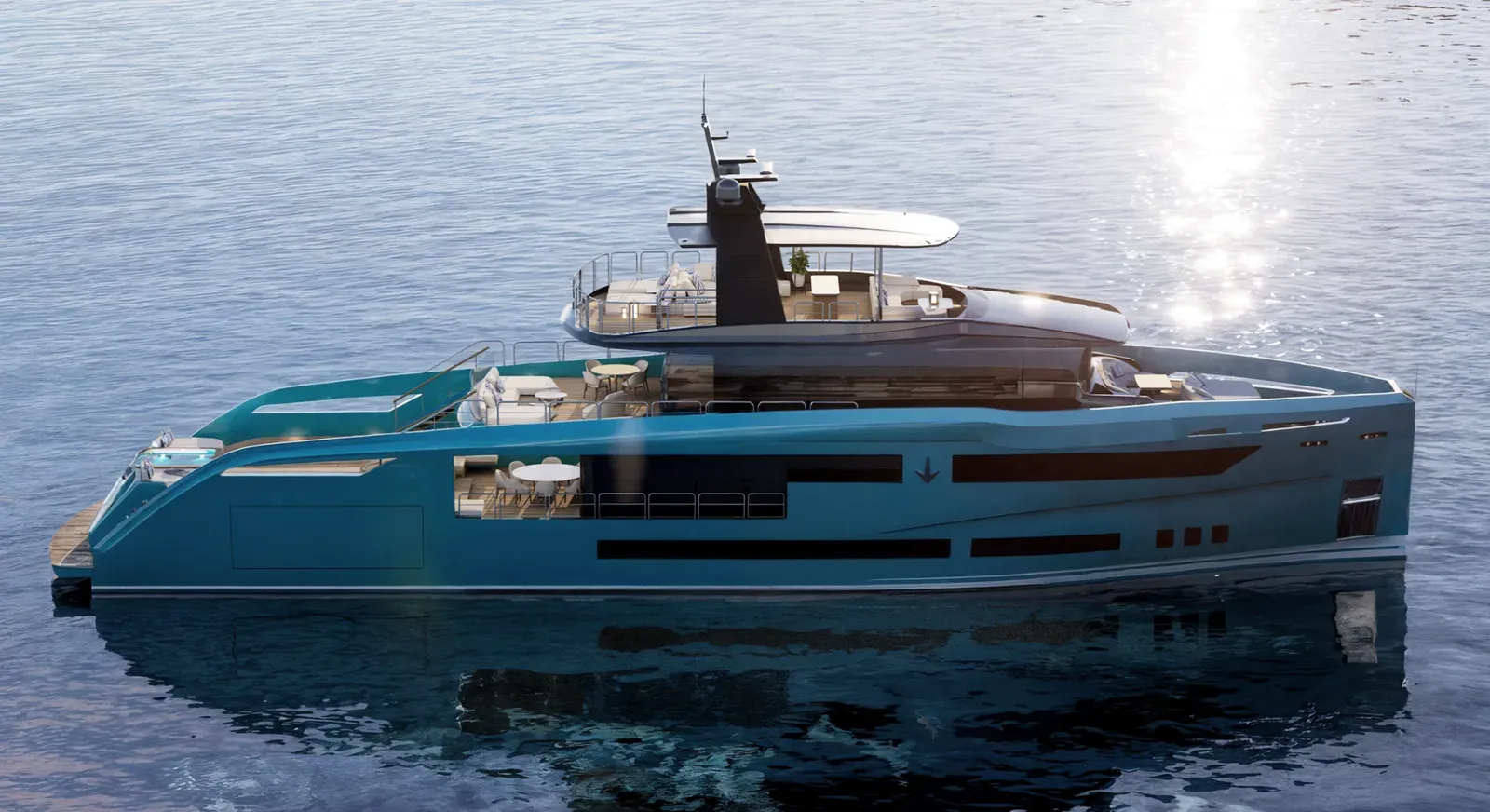
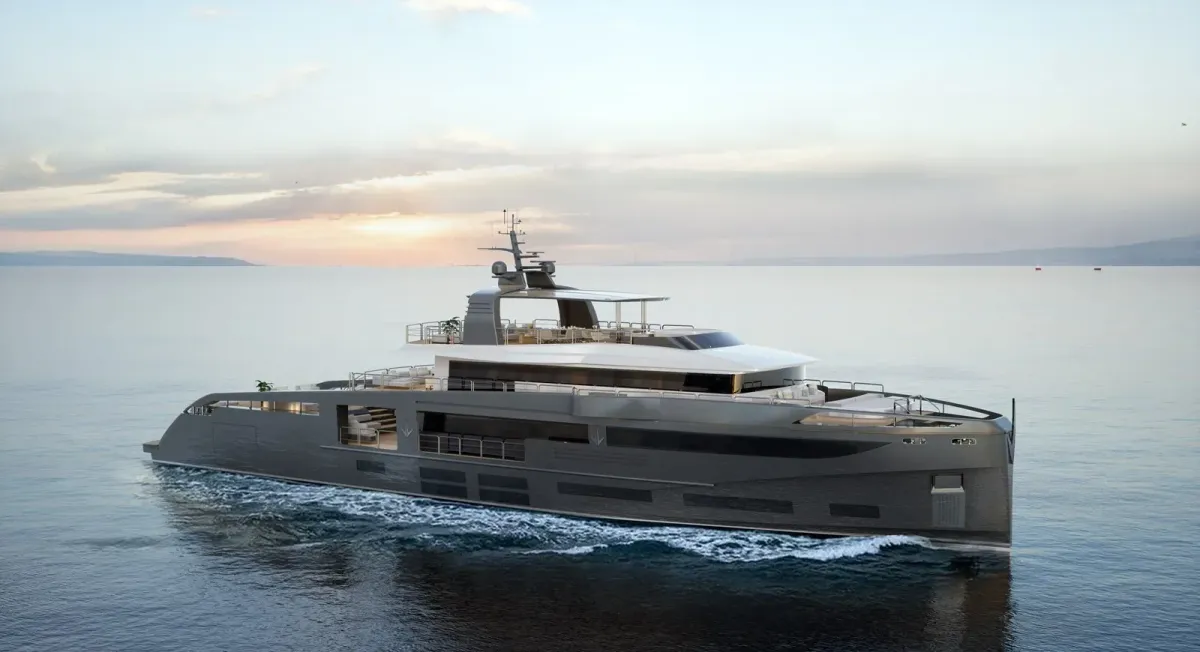
- Conceptual platform: the UP40 program, presented as a modular 40‑meter steel platform that can be adapted into different typologies (e.g., explorer, crossover, “island”/lifestyle variants) via superstructure and arrangement changes. The logic is to compress lead times by standardizing the underwater body and part of the machinery spaces while preserving customization above the main deck. This approach aims to de-risk the early engineering phase, stabilize weight and performance predictions, and let owners invest their decision time and budget into exterior styling and interior identity.
- Design partnerships: Antonini Navi has publicly collaborated with Fulvio De Simoni Yacht Design on the UP40 family. For one-off projects, the yard can work with a client’s chosen studio and naval architecture office, blending outside design intent with in‑house engineering leadership and class compliance.
- Refit and service
- Scope: structural and mechanical works, class surveys and five/ten-year programs, paint and coatings, interior upgrades, electronics and AV/IT, and stabilization or hotel-plant retrofits. The yard’s industrial roots translate into strong capabilities for steel and aluminum repairs, insertions, and conversions—useful for explorers and older metal yachts requiring substantial structural attention.
- Logistics and project control: the yard emphasizes owner/crew communication and a structured project management cadence (milestones, inspections, approvals). Given its location within the Ligurian–Tuscan yachting corridor, Antonini Navi is well-placed for yachts migrating between Western Med and Italian hubs for winter layup, warranty tasks, or seasonal worklists.
- Engineering depth and classification
- Class and statutory: builds are conducted to the usual superyacht class society regimes (e.g., RINA, Lloyd’s Register) and flag requirements, with SOLAS/MCA considerations where applicable for tonnage and commercial coding.
- Machinery and systems: the yard is conversant with contemporary stabilization, noise and vibration dampening, hotel load management, shore-power interfaces, and hybrid‑ready machineries. While specific configurations depend on project scope, the engineering standard targets quiet operation, low maintenance burden, and future service access, reflecting the group’s industrial serviceability mindset.
Operationally, Antonini Navi’s schedule tends to balance a small number of new builds with a steady throughput of refit projects across the calendar year, an arrangement that helps keep core trades continuously employed and infrastructure utilized. The location within a dense supply chain—metal fabricators, interior outfitters, fairing/paint specialists, mechanical and electrical integrators—supports bespoke choices and owner-specified equipment lists without incurring extraordinary logistics costs. This regional clustering is a quiet but significant competitive advantage in Italy’s superyacht belt from Viareggio through La Spezia and into Genoa.
From a market-position standpoint, Antonini Navi is targeting owners who want:
- The gravitas of steel/aluminum construction and oceanic autonomy.
- The latitude to customize layouts and exterior lines without moving into the time and cost risk of an entirely blank-sheet, once-off naval package.
- A direct line to the yard’s leadership and engineering decision-makers, which is often a deciding factor for experienced owners and captains.
- Strong lifecycle support, with the same facility providing warranty, refit, and heavy maintenance.
While the company communicates the modularity and speed-to-contract advantages of its UP40 concept, its identity remains that of a builder willing to tailor structure, styling, and interior programs to match a client’s operational profile—Med season cruising, transatlantic capability, shallow‑draft island operations, or higher-latitude range with increased tankage, storage, and redundancy. That flexibility, underpinned by industrial metalwork capability, is the essence of the yard’s current production stance.
Latest News
In recent years, Antonini Navi has focused public communications on three intertwined themes: its modular superyacht initiative, its collaborations with established design talent, and the continued reinforcement of its refit/service offering in the Ligurian–Tuscan corridor.
-
Expansion of the UP40 family: The yard has promoted the UP40 as a steel-hulled, approximately 40‑meter platform able to underpin multiple superstructure typologies. The core message emphasizes reduced lead times, predictable weight and performance baselines, and the ability to express divergent aesthetics—more expeditionary for an “Explorer,” more lifestyle-driven for an “Island,” and a middle path for a “Crossover.” For owners, this modularity is presented as a way to capture custom benefits without surrendering the schedule and budget advantages of a partially standardized technical platform.
-
Designer collaborations and concept refinement: Antonini Navi’s dialogue with Fulvio De Simoni Yacht Design has been part of the brand story from the outset of the UP40 program, helping articulate a clean, contemporary exterior language with purposeful volumes for tenders, toys, and expedition gear. The yard has continued to use major yacht shows and media briefings to share updated renderings and arrangement studies illustrating how the base platform morphs between mission profiles, including various beach club concepts, foredeck working areas for explorers, and glazing strategies to bring light deep into semi-custom interiors.
-
Steady refit visibility: Recognizing that ownership decisions increasingly hinge on lifecycle support, Antonini Navi has remained vocal about its refit capacity—particularly structural and mechanical expertise rooted in steel and aluminum work. Communications have highlighted the yard’s ability to handle class program milestones, complex steel/aluminum insertions, mechanical retrofits, and full paint cycles. For many owners, this “one-roof” ability to build, warranty, and later refit the same yacht reduces long-term friction and supports value retention.
-
Trade show participation and market outreach: The company has maintained a presence at the Mediterranean’s flagship industry events—particularly the Monaco Yacht Show and the Cannes Yachting Festival—using these venues to meet brokers, owners’ reps, and captains, and to showcase updates to its platform strategy. This ongoing engagement underscores a boutique-yet-serious stance: Antonini Navi positions itself as accessible to one-off conversations while remaining process‑driven and class‑compliant.
-
Emphasis on engineering transparency: A recurring thread in communications has been engineering clarity—sharing how the platform’s machinery spaces, tankage, and structural members are arranged to preserve service access and accommodate owner‑chosen systems (for instance, stabilization packages, genset arrangements, hotel load strategies, and hybrid‑ready provisions where specified). While such details vary from project to project, the yard signals that it is comfortable integrating owner-specified technologies into a coherent, class‑approved whole.
Broadly, the “news” around Antonini Navi is less about chasing size records and more about executing a coherent plan: leverage heavy-industry skill, standardize wisely where it shortens time-to-delivery, keep customization open where it matters to owners, and backstop the promise with a capable refit/service platform. For clients comparing yards across Italy and Northern Europe, this narrative situates Antonini Navi as a focused, metal-first builder with a modern modular concept and the discipline to support yachts over a long service life.
Frequently Asked Questions
Question:Who is ANTONINI NAVI?
Answer:ANTONINI NAVI is an Italian superyacht shipbuilder based in the Gulf of La Spezia. It was created by the Antonini family, an industrial group with decades of experience in complex steel and aluminum fabrication for marine and energy sectors. Leveraging that heavy-industry pedigree, ANTONINI NAVI focuses on fully custom and semicustom steel-and-aluminum yachts—particularly displacement and long-range vessels—built with the precision, discipline, and safety culture of commercial-grade shipbuilding and the craftsmanship expected of high-end Italian yachting.
Question:What size and type of yachts does ANTONINI NAVI build?
Answer:The shipyard concentrates on custom and semicustom superyachts generally in the 30–70 meter range. Most projects feature steel hulls with aluminum superstructures, optimized for comfort, range, and seakeeping. The brand is especially associated with ocean-capable displacement yachts, explorer-inspired concepts, and versatile “crossover” layouts that merge robust cruising capability with generous lifestyle amenities.
Question:What is the UP40 platform I keep hearing about?
Answer:UP40 stands for “Utility Platform 40,” a modular 40-meter steel/aluminum platform engineered to accommodate different superstructure configurations and onboard programs without changing the proven hull and engineering backbone. Within UP40, owners can select among distinct stylistic and functional families—such as Explorer, Crossover, and Motoryacht—while retaining the efficiency and reliability of a standardized platform. This approach streamlines engineering, increases build predictability, and can shorten delivery times compared with entirely one-off yachts.
Question:Where are ANTONINI NAVI yachts built and outfitted?
Answer:Construction, outfitting, and testing are carried out in the La Spezia area—one of Italy’s most established marine industrial hubs. The location offers deep-water access, extensive maritime supply chains, and a concentration of specialized artisans and subcontractors. That ecosystem supports the shipyard’s ability to deliver complex custom metalwork, precision engineering, and luxury interiors under one coordinated umbrella.
Question:Does the shipyard do truly custom yachts or only platform-based builds?
Answer:Both. ANTONINI NAVI offers full-custom yachts engineered from the keel up to a client’s brief as well as semicustom projects based on the UP40 platform. The platform option retains significant flexibility in deck plans, interior design, technical specifications, and exterior styling elements, while benefitting from an already validated naval architecture. For owners seeking total originality, the yard will develop a bespoke hull and superstructure with external naval architects and designers.
Question:Which designers and naval architects has ANTONINI NAVI collaborated with?
Answer:The yard is widely known for collaborating with renowned Italian designer Fulvio De Simoni on the UP40 family. Depending on the project, ANTONINI NAVI also partners with independent design studios and naval architects chosen by the owner, ensuring a fit-for-purpose team for exterior styling, interior design, and engineering. The yard’s industrial background allows it to align creative vision with practical buildability early in the process.
Question:What are the key advantages of building in steel and aluminum?
Answer:Steel hulls provide excellent strength, durability, and damage tolerance—ideal for expedition and long-range use. Aluminum superstructures help control weight aloft, improving stability and enabling creative, large-volume layouts. Steel/aluminum construction is also highly customizable, so structural modifications and one-off features can be engineered with fewer compromises than in molded composite series production.
Question:How does ANTONINI NAVI approach noise, vibration, and comfort?
Answer:The yard leverages commercial shipbuilding practices—such as robust structural scantlings, resiliently mounted machinery, and extensive insulation—tuned for luxury yacht expectations. By combining detailed weight and vibration studies with careful machinery selection and isolation strategies, they target low noise and vibration levels across guest areas. The displacement hull forms are optimized for seakeeping and long passages, prioritizing comfort at sea.
Question:What classification and regulatory standards do they build to?
Answer:Yachts are constructed to the standards of leading classification societies (such as RINA or equivalent), with compliance pathways available for commercial or private registration as requested by the owner. Depending on the brief, projects can be specified to meet requirements for charter operation (for example, MCA LY3/LY4 compliance) and the latest emissions norms.
Question:Do they offer hybrid or alternative propulsion options?
Answer:Conventional twin-diesel propulsion remains the foundation for many projects due to its global serviceability and proven reliability on long-range yachts. However, the shipyard can integrate advanced energy-management solutions and, subject to project scope, hybrid assistance or alternative technologies aligned with the owner’s cruising profile, range targets, and regulatory considerations. Shore-power integration, waste-heat recovery strategies, and hotel-load optimization are also part of the design dialogue.
Question:How customizable are the interior layouts and finishes?
Answer:Highly customizable. Interior architecture, materials, and finish quality are tailored to each owner’s aesthetic. The volumetric advantages of steel/aluminum platforms allow for generous guest arrangements—often with full-beam owner’s suites, multiple VIP cabins, and flexible multipurpose spaces (gyms, cinemas, offices) as well as functional crew flows and generous service areas. Owners may work with their preferred interior designer or select from design partners proposed by the shipyard.
Question:What does the build process look like from concept to delivery?
Answer:A typical journey includes:
- Owner brief and mission profile definition (range, guest capacity, amenities, tenders, and toys).
- Preliminary GA (general arrangement), weight study, and performance estimates.
- Naval architecture development and class plan approval, alongside 3D engineering of structures, piping, and electrical systems.
- Hull and superstructure fabrication in steel and aluminum, followed by fairing and paint works.
- Machinery installation, outfitting, interior fit-out, electronics integration, and commissioning.
- Harbor trials, class and flag inspections, sea trials, and final handover with documentation and crew training.
Question:How does ANTONINI NAVI manage quality assurance?
Answer:The yard employs traceable, process-driven quality systems inherited from its industrial background: material certification, documented weld procedures, NDT (non-destructive testing) where required, and staged inspections coordinated with classification and flag authorities. Systems are function-tested progressively, culminating in full integration trials. This approach emphasizes repeatable quality, machinery accessibility, and maintainability—critical attributes for world-cruising yachts.
Question:What about service, warranty, and refit support?
Answer:As a shipbuilding group with substantial technical resources, ANTONINI NAVI provides warranty follow-up and scheduled maintenance support, leveraging both in-house expertise and trusted regional partners worldwide for service interventions. The yard also has the facilities and experience to undertake refits, upgrades, and class renewals, aligning the yacht’s lifecycle with changing owner requirements and evolving regulations.
Question:What distinguishes ANTONINI NAVI from other builders?
Answer:Several attributes stand out:
- Industrial-grade metalworking combined with superyacht craftsmanship.
- Emphasis on ocean-capable displacement designs and practical, serviceable engineering.
- A modular platform (UP40) that preserves individuality while improving build efficiency.
- Close designer collaboration to balance aesthetics with buildability.
- Owner-oriented flexibility, enabling tailored technical specifications, interior visions, and operational profiles.
Question:How are tenders, toys, and expedition gear integrated?
Answer:The yard plans tender handling, storage, and launch/recovery from the earliest GA discussions, ensuring clear deck logistics and safe operations in a seaway. Depending on the model family and owner goals, options include recessed garages, full-beam beach clubs, open working decks, or hybrid crossover solutions that preserve guest spaces while accommodating serious gear—subtly reinforcing the yacht’s mission (exploration, family cruising, or entertainment-forward).
Question:What speed and range can be expected?
Answer:These are determined by displacement, propulsion package, and tankage chosen during specification. Displacement yachts in this size bracket typically offer efficient cruise speeds in the low-to-mid-teens (knots) with transoceanic range at economical settings. The yard’s engineering team models fuel curves and endurance to align with the owner’s itinerary vision—whether that means slow-rolling efficiency for extended passages or a slightly higher cruise for coastal schedules.
Question:How are safety and redundancy handled?
Answer:Systems architecture emphasizes redundancy in critical functions: twin main engines, duplicated steering pumps, dual or segregated fuel systems, emergency power provisions, and layered monitoring. Fire protection, watertight integrity, and damage-stability considerations are addressed through class-led design and robust structural compartmentalization. Crew workflow, access routes, and service clearances are planned to support safe and efficient operations.
Question:Can the yachts be configured for commercial charter?
Answer:Yes. Upon request, projects can be specified and built to the relevant charter standards and class notations, with appropriate safety equipment, cabin egress requirements, service pantries, and crew arrangements to support charter operations while preserving the owner’s private-use requirements.
Question:What is the typical project timeline?
Answer:Build time varies with scope and custom content. A platform-based 40-meter project can significantly reduce engineering lead time compared with a full one-off. Full-custom yachts require additional concept and development phases. The shipyard sequences engineering, procurement, and fabrication to minimize critical-path risk and will present a detailed program timeline during contract negotiations.
Question:How involved can an owner be during the build?
Answer:As involved as desired. The process encourages regular reviews—both virtual and on site—covering structure, systems, and interior milestones. Owners often appoint an owner’s representative and a surveyor to streamline communication. Transparent reporting, mock-ups, and material sample boards help ensure decisions are informed and revisions are efficiently captured.
Question:What sustainability measures are available?
Answer:Beyond efficient hulls and right-sized machinery, available measures may include shore-power compatibility, advanced battery support for hotel loads, high-efficiency HVAC, heat-recovery strategies, LED lighting throughout, and waste- and water-management systems. Compliance with current emissions frameworks can be pursued through engine selection, exhaust aftertreatment, and, where appropriate, hybrid assistance.
Question:Is refit or conversion of existing vessels part of the yard’s capabilities?
Answer:Yes. Drawing on heavy-industry metalwork and systems integration expertise, ANTONINI NAVI can undertake structural modifications, mechanical and electrical overhauls, interior refurbishments, and class updates, all coordinated under a single project management structure.
Question:What crew considerations are embedded in the designs?
Answer:The yard emphasizes effective crew flows, discreet service routes, adequate provisioning and cold storage, functional galleys and laundries, and maintenance access that does not intrude on guest areas. Comfortable crew cabins, proper mess facilities, and compliant escape routes support safe, professional operation, which in turn elevates owner and guest experience.
Question:How does the shipyard balance aesthetics with practicality?
Answer:Early-stage collaboration between design and production teams is key. Structural feasibility, machinery access, and serviceability are tested in 3D engineering simultaneously with exterior and interior design development. This integrated method helps avoid late-stage compromises, protects styling intent, and preserves technical rigor.
Question:What kinds of owners typically choose ANTONINI NAVI?
Answer:Owners who prioritize real-world cruising capability, robust construction, and technical integrity—often with an emphasis on exploration, autonomy, and low-stress ownership—find the brand appealing. Many value the latitude to tailor systems and layout to a specific mission profile while still enjoying sophisticated Italian design and finish quality.
Question:Does ANTONINI NAVI offer post-delivery training and documentation?
Answer:Yes. Commissioning includes crew familiarization, systems handover, and comprehensive technical documentation. The yard can assist with developing maintenance schedules, spare-part strategies, and vendor contacts to support reliable global operation from the first season onward.
Question:What is the philosophy behind the Crossover concept?
Answer:The “Crossover” philosophy blends the purposeful stance and capability of an explorer with an emphasis on lifestyle amenities—think beach clubs, wellness areas, and large glazed spaces—without sacrificing tender/toy capacity or easy access to the water. It’s designed for owners who want to roam widely yet entertain generously.
Question:Can owners bring their own design team?
Answer:Absolutely. Owners may appoint their preferred exterior and interior designers, naval architects, surveyors, and technical managers. ANTONINI NAVI coordinates these stakeholders through an integrated project plan, ensuring decisions are validated against class, engineering, and production realities.
Question:How are exterior decks optimized for Mediterranean and tropical use?
Answer:Shading strategies, wind-flow management, outdoor galleys and bars, convertible lounges, and sea-level terraces are integrated with storage for water toys and quick “gear-to-water” transitions. Materials and finishes are chosen for durability under UV and salt exposure, and drainage, lighting, and tender operations are planned holistically to keep decks practical and guest-friendly.
Available Models
-
UP40 Explorer
- Length: Approx. 40 meters (steel hull, aluminum superstructure)
- Guest accommodation: Typically 4–6 cabins (about 8–12 guests), customizable
- Maximum speed: Generally in the mid-teens (knots), depending on specification
- Engine type: Twin diesel main engines with long-range displacement cruising; emissions compliance and hybrid assistance available by specification
- Notes: Emphasizes range, seakeeping, protected working decks, and robust tender/toy handling for expedition-style itineraries.
-
UP40 Crossover
- Length: Approx. 40 meters (shared UP40 platform)
- Guest accommodation: Typically 5 cabins for 10–12 guests, adaptable layouts
- Maximum speed: Typically in the low-to-mid-teens (knots) with efficient displacement cruising
- Engine type: Twin diesel, with options for enhanced hotel-load efficiency and shore-power integration
- Notes: Balances exploration capability with larger beach-club concepts, expansive lounges, and versatile deck arrangements suited to family cruising and entertaining.
-
UP40 Motoryacht
- Length: Approx. 40 meters (shared UP40 platform)
- Guest accommodation: Configurable 4–6 cabins; generous owner suite options
- Maximum speed: Tuned to owner preference within displacement regime; efficient cruise prioritized
- Engine type: Twin diesel, with customization of generators, stabilization, and energy management per owner brief
- Notes: Focuses on sleek styling and lifestyle-forward layouts, leveraging the UP40’s proven hull for comfort with a more yachting-classic presentation.
Note: Because ANTONINI NAVI specializes in custom and semicustom construction, the final dimensions, cabin counts, speeds, and machinery selections are established during design development with the owner’s team. The information above describes typical characteristics of the announced platform families rather than fixed series specifications.

Learn more on the “N/A”
To learn more on the “N/A” or to get advice on how to buy or sell a yacht or get a great price for a yacht charter
please call +1 (954) 274-4435 USAOnly deal with professionals!