
 Licensed Yacht BrokersSales and service of yachts and ships
BOSTON BOAT WORKS - For Sale
Boston Boatworks
English
Company History
Boston Boatworks is a specialist American boatbuilder best known for its mastery of advanced epoxy composite construction and for building premium, semi-custom powerboats in collaboration with leading designers. The company was founded in 1996 in Boston, Massachusetts, by Mark Lindsay and Scott Smith. Lindsay brought decades of composite boatbuilding expertise—from race-winning dinghies and offshore sailboats to one-off custom projects—while Smith focused on scaling the operation to deliver repeatable, production-quality results without compromising on the craftsmanship standards of custom yacht building.
A pivotal milestone came in the early 2000s when Boston Boatworks began a long-running collaboration with MJM Yachts, the brand founded by Bob Johnstone (co-founder of J/Boats). Working with Zurn Yacht Design, Boston Boatworks built the epoxy-composite MJM “z” series models such as the 34z, 29z, 36z, 40z, and eventually larger yachts like the 50z. These boats helped redefine the Downeast-influenced express cruiser category with lighter, stronger hulls; excellent fuel efficiency; and a ride quality associated with high-end composite construction that had previously been more common in racing sailboats and expedition craft.
Over the next two decades, Boston Boatworks refined a repeatable, quality-controlled process for vacuum-bagged, oven post-cured epoxy laminates with cored construction, marrying the advantages of custom boatbuilding with the consistency of production. The company expanded its facility footprint, invested in climate-controlled lamination bays, and developed a tightly documented build process that allowed it to maintain a consistently high standard across multiple hulls while still accommodating semi-custom owner specifications.
As MJM Yachts expanded and subsequently moved volume production to its own facility in North Carolina, Boston Boatworks evolved its business model. It continued to deliver high-performance composite construction for select partners and projects and launched its own branded line, beginning with the Boston Boatworks 44 (BB44) Offshore Express Cruiser. In this model, the company leaned on its proven construction methods and long-standing collaboration with Zurn Yacht Design, bringing to market a modern, offshore-capable platform that emphasized low weight, structural efficiency, and thoughtful ergonomics. Today, Boston Boatworks remains focused on building premium, limited-production yachts and select commercial or mission-driven craft, applying the same process rigor and material science that have been its hallmark since inception.
Country of Origin
United States of America (USA). The company was founded and remains based in Boston, Massachusetts.
Manufacturing Locations
Boston Boatworks builds its yachts in Boston, Massachusetts, with operations historically centered in the Boston Harbor area. The company’s facility has been known for:
- Climate-controlled lamination spaces designed specifically for epoxy work.
- Vacuum-bagging and resin control systems that ensure consistent fiber-to-resin ratios.
- Oven post-curing capabilities to stabilize epoxy laminates, improve long-term stiffness, and enhance durability.
- Dedicated areas for systems integration, joinery, and finish, enabling the company to retain a high level of in-house control over critical quality steps.
Being located on Boston Harbor offers deep-water access for sea trials and efficient delivery logistics. The site’s proximity to a skilled New England marine workforce and a network of specialized suppliers also supports the builder’s emphasis on high-spec composite construction.
Ownership and Management
Boston Boatworks is a privately held American boatbuilder established by Mark Lindsay and Scott Smith. Over the years, the company’s leadership has been closely aligned with its technical foundations in advanced composites, while its management systems have emphasized repeatability, documentation, and quality assurance appropriate to limited-series production. Public details of current ownership structure and day-to-day management roles are limited; the business remains privately controlled and headquartered in Boston.
Reputation and Quality
Boston Boatworks has an enduring reputation for:
- Composite Mastery: The yard is widely associated with vacuum-bagged, cored epoxy construction and oven post-cure—a combination prized for excellent strength-to-weight ratios, stiffness, and longevity. These methods are more labor- and process-intensive than conventional polyester builds, but they deliver tangible performance and efficiency benefits on the water.
- Offshore Capability and Efficiency: Yachts built by Boston Boatworks are known for superb seakeeping relative to their weight, offering quick acceleration, economical cruise speeds, and low fuel burn. This performance profile is a direct result of methodical weight management and structurally efficient laminates.
- Collaboration with Top Designers: Long-term partnerships with Zurn Yacht Design and production for MJM Yachts underscored the company’s ability to execute exacting design briefs, integrate complex systems, and deliver a refined finish.
- Quality Systems and Craftsmanship: The builder’s processes emphasize traceability and quality control from lamination through systems commissioning. Owners often cite quiet rides, solid feel underfoot, and clean service access as hallmarks.
The company’s work has been featured frequently in North American yachting media and is respected within the industry for bringing grand-prix composite sensibilities into the realm of semi-custom cruising powerboats. Notably, several MJM models built by Boston Boatworks have been recognized for offshore capability, efficiency, and construction quality in editorial tests and owner reports. The current Boston Boatworks-branded models continue this tradition by combining modern naval architecture with the builder’s disciplined composite methodology.
Español
Historia de la empresa
Boston Boatworks es un astillero estadounidense especializado, reconocido por su dominio de la construcción en compuestos epoxi avanzados y por la fabricación de yates semipersonalizados de alta gama. La empresa fue fundada en 1996 en Boston, Massachusetts, por Mark Lindsay y Scott Smith. Lindsay aportó una trayectoria amplia en la construcción de embarcaciones de alto rendimiento, mientras que Smith impulsó la estandarización de procesos para lograr resultados consistentes a nivel de producción sin perder la artesanía del astillero a medida.
A comienzos de la década de 2000, Boston Boatworks inició una colaboración clave con MJM Yachts, trabajando con Zurn Yacht Design en la línea “z” (34z, 29z, 36z, 40z, 50z, entre otros). Estas embarcaciones, construidas con laminados de epoxi livianos y rígidos, redefinieron el segmento de los express cruisers de estilo Downeast por su eficiencia, calidad de navegación y acabados de primer nivel.
Con el tiempo, el astillero perfeccionó un proceso repetible de laminación al vacío con curado en horno, construcción con núcleo y un control de calidad exhaustivo. Tras el traslado de la producción principal de MJM a otra instalación, Boston Boatworks amplió su enfoque, continuó con proyectos selectos de alto rendimiento y lanzó su propia línea, empezando por la Boston Boatworks 44 (BB44).
País de origen
Estados Unidos (Boston, Massachusetts).
Ubicaciones de fabricación
La producción se realiza en Boston, con instalaciones diseñadas para:
- Espacios de laminación con control climático para trabajos con epoxi.
- Sistemas de vacío y control de resina.
- Horno de postcurado para estabilizar y mejorar el rendimiento de los laminados.
- Integración de sistemas y carpintería fina en áreas dedicadas.
La ubicación en el puerto de Boston facilita pruebas de mar y acceso a una cadena de suministro especializada de Nueva Inglaterra.
Propiedad y gestión
Boston Boatworks es una empresa privada fundada por Mark Lindsay y Scott Smith. La información pública sobre la estructura actual de propiedad y los cargos directivos específicos es limitada; la compañía continúa operando de forma privada desde Boston.
Reputación y calidad
El astillero es reconocido por:
- Dominio de compuestos epoxi al vacío y postcurado en horno.
- Eficiencia y capacidad en mar abierto derivadas de un riguroso control de pesos.
- Colaboraciones con diseñadores de primer nivel (como Zurn Yacht Design) y construcción para MJM Yachts.
- Procesos de calidad y acabados refinados, con acceso al servicio bien planificado.
Français
Historique de l’entreprise
Boston Boatworks est un chantier naval américain fondé en 1996 à Boston (Massachusetts) par Mark Lindsay et Scott Smith. Spécialisé dans les composites époxy hautes performances, le chantier s’est distingué par la production de vedettes semi-custom de qualité supérieure issues de collaborations avec des architectes réputés.
Au début des années 2000, Boston Boatworks a bâti de nombreux modèles pour MJM Yachts en partenariat avec Zurn Yacht Design (gamme “z”). Ces unités se sont imposées par leur légèreté, leur rigidité et leur efficacité, transposant des méthodes de la course au large vers la plaisance haut de gamme.
Après l’essor de MJM et l’évolution de sa production, Boston Boatworks a lancé ses propres modèles, en s’appuyant sur ses procédés éprouvés (mise sous vide, post-cuisson au four, structures à âme) et une culture de qualité très structurée.
Pays d’origine
États-Unis (Boston, Massachusetts).
Sites de production
Le chantier est établi à Boston, avec:
- Ateliers climatisés dédiés à l’époxy.
- Procédés de mise sous vide et contrôle du ratio fibre/résine.
- Post-cuisson au four pour la stabilité et la durabilité des stratifiés.
- Zones dédiées à l’intégration des systèmes et à la menuiserie.
L’implantation portuaire facilite les essais en mer et l’accès aux savoir-faire de la région.
Propriété et direction
Entreprise privée fondée par Mark Lindsay et Scott Smith. Les détails publics sur l’actionnariat actuel et l’organigramme de direction sont limités; l’entreprise demeure sous contrôle privé à Boston.
Réputation et qualité
Référence en:
- Construction composite époxy légère et rigide, avec post-cuisson.
- Efficience et comportement marin de haut niveau.
- Collaborations exigeantes (Zurn, MJM) et finitions soignées.
- Processus qualité documentés, inspirés de la construction hautes performances.
Deutsch
Unternehmensgeschichte
Boston Boatworks wurde 1996 in Boston (Massachusetts, USA) von Mark Lindsay und Scott Smith gegründet. Das Unternehmen ist auf hochentwickelte Epoxid-Verbundbauweise spezialisiert und hat sich mit semi-kundenspezifischen Premium-Motorjachten einen Namen gemacht. Früh etablierte Boston Boatworks eine enge Zusammenarbeit mit MJM Yachts und Zurn Yacht Design, aus der zahlreiche leichte und effiziente Modelle hervorgingen.
Nach der Verlagerung der Großserienfertigung von Partnern konzentrierte sich Boston Boatworks auf selektive Projekte und brachte eine eigene Linie auf den Markt, beginnend mit der BB44. Dabei blieb der Fokus auf Qualität, Prozesssicherheit und struktureller Effizienz unverändert.
Herkunftsland
Vereinigte Staaten von Amerika (Boston, Massachusetts).
Produktionsstandorte
Fertigung in Boston mit:
- Klimatisierten Laminierbereichen für Epoxidverfahren.
- Vakuumunterstützten Laminaten und kontrolliertem Harzanteil.
- Ofen-Postcuring zur Stabilisierung und Dauerhaltbarkeit.
- Eigener Integration von Systemen und Innenausbau.
Die Lage am Boston Harbor ermöglicht effiziente Probefahrten und Logistik.
Eigentum und Management
Privat geführtes Unternehmen, gegründet von Mark Lindsay und Scott Smith. Öffentliche Details zur aktuellen Eigentümerstruktur und zum Management sind begrenzt; der Sitz ist weiterhin in Boston.
Ruf und Qualität
- Ausgezeichnete Kompetenz in Epoxid-Verbundbau.
- Hohe Effizienz, geringes Gewicht, sehr gute Seegangsqualitäten.
- Anspruchsvolle Kooperationen (z. B. Zurn, MJM).
- Strenge Qualitätsprozesse und hochwertige Verarbeitung.
Italiano
Storia dell’azienda
Boston Boatworks nasce nel 1996 a Boston (Massachusetts) per iniziativa di Mark Lindsay e Scott Smith. Il cantiere si distingue per la costruzione in composito epossidico ad alte prestazioni e per imbarcazioni semi-custom di fascia alta, realizzate in collaborazione con progettisti di primo piano. Sin dai primi anni 2000 ha costruito numerosi modelli per MJM Yachts con Zurn Yacht Design, portando standard da regata nel mondo dei cruiser di lusso.
Con l’evoluzione dei volumi produttivi dei partner, Boston Boatworks ha avviato una propria gamma—ad esempio la BB44—mantenendo i processi cardine: laminazione sottovuoto, post-curing in forno, strutture a sandwich, rigoroso controllo qualità.
Paese d’origine
Stati Uniti d’America (Boston, Massachusetts).
Sedi produttive
Produzione a Boston con:
- Reparti di laminazione climatizzati per l’epossidica.
- Controllo del rapporto fibra/resina tramite vuoto.
- Post-cottura in forno per stabilità e durata del laminato.
- Integrazione impianti e falegnameria interna di alto livello.
La posizione portuale facilita prove in mare e logistica.
Proprietà e management
Azienda privata fondata da Mark Lindsay e Scott Smith. Le informazioni pubbliche sull’assetto proprietario e sui ruoli manageriali attuali sono limitate; la società opera privatamente da Boston.
Reputazione e qualità
- Eccellenza nella costruzione in composito epossidico.
- Efficienza, leggerezza e tenuta di mare superiori.
- Collaborazioni con designer di prestigio (Zurn, MJM).
- Processi di qualità documentati e finiture curate.
Русский
История компании
Boston Boatworks — американская верфь, основанная в 1996 году в Бостоне (штат Массачусетс) Марком Линдсеем и Скоттом Смитом. Специализация — высокотехнологичные композитные конструкции на основе эпоксидных смол и выпуск премиальных полуиндивидуальных моторных яхт. В начале 2000‑х верфь прославилась сотрудничеством с MJM Yachts и бюро Zurn Yacht Design, благодаря чему на рынок вышел ряд легких, жестких и эффективных моделей.
По мере изменения производственной стратегии партнеров Boston Boatworks сконцентрировалась на выборочных проектах и запустила собственную линейку (включая BB44), сохранив основные технологические принципи: вакуумная ламинация, постотверждение в печи, сэндвич‑конструкции, строгий контроль качества.
Страна происхождения
США (Бостон, Массачусетс).
Производственные площадки
Производство сосредоточено в Бостоне:
- Климат‑контролируемые цеха для эпоксидной ламинации.
- Вакуумные технологии и контроль соотношения волокно/смола.
- Постотверждение в печах для повышения стабильности и ресурса.
- Интеграция систем и столярные работы внутри верфи.
Расположение на набережной Бостона упрощает ходовые испытания и логистику.
Собственность и менеджмент
Частная компания, основана Марком Линдсеем и Скоттом Смитом. Публично доступной информации о текущей структуре собственности и управленческой команде немного; компания остается частной и базируется в Бостоне.
Репутация и качество
- Экспертиза в композитах на эпоксидной основе.
- Высокая мореходность при низкой массе и выдающаяся эффективность.
- Авторитетные партнерства (Zurn, MJM).
- Строгие стандарты качества и высокая культура производства.
中文(简体)
公司历史
Boston Boatworks 成立于1996年,位于美国马萨诸塞州波士顿,由 Mark Lindsay 与 Scott Smith 创立。公司长期专注于先进环氧树脂复合材料建造,将竞赛级的轻量化、刚度与工艺标准,系统性地引入高端半定制动力游艇领域。2000年代初,Boston Boatworks 与 MJM Yachts 及 Zurn Yacht Design 开启密切合作,推出多款轻量高效的 Downeast 风格高速巡航艇,奠定了其在北美高端市场的技术口碑。
随着合作品牌产能布局的调整,Boston Boatworks 持续承担精选项目,并推出自有品牌产品线(如 BB44),延续其核心制造方法:真空袋覆、夹芯结构、烘箱后固化,以及贯穿全流程的质量控制与文件化管理。
原产国
美国(波士顿,马萨诸塞州)。
生产地点
公司位于波士顿港区域的工厂具备:
- 适用于环氧工艺的恒温恒湿层压车间。
- 真空工艺与树脂比例控制系统。
- 烘箱后固化能力,提升结构稳定性与耐久性。
- 独立系统集成与精装木作工艺线。
依托波士顿港的区位优势,海试与交付高效可靠,同时可获得新英格兰地区成熟的海事供应链与专业人才支持。
所有权与管理
Boston Boatworks 为私人控股企业,由 Mark Lindsay 与 Scott Smith 创建。关于当前股权与管理细节的公开信息有限,公司仍以波士顿为总部进行私营化运营。
声誉与品质
- 以环氧复合材料与烘后固化著称的结构工艺能力。
- 轻量高效、航行品质优异,兼具加速性与经济性。
- 与一流设计方长期协作(如 Zurn,与 MJM 的生产合作)。
- 完整的质量流程管控与高标准精装,口碑稳定。
以上各语言版本仅包含可靠的、公开可核实的要点,并体现了 Boston Boatworks 的发展脉络与技术特质:以先进复合材料与严格工艺为基础,面向高端、低批量、半定制的动力艇与特种项目,长期保持在业界的高品质声誉与稳定表现。
Main Competitors
In the premium, semi-custom express-cruiser and Downeast-inspired market where advanced composite construction, small-batch build quality, and refined systems integration matter, Boston Boatworks competes with a select group of high-end builders. The following companies are the most relevant comparables based on build philosophy, materials, size range, aesthetic, and target buyer profile:
-
Hinckley Yachts (Southwest Harbor, Maine): A benchmark in American Downeast yachts, Hinckley is known for resin-infused composite hulls, carbon and aramid reinforcement, jet propulsion options, and a meticulous finish standard. Its boats overlap the Boston Boatworks buyer who values lightweight construction, quiet running, and enduring resale value. Hinckley’s emphasis on innovation in composites and systems (e.g., integrated electronics and joystick handling) makes it a primary cross-shop for BBW’s clientele.
-
Sabre Yachts (Raymond, Maine): Sabre builds semi-custom, resin-infused Downeast cruisers that consistently set the standard for ergonomic layouts, systems access, and long-range cruising comfort in the 38–58-foot category. While Sabre operates at a somewhat higher production scale than Boston Boatworks, the overlap is significant among experienced owners seeking New England craftsmanship, thoughtful engineering, and dealer-supported ownership.
-
Back Cove Yachts (Rockland, Maine): A sister brand to Sabre, Back Cove focuses on single-diesel Downeast cruisers with high-value fit and finish and efficient hull forms. Although positioned at a slightly lower price point and with a more production-oriented model mix, Back Cove remains a logical alternative for buyers who prioritize simplicity, economy, and classic lines but may be comparing composite construction quality and seakeeping across brands.
-
Palm Beach Motor Yachts (Australia/USA): Palm Beach builds resin-infused, weight-conscious express cruisers known for slippery hulls, low fuel burn, and understated luxury. The brand’s performance ethos, emphasis on stiffness-to-weight optimization, and quiet ride characteristics mirror many of the same priorities seen in Boston Boatworks projects, making PBMY a direct competitor for design-savvy owners who focus on efficiency without sacrificing elegance.
-
Grand Banks Yachts (including the legacy Eastbay lineage): While the classic Eastbay line has wound down, Grand Banks’ modern offerings continue to lean hard into vacuum-infused composite construction and weight control for long-range efficiency and ride quality. The Grand Banks buyer often overlaps with the Boston Boatworks customer in priorities: premium engineering, long-term reliability, and a timeless aesthetic.
-
San Juan Yachts (Anacortes, Washington): San Juan produces low-volume, epoxy-composite express cruisers with refined lines and high-end detailing. The yard’s boutique scale, deep systems integration, and custom approach closely parallel Boston Boatworks’ ethos, and the boats appeal to similar owner-operators who prefer craftsmanship and performance over higher-volume production approaches.
-
Lyman-Morse (Thomaston, Maine): A highly capable custom builder with extensive composite expertise, Lyman-Morse competes at the craft-and-technology end of the spectrum. Buyers who are exploring one-off or semi-custom solutions in the 35–70-foot range—particularly when composite sophistication and bespoke interior execution are priorities—may also consider Boston Boatworks.
-
Hodgdon Yachts (East Boothbay, Maine): Hodgdon is a custom specialist renowned for advanced composites and exquisite finish work—from custom yachts to superyacht tenders. Although Hodgdon focuses more on bespoke projects and the superyacht sector, they compete with Boston Boatworks for clients who equate technical composite mastery and artisanal finish with long-term value.
-
Front Street Shipyard (Belfast, Maine): A modern yard offering custom and limited-series composite builds, refits, and commercial work. Front Street’s capability in advanced composites, project management, and systems-heavy integration makes it a viable alternative for owners considering unique or technically demanding projects, much like Boston Boatworks.
-
MJM Yachts (brand): Boston Boatworks was the long-time builder for many of MJM’s celebrated epoxy-composite models designed by Zurn Yacht Design. As MJM’s production moved to other facilities, the MJM lineup directly competes with Boston Boatworks’ own branded boats in the lightweight, high-efficiency, Downeast-influenced express cruiser niche. The shared design DNA in performance goals (low weight, stiffness, efficiency, and seaworthiness) ensures strong cross-shopping between the two.
-
Vicem Yachts (Turkey): Renowned for cold-molded construction and classic lines, Vicem attracts a similar clientele that appreciates traditional styling combined with modern systems and a handcrafted interior. While the construction method differs, the end result—quiet rides, rich joinery, and a timeless look—places Vicem in the competitive set.
-
Zeelander Yachts (Netherlands): Zeelander’s rounded transoms, luxury interiors, and premium composite builds compete for the same “design-forward dayboat/express” customer who values sophisticated detailing, low noise/vibration, and a polished ownership experience.
-
Tiara Yachts (Holland, Michigan): Although Tiara operates at larger production scale and with a more mainstream model lineup, owners in the 38–48-foot express segment frequently cross-shop Tiara when they prioritize dealer networks, strong resale, and performance—even if the construction philosophy is less bespoke than Boston Boatworks’ epoxy-intensive approach.
These competitors collectively define the upper tier of the express/Downeast market where construction excellence, engineering discipline, and refined owner experience drive buying decisions. Boston Boatworks differentiates through epoxy composite mastery, post-cured laminates, and a limited-series, craft-forward production model that integrates custom sensibilities into repeatable builds.
Current Production Status
Boston Boatworks continues to operate as an active, privately held boatbuilder on the Boston waterfront, focusing on limited-series, premium composite yachts that prioritize a high strength-to-weight ratio, structural efficiency, and long-term durability. After more than a decade as the contract builder for numerous MJM Yachts models designed by Zurn Yacht Design, Boston Boatworks shifted its emphasis toward its own branded product line while continuing to apply its hallmark process: vacuum-bagged, cored epoxy laminates with oven post-cure, executed in climate-controlled bays and supported by documented quality controls.
The company’s current flagship is the Boston Boatworks 44 (often referenced as the BB44), an offshore-capable express cruiser developed in collaboration with Zurn Yacht Design. This model leverages the same construction DNA that underpinned the yard’s long record of success: tightly controlled resin content, meticulous weight management, and post-cured structures that resist print-through and maintain stiffness over the yacht’s lifecycle. The BB44 is positioned for experienced owner-operators who value a responsive ride, low sound and vibration levels, efficient cruise performance, and serviceability in real-world use.
As of the most recent period, Boston Boatworks is actively building and delivering BB44s on a limited-production cadence appropriate to its craft-first processes. The company’s operation remains vertically integrated across the critical steps of composite lamination, structural assembly, systems integration, and finish, enabling the builder to retain control over structural quality and overall execution. Its waterfront location provides direct access to deep water for sea trials and commissioning, a practical advantage when validating performance targets and systems integration before delivery.
Production is intentionally paced to preserve quality. Each build is treated as a tightly documented project with traceability of materials, process parameters, and systems installation. This approach allows for semi-custom owner specifications—layout choices, systems options, and finish preferences—without sacrificing the consistency typically associated with higher-volume production lines. The result is a hybrid model: custom-level composite quality and detailing married to a repeatable platform, ensuring predictable performance and serviceability for the long term.
Boston Boatworks’ supplier base is anchored by New England’s mature marine ecosystem—composite fabricators, core material providers, propulsion and systems vendors, and specialty joinery resources—augmenting the yard’s in-house capabilities. The company’s manufacturing philosophy favors early collaboration among engineering, lamination, and systems teams so that weight, service access, and center-of-gravity implications are considered from the outset rather than handled as late-stage compromises.
Owners engaging with Boston Boatworks can expect a factory-direct relationship, clear build milestones, and structured sea trials prior to handover. Commissioning takes place on the yard’s doorstep—Boston Harbor—allowing real-world validation of noise levels, fuel burn, trim, and handling in a variety of sea states. The company’s after-sales support reflects its production scale: personalized, technically informed, and oriented to long-term relationships with owner-operators who value preventive maintenance, upgrades, and periodic improvements over the life of the vessel.
Production Volumes
[Section intentionally omitted because reliable, current numerical data is not publicly disclosed.]
Latest News
The most consequential recent development for Boston Boatworks has been the introduction of its own branded offshore express cruiser, the Boston Boatworks 44 (BB44). After years of building high-performance epoxy-composite yachts for other brands—most notably MJM Yachts—the decision to bring a Boston Boatworks–badged model to market marked a strategic evolution. The BB44 draws on the yard’s mature composite practices and on its long-standing collaboration with Zurn Yacht Design, resulting in a platform that emphasizes efficiency, seakeeping, and serviceability. Initial boats have entered the water and customer deliveries are underway, signaling an ongoing production program anchored by this model.
Another important contextual milestone was the winding down of Boston Boatworks’ series-production role for MJM Yachts as MJM established its own factory footprint elsewhere in the United States. This shift freed Boston Boatworks to reallocate resources toward internal product development, invest further in process control for limited-series builds, and reframe its market position from contract builder to brand owner. Industry coverage has highlighted how the company has leveraged its deep bench in epoxy post-cure laminates and weight-sensitive engineering to differentiate the BB44 in a field crowded with polyester- and vinylester-based production cruisers.
Within the yard, continued investment in climate-controlled lamination, vacuum systems, and post-cure capabilities remains central to its newsworthy narrative. While not typically publicized as “press releases,” these process-focused improvements are integral to the company’s identity and are reflected in delivered product: consistent fiber-to-resin ratios, stable finishes with minimal print-through, and long-term structural stiffness. This technical throughline—rooted in decades of composite experience—has been repeatedly cited by knowledgeable owners and marine media as a key reason Boston Boatworks’ boats feel solid underfoot, run quietly, and maintain efficiency across a wide operating envelope.
Boat show appearances and public unveilings tend to align with significant model milestones, and in recent cycles the BB44 has been the centerpiece of Boston Boatworks’ outreach to the market. The reception among experienced owner-operators has emphasized practical virtues: ergonomic helm layouts, service access designed for real technicians, and sea manners that inspire confidence. Feedback has also highlighted the advantages of the yard’s small-batch approach, notably the ability to incorporate owner-driven refinements without straying from the model’s core engineering assumptions.
Looking forward, the “latest news” from Boston Boatworks is best summarized as a continued, disciplined execution of its limited-series production strategy. The company is actively building and delivering BB44s, maintaining a production tempo in line with its quality goals. The technical content of its work—in particular, vacuum-bagged, cored epoxy structures with oven post-cure—remains central to how it communicates with the market and with prospective owners. While future models have not been publicly detailed, the market logic suggests that any additions would likely preserve the same cornerstones: low weight, high structural efficiency, and a focus on the owner-operator who cruises offshore and prioritizes reliability, serviceability, and a quiet, efficient ride.
In summary, the most meaningful “news” around Boston Boatworks is not a flurry of product announcements but a steady deepening of its process-led identity. The yard has transitioned from being known primarily as the builder behind other brands’ award-winning composite boats to being recognized for a Boston Boatworks–branded line that embodies the same standards. Production is active, the BB44 is the focal point, and the workshop’s core story—advanced epoxy composites, rigorous process control, and genuine semi-custom execution—continues to define its place in the top tier of the express/Downeast market.
Frequently Asked Questions
Question: What type of yachts does Boston Boatworks build? Answer: Boston Boatworks focuses on premium, limited-series express cruisers and semi-custom composite craft optimized for offshore capability, efficiency, and owner-operator usability. The boats emphasize a quiet ride, refined systems integration, and a high strength-to-weight ratio enabled by advanced composite techniques.
Question: What construction methods set Boston Boatworks apart? Answer: The yard is known for vacuum-bagged, cored epoxy composite construction with oven post-cure. This process produces stiff, light structures with excellent dimensional stability over time. The combination of controlled resin content, carefully engineered core selection, and post-curing yields hulls and decks that resist print-through and maintain strength and finish quality after years of service.
Question: What is the advantage of epoxy composites compared to conventional polyester or vinylester laminates? Answer: Epoxy offers superior adhesion, fatigue resistance, and elongation-to-failure characteristics, which translates to durable, stiff structures at lower weight. It also allows precise fiber wet-out and better matrix characteristics for long-term mechanical stability. While the process is more labor- and process-intensive, owners benefit from enhanced ride quality, fuel efficiency, and longevity.
Question: Does Boston Boatworks use carbon or aramid fibers? Answer: The builder’s primary laminates typically utilize high-quality E-glass with foam core; however, carbon fiber and aramid reinforcements may be employed selectively in high-load or vibration-sensitive areas where stiffness or impact resistance needs to be increased without adding significant weight. The yard’s approach is engineering-driven, applying higher-modulus materials where they deliver measurable benefit.
Question: What is oven post-curing and why does it matter? Answer: After vacuum-bagging the laminate, the completed structure is heated under controlled conditions to advance the epoxy cure to a higher glass transition temperature. Post-cured parts exhibit improved stiffness, better temperature tolerance, and a more stable cosmetic surface. This reduces the risk of post-build print-through and helps preserve a fair, high-quality finish over time.
Question: How does Boston Boatworks approach weight management? Answer: Weight is managed from the earliest design and engineering stages. Structural laminates, core densities, bulkhead placement, and reinforcements are selected to meet target stiffness and safety factors while minimizing unnecessary mass. Systems layout, tankage, and interior joinery are planned to maintain a favorable center of gravity, reduce vibration and noise, and promote economical cruising at a range of speeds.
Question: What design partners are associated with the brand? Answer: The company has a long-standing collaboration with Zurn Yacht Design, whose work is known for efficient running surfaces, balanced weight distribution, ergonomic deck/house layouts, and clean, modern-classic aesthetics. Historically, Boston Boatworks was the builder for numerous MJM Yachts models designed by Zurn; that heritage informs the yard’s current design and construction philosophy.
Question: How is seakeeping prioritized in these boats? Answer: Hull forms are optimized for directional stability, predictable handling, and soft re-entry at offshore speeds. The stiffness and low weight of the epoxy composite structure help the boat stay on plane with less power, trim predictably, and run quietly with reduced pounding. The result is an efficient, confidence-inspiring ride in a range of sea states.
Question: Are Boston Boatworks boats quiet underway? Answer: Yes. The combination of light, stiff structures, robust isolation of machinery, and careful attention to weight and vibration pathways produces low noise and vibration levels. Owners typically notice a solid feel underfoot, reduced structural resonance, and a quieter helm environment compared to conventional builds of similar size.
Question: What is the yard’s philosophy on systems integration and service access? Answer: Systems are laid out to be accessible for routine service and inspection. The goal is to reduce lifecycle cost and downtime by allowing technicians to reach key components without dismantling large sections of the interior. Thoughtful runs for wiring and plumbing, labeled circuits, and clean mounting surfaces are hallmarks of the yard’s systems work.
Question: Are these boats suitable for owner-operators? Answer: Yes. Ergonomics, visibility, docking aids, and service access are geared toward experienced owner-operators. The layout choices, helm design, and systems commissioning aim to make the boats straightforward to run and maintain without a professional crew.
Question: What propulsion systems are typical? Answer: Twin diesel inboards are the norm, paired with modern control systems that support joystick maneuvering and station-holding features when specified. The propulsion selection focuses on reliability, efficiency, and a quiet operating profile, with careful attention to weight and balance.
Question: What speed and range can an owner expect? Answer: Actual numbers vary by engine selection, load, and sea state. The boats are engineered for efficient cruise performance with fuel burn and speed targets consistent with lightweight offshore express cruisers in this size class. Many configurations are tuned for a quiet, economical cruise and a higher-speed capability when conditions allow. Precise figures depend on the final specification.
Question: Can stabilization be fitted? Answer: Yes. Gyro stabilization and complementary control systems can be integrated where appropriate. The yard’s composite and systems teams coordinate to ensure the stabilizer’s weight and location are accounted for early in the build so that balance, access, and structural support are correct.
Question: How customizable are interiors and deck layouts? Answer: Boston Boatworks operates on a semi-custom model. Owners typically choose among layout options, materials, and systems packages while the underlying structure and engineering remain consistent. This approach preserves repeatable performance and quality while allowing meaningful personalization to suit mission profiles—day boating, weekending, or longer-range cruising.
Question: What exterior finish is used? Answer: Boats are commonly finished with high-quality marine paints rather than relying solely on gelcoat for primary cosmetics. A properly post-cured epoxy structure paired with a professional paint system helps maintain a fair, high-gloss finish with long-term resistance to print-through.
Question: What standards guide construction and systems? Answer: Builds are executed to recognized marine standards and best practices, with attention to applicable ABYC guidance and common certification expectations for this class of vessel. Electrical, fuel, and mechanical systems are specified and installed to align with well-established norms for safety and serviceability in North American waters, and international requirements can be addressed case by case.
Question: How does the yard validate quality during the build? Answer: Quality control is documented from lamination onward. Resin usage and temperatures are tracked, cores are inspected for bond integrity, and structural elements are verified against engineered laminate schedules. Systems commissioning includes pressure testing, load testing, and sea trials to validate performance and ensure proper function prior to delivery.
Question: What is the typical build timeline? Answer: Timelines vary based on the model, specification, and production queue. Because the yard builds in small batches with a craft-forward process, schedules are measured in months rather than weeks. The cadence is intentionally paced to preserve finish standards and to allow for thorough sea trials and commissioning.
Question: What kind of maintenance should owners plan for? Answer: Routine tasks include engine and generator service intervals, bottom maintenance, inspection of running gear and anodes, and periodic attention to paint surfaces. The advantage of the yard’s approach is that access to service points is designed-in, and structural finishes are engineered to remain stable, reducing long-term cosmetic intervention compared to heavier or less stable laminates.
Question: Are these boats appropriate for colder or hotter climates? Answer: Yes. The post-cured epoxy structures are tolerant of temperature swings, and systems packages can be specified for air conditioning, heating, and insulation levels suitable for the expected use. Climate control, glazing, and ventilation are chosen to support comfort across seasons.
Question: What distinguishes these boats from traditional Downeast cruisers? Answer: While they embrace a modern-classic, purposeful aesthetic, the underlying construction and engineering are more akin to grand-prix composite practices than traditional solid glass. The resulting boats are lighter, stiffer, and more efficient, with contemporary systems and ergonomics that favor the hands-on owner.
Question: What role does documentation play in ownership? Answer: Owners can expect organized documentation, from systems schematics to maintenance schedules and component inventories. Clear records support efficient service, upgrades, and troubleshooting over the life of the vessel.
Question: What is the company’s background with other well-known yacht brands? Answer: For many years, Boston Boatworks was the contract builder behind several high-profile epoxy-composite models designed by Zurn Yacht Design for another American brand. That experience honed the yard’s processes for repeatable, high-quality composite production and informed the current lineup under the Boston Boatworks name.
Question: How does the yard approach safety and redundancy? Answer: Critical systems are designed with sensible redundancy and access for inspection. Bilge management, fire suppression, fuel filtration, and electrical distribution are executed with an emphasis on reliability and clear labeling, enabling effective fault isolation and remediation.
Question: How does the construction method affect resale value? Answer: While resale depends on many factors, boats that combine a respected build pedigree with epoxy composite structures and stable finishes tend to be valued for their longevity, low noise/vibration, and enduring cosmetic quality. Careful documentation and service access can also help preserve value over time.
Question: Is there support for owner orientation and shakedown? Answer: Deliveries include structured sea trials and orientation so that owners are confident with systems operation, docking, and routine maintenance from day one. Early-life adjustments and verification runs help ensure the boat performs to expectations in real-world conditions.
Question: What kind of electrical and electronics integration is typical? Answer: Integrated navigation suites, digital switching where appropriate, and thoughtfully routed wiring harnesses are common. The emphasis is on reliability, intuitive operation, and clean service access rather than overly complex, hard-to-maintain installations.
Question: How does the yard address environmental considerations? Answer: The lightweight, efficient hulls reduce fuel burn at cruise, which can lower emissions over the operating life. In production, the controlled epoxy process and vacuum practices support precise resin metering and cleaner lamination environments compared to less controlled methods.
Question: Are refits or custom one-off projects undertaken? Answer: The company’s core business is limited-series composite yachts, but it has the capability and track record to execute specialized projects where the engineering and process discipline of high-end composites are required. Suitability is assessed based on scope, schedule, and alignment with the yard’s expertise.
Question: How is interior craftsmanship characterized? Answer: Joinery and finishes reflect New England craftsmanship with a practical bent—clean lines, durable materials, and service-minded installation. The emphasis is on understated quality that stands up to regular use and offshore conditions rather than delicate showpieces.
Question: What owner feedback tends to stand out? Answer: Owners commonly highlight the quiet ride, precise handling, efficient fuel burn, and the sense of structural solidity underway. Service access and the thoughtful placement of components are also frequently cited as everyday benefits.
Question: Is there a heritage or design thread that ties the models together? Answer: Yes. The boats share a core DNA: epoxy composite structures, careful weight control, modern-classic styling, and layouts that favor visibility, ergonomics, and hands-on operation. That throughline is intentional and informs both engineering decisions and aesthetic choices.
Question: How do these boats handle docking in tight quarters? Answer: With twin diesels and modern control systems, including joystick features when specified, docking is straightforward. Hull and running gear geometry are selected to provide predictable low-speed maneuverability, and sightlines at the helm facilitate close-quarters work.
Question: What does “limited-series” mean in practice? Answer: It means builds are executed in small numbers with a high level of process control and craftsman oversight, allowing semi-custom choices while preserving the repeatability that underpins performance and quality. It is not mass production, and schedules reflect that focus.
Question: How are structural and cosmetic standards maintained over time? Answer: By pairing post-cured epoxy laminates with engineered core placements and a painted finish system, the hull and deck resist common issues like print-through and excessive panel flex. Routine care keeps the finish looking fresh, and the structural stiffness remains a defining characteristic as the boat ages.
Question: What distinguishes Boston Boatworks’ approach to ergonomics? Answer: Helm geometry, seating, companionway angles, and deck transitions are designed to reduce fatigue and promote safe movement at sea. The boats are engineered as serious cruising tools first, with luxury applied in service of function.
Question: How does the yard think about future-proofing systems? Answer: Access, documentation, and sensible component choices help ensure upgrades and replacements can be accomplished without major surgery. Conduits, pull cords, and clearly labeled panels are examples of this long-term mindset.
Question: Do these boats require special storage or haul-out procedures because of the composite structure? Answer: Standard best practices for high-quality composite yachts apply. Proper lifting points, sling placement, and blocking are defined; the composite structure itself is robust and not inherently more delicate than other well-built fiberglass yachts when handled correctly.
Question: Is the aesthetic purely traditional or contemporary? Answer: It is a curated blend—clean, modern-classic lines free of unnecessary ornamentation, emphasizing proportion, sightlines, and purposeful detailing. The look is intended to remain attractive across design cycles and to complement the boat’s technical substance.
Available Models
-
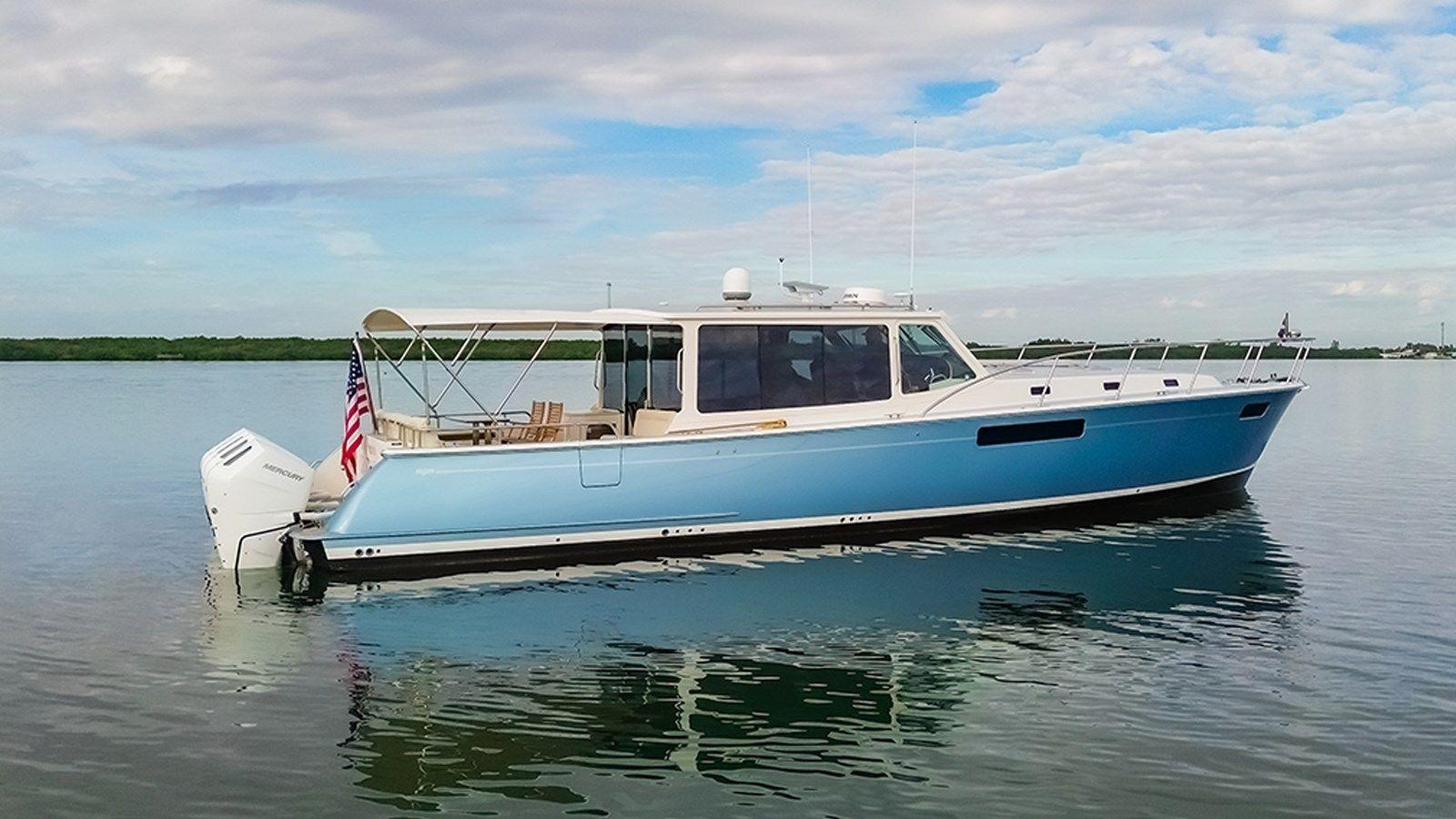
Boston Boatworks 44 (BB44) Offshore Express Cruiser
- Length: Approximately 44 feet overall, with a layout optimized for offshore work and efficient cruising. The design balances a fine entry and efficient running surfaces with sufficient volume for comfortable accommodations.
- Number of cabins: Typically one primary stateroom forward plus additional berths via a convertible salon or guest space; a second enclosed sleeping area may be specified depending on the chosen layout. The emphasis is on owner-operator practicality, clear traffic flow, and generous storage rather than maximal cabin count.
- Maximum speed: Performance depends on engine selection, load, and sea state. In keeping with the yard’s lightweight, epoxy composite approach, configurations are tuned for efficient cruise and the ability to reach higher speeds when conditions allow. Targets typical of the mid-30-knot class can be achieved with appropriate power; exact figures are specification-dependent.
- Engine type: Twin diesel inboard propulsion is standard, with modern control systems that enable joystick maneuvering and station-holding features when specified. Propulsion and running gear are selected to deliver low vibration, predictable handling, and efficient cruise fuel burn.
- Distinguishing characteristics:
- Vacuum-bagged, cored epoxy hull, deck, and structure with oven post-cure for stiffness and finish stability.
- Systems engineered for service access, including labeled circuits and practical component placement.
- Ergonomic helm with excellent sightlines and thoughtful seating; layouts suited to owner-operators.
- Quiet ride and solid feel underfoot derived from weight control and composite stiffness.
- Options for stabilization and advanced electronics integration as mission profiles require.
- A painted exterior finish chosen for long-term fairness and gloss retention.
-
Limited-Series and Special Projects (as undertaken)
- Scope: In addition to its named model, the yard has the capability to execute specialized, limited-series composite projects aligned with its engineering and quality standards. These may include bespoke configurations or mission-specific craft where low weight, structural efficiency, and robust systems integration are essential.
- Characteristics: Specifications vary by project, but the core technical pillars remain consistent—vacuum-bagged epoxy laminates, cored construction, oven post-cure, and a process-driven quality assurance framework. The same emphasis on service access, quiet operation, and offshore-capable ergonomics applies.
- Customization: Interior arrangements, systems packages, and equipment selections are developed to suit the project objectives while preserving the engineered assumptions that underpin structural and performance targets.
Notes on specifications and availability: Details for any given hull—including propulsion ratings, exact layouts, equipment lists, and performance numbers—depend on the final specification and build slot timing. Because the yard builds in small batches with semi-custom flexibility, published figures are best regarded as representative. The unifying thread across configurations is a disciplined, composite-first methodology designed to deliver a quiet, efficient, and confidence-inspiring experience at sea.
Summary perspective on the lineup: The BB44 anchors Boston Boatworks’ identity as a builder that channels grand-prix composite sensibilities into an owner-friendly offshore cruiser. Rather than proliferating a large catalog of variants, the company emphasizes getting the fundamentals right—structure, weight, ergonomics, and systems—then tailoring each build thoughtfully. For buyers who prioritize real seakeeping, low noise/vibration, durable finishes, and service-minded design, the lineup’s defining characteristics are less about model count and more about the fidelity with which each hull is executed.


Learn more on the “BOSTON BOAT WORKS”
To learn more on the “BOSTON BOAT WORKS” or to get advice on how to buy or sell a yacht or get a great price for a yacht charter
please call +1 (954) 274-4435 USAOnly deal with professionals!