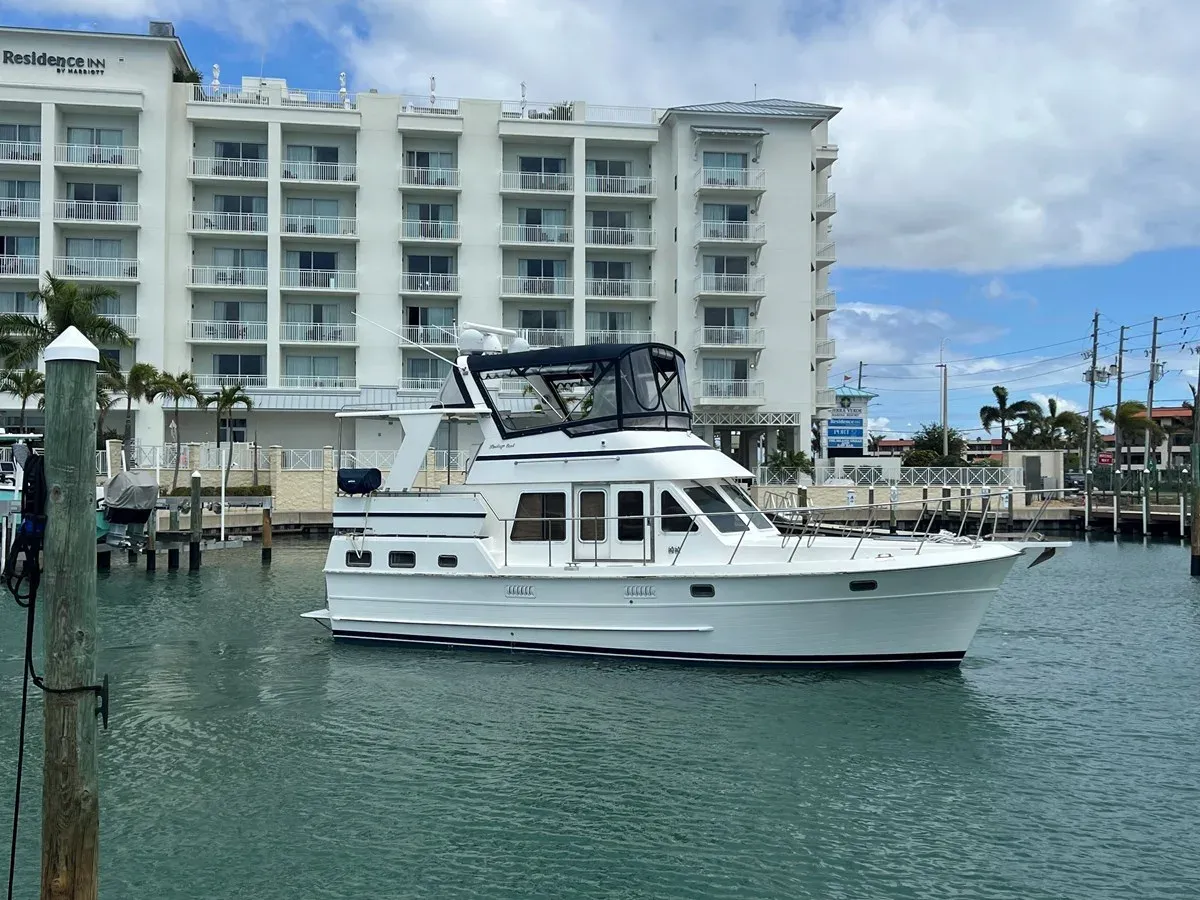
Licensed Yacht BrokersSales and service of yachts and shipsN/A - For Sale
Heritage East
Company History
Heritage East is best understood as a U.S.-market brand applied to a family of trawler-style motor yachts that were contract-built in Asia and imported for North American buyers. Rather than operating as a single, vertically integrated shipyard with a long public corporate record, Heritage East functioned within a common business model of its era: a stateside importer/brand owner coordinated design direction, specifications, quality control, and marketing, while partner yards in Taiwan—and later mainland China—handled the actual construction. This model was widespread among value-oriented cruising trawlers introduced to the U.S. market from the late 1980s onward.
Heritage East boats gained visibility primarily through the 1990s and 2000s, a timeframe reflected in the majority of brokerage listings still on the market today. The line coalesced around practical, liveaboard-friendly sundeck motor yachts and sedan-style trawlers, with the best-known models including approximately 36-foot, 40/42-foot, and 44-foot configurations. Among enthusiasts and brokers, the “Heritage East 44 Sundeck” is often cited as a signature model: a two-stateroom, two-head layout with a raised aft deck (sundeck), a covered or hardtop flybridge, and a semi-displacement hull meant to balance efficient displacement-speed cruising with the ability to run into the low-to-mid-teens when conditions and engine packages allow.
The brand’s trajectory mirrors the broader evolution of Asian-built motoryachts bound for North America. Early Heritage East hulls were typically produced in Taiwan, home to a dense ecosystem of skilled joinery shops and fiberglass specialists that, by the 1990s, had earned a strong reputation for hand-finished interiors and robust construction on semi-custom builds. As labor markets and supply chains shifted in the 2000s, production for numerous U.S.-market trawler brands migrated to mainland China, where larger facilities and cost structure supported competitive price points without entirely abandoning the wood craftsmanship that defined Taiwanese builds. Brokerage documentation and owner reports indicate Heritage East followed this general pattern: earlier hulls built in Taiwan; later ones in China, with U.S. commissioning and dealer support handling final fit-out details and regulatory compliance.
Because Heritage East operated as a brand with multiple contracted production partners rather than an individually prominent, continuously documented shipyard, deeply granular corporate milestones (such as named founders or a single, continuously operated factory campus) are not as readily traceable in the public record as they would be for the largest premium yacht builders. Nonetheless, the boats themselves—recognizable by their layouts, joinery, and owner-upgraded equipment—tell a coherent story: a line created to deliver the comforts most in demand among U.S. coastal cruisers and “Great Loop” aspirants, at price points that undercut top-shelf trawler brands while still offering pleasing woodworking, conservative hulls, and practical systems.
For buyers and owners today, Heritage East’s “company history” is most apparent in how these boats were used and regarded over time: as reliable liveaboards for couples and small families; as efficient, semi-displacement cruisers for the Intracoastal Waterway, Chesapeake, Florida/Bahamas, and Pacific Northwest; and as value-forward alternatives to better-known but pricier marques. That historical footprint persists strongly in the used market, where well-kept examples continue to attract interest for their layout, economy, and approachable maintenance profile.
Country of Origin
United States (brand and importing entity for the North American market), with production contracted to boatbuilding partners in Asia (initially Taiwan and, in later years, mainland China). In other words, Heritage East was a U.S.-market brand whose boats were built overseas to specifications set and overseen by its American importer and dealer network.
Manufacturing Locations
Heritage East yachts were contract-built in Asia:
-
Taiwan (earlier production): Many of the brand’s early hulls were laid up in Taiwan, particularly in and around the established boatbuilding hub of Kaohsiung. This region was—and remains—renowned for hand-laid fiberglass hulls, traditional teak joinery, and semi-custom yacht construction. The workmanship in these boats typically reflects the Taiwanese yards’ strengths: solid cabinetmaking, detailed interior finishing, and conservative, overbuilt laminates aimed at durability.
-
Mainland China (later production): As with numerous U.S.-market trawler brands in the early-to-mid 2000s, Heritage East production migrated to mainland China for at least part of its run. These later boats leveraged more modern facilities and supply chains while endeavoring to maintain the interior woodwork quality that drew yacht buyers to Taiwanese builds. Many examples were subsequently commissioned or further outfitted in the United States by dealers or service yards—this often included electronics packages, canvas/enclosure work, ABYC-compliant electrical tweaks, and final detail finishing.
It is important to note that, like many contract-built marques of the period, Heritage East did not rely on a single manufacturing address throughout its lifespan. Instead, production partners and facilities could change over time, especially as the brand responded to currency fluctuations, global supply shifts, and evolving dealer feedback. As a result, small construction details—corings used above the waterline, hardware suppliers, tank materials, and interior wood species/finish—can vary subtly from one year or hull series to another. The through-line across these boats is a semi-displacement cruising mission profile and a design language centered on practical liveaboard comfort and efficient coastal passagemaking.
Reputation and Quality
Within the trawler and sundeck-motoryacht niche, Heritage East is typically regarded as a value-oriented, well-finished alternative to the most famous premium brands. The boats earned a reputation for:
-
Practical, owner-focused layouts:
- Sundeck/Aft-cabin configurations with two staterooms and two heads are common in the 40–44-foot range, enabling owners to live aboard without sacrificing privacy.
- The 36-foot class models often appear in sedan or trunk-cabin arrangements with lower bridge clearance, attractive to Great Loop cruisers managing fixed bridge heights.
- Salons generally provide abundant natural light and seating optimized for long stays aboard rather than short, occasional outings.
- Engine rooms, while sometimes tighter than pure displacement trawlers, are generally serviceable and benefit from straightforward systems runs.
-
Solid joinery and finish:
- One of the brand’s calling cards is the interior woodwork—typically teak joinery with a classic, warm presentation, or, on some later boats, a lighter modern finish. Attention to cabinetry, doors, and trim is typically good to very good for the price segment.
- Many boats feature parquet or teak-and-holly soles, radiused trim, and thoughtful stowage solutions—hallmarks of Taiwanese heritage and a point of owner pride.
-
Conservative, semi-displacement hulls:
- Heritage East hulls are intended primarily for efficient displacement-speed cruising (7–10 knots), with the ability to quicken the pace into the low-to-mid-teens when conditions and power permit.
- At displacement speeds, owners generally report agreeable fuel economy, especially with single-diesel configurations on the smaller models; twin installations, common on 40–44-foot sundeck boats, trade a measure of economy for redundancy and docking agility.
- Running surfaces are designed to prioritize predictable handling, good manners in a range of coastal seaways, and comfort over absolute top-end speed.
-
Dependable, widely supported propulsion and systems:
- Many Heritage East examples are powered by Cummins 6B-series or Yanmar diesels—engines with broad support networks and abundant parts availability in North America.
- Generators from well-known suppliers (e.g., Onan, Northern Lights) and common-brand systems (windlasses, thrusters, air conditioning) ease upkeep and parts sourcing.
- Electrical systems on import often benefited from U.S. dealer commissioning, which brought installations closer to ABYC norms and incorporated American-market electronics packages.
-
Liveaboard capability:
- Aft decks (sundecks) with hardtops or full enclosures create “outdoor rooms” prized by liveaboards.
- Two-head layouts with separate showers, generous tankage for boats in this size bracket, and practical galleys position Heritage East as a comfortable long-stay cruiser for couples who entertain or travel with guests.
Market positioning and value:
- Heritage East occupied a middle ground: above entry-level Asian trawlers in finish and detailing, yet priced below legacy blue-chip marques like Fleming or the higher-spec lines of Grand Banks and similar. This alignment delivered a strong value proposition for buyers who prioritized comfort, fit-and-finish, and range over maximum brand prestige.
- On the brokerage market, pricing typically reflects condition, year, power, and update history (electronics, soft goods, canvas, genset hours). Because the brand’s identity is closely tied to the tangible quality of a given hull rather than to a singular, longstanding corporate marquee, well-maintained individual examples command a premium over average-condition boats.
Construction notes and owner-observed nuances:
- Laminates are typically hand-laid fiberglass with solid hull bottoms; coring may appear in decks and superstructures to manage weight and stiffness. Exact materials can vary by production run and yard.
- Teak decks were available on some boats and remain aesthetically appealing, though they require diligent maintenance and, on older examples, inspection for core moisture at fastener penetrations.
- Fuel tank materials can vary; some older Asian-built trawlers (industry-wide) used black-iron tanks that warrant close survey attention for corrosion, while later builds more commonly employed stainless steel or aluminum. Prospective buyers should ask specifically about tank material and access for inspection or eventual replacement.
- Windows and deck penetrations deserve a careful survey, as bedding compounds age and water ingress can follow if maintenance was deferred. This is not unique to Heritage East; it is a general consideration for cruising boats of similar vintage.
- Wiring quality is often serviceable and improves where U.S. dealers or owners reworked panels to current standards; still, surveys occasionally uncover legacy practices (e.g., wire labeling gaps, non-tinned wire in localized circuits) that owners subsequently upgrade.
Use case and cruising reputation:
- Heritage East yachts are widely used for the Great Loop, coastal circuits on the U.S. East and Gulf Coasts, Bahamas runs in settled weather windows, and Pacific Northwest cruising. Their semi-displacement nature, comfortable accommodations, and moderate draft suit these missions particularly well.
- While stout for coastal passagemaking, they are not marketed as bluewater, transoceanic trawlers. Owners typically plan routes to take advantage of weather windows and protected waterways, where the boats shine in comfort and efficiency.
Support, community, and parts:
- Although there is no single all-encompassing factory support hub in the way a vertically integrated premium yard might provide, owners benefit from the fact that engines and most ship’s systems are mainstream, with robust North American service networks.
- Owner communities—through forums, social media groups, and looper networks—offer practical knowledge on maintenance, refits, and sourcing. These peer networks are an important part of the brand’s support ecosystem on the secondary market.
Awards and formal recognition:
- Heritage East is not widely associated with high-profile international design awards. Its reputation rests more on steady owner satisfaction, enduring market presence on the brokerage scene, and the brand’s alignment with real-world cruising needs. In that sense, its “recognition” is organic: a steady base of repeat owners and word-of-mouth referrals in the trawler community.
Resale and long-term outlook:
- Demand for comfortable, economical liveaboard cruisers remains resilient, and Heritage East benefits from this trend. Sundeck motor yachts with two-stateroom/two-head layouts continue to appeal to cruising couples planning seasonal or full-time adventure. The 36-foot class appeals to solo or couple cruisers who value lower bridge clearance and easier handling.
- As always, survey results, maintenance history, and thoughtful upgrades determine outcomes. Boats with well-documented care—particularly tank replacements when needed, updated electronics, renewed canvas/enclosures, fresh upholstery, and diligent deck/window bedding—stand out in the marketplace and underscore the strong value proposition that made Heritage East attractive at launch.
In summary, Heritage East’s quality reputation is anchored less in corporate lore and more in the tangible experience aboard: sensible layouts, agreeable woodwork, conservative hulls, approachable systems, and the kind of day-to-day livability that turns “just cruising” into a comfortable lifestyle. That combination explains why, decades on, the name continues to surface on shortlists for practical coastal trawler buyers seeking classic looks and enduring, serviceable construction without the premium of the most exalted badges.
Main Competitors
Heritage East occupies a well-known niche in the used-yacht market: traditional, fiberglass sundeck/aft-cabin trawlers and motoryachts in the roughly 36- to 44-foot range that were built in Asia (predominantly Taiwan, with some production later moving to mainland China) and imported into North America. These boats emphasize comfortable, liveaboard-friendly layouts, efficient semi-displacement hulls, and conservative styling with wide side decks and sheltered aft decks. In that space, the following builders and model families are most frequently cross-shopped against Heritage East on the brokerage market:
-
Marine Trader (various Sundeck and Double-Cabin models)
- Why it competes: Perhaps the closest like-for-like peer for Heritage East in both size and era. Marine Trader offered an extensive lineup of 34–50 ft trawlers and aft-cabin motoryachts that mirror Heritage East’s typical layouts and mission profile.
- Typical comparison points: Fit-and-finish and systems installation quality vary widely by year and yard, just as buyers will see across Heritage East examples. Buyers compare saloon volume, two-stateroom, two-head layouts, and bridge/sundeck ergonomics. Pricing and availability on the used market are very similar.
-
CHB / Chung Hwa Boat (often badged as “CHB 34/40” or sold under dealer/brand names)
- Why it competes: CHB-built yachts helped define the classic Taiwanese trawler look that Heritage East also followed—teak interiors, aft-cabin master suites, and workboat-simple systems.
- Typical comparison points: Heritage East interiors are often judged against CHB’s heavy-teak joinery. Buyers also weigh the presence of walkaround side decks, deck overhangs, and engine-room access. Both attract cruisers seeking comfort and economy over speed.
-
Nova (e.g., Nova 40 Sundeck)
- Why it competes: Nova’s sundeck trawlers parallel Heritage East in size, layout, and vintage, with many boats produced in Taiwan for the North American market.
- Typical comparison points: Nova’s 40 is often discussed alongside the Heritage East 36–40 for loop-cruising practicality, efficient hulls at trawler speeds, and simple mechanical systems.
-
Ponderosa (e.g., Ponderosa 42/43 Sundeck)
- Why it competes: Another Taiwanese brand of the same era, noted for roomy sundecks and livable aft-cabin layouts.
- Typical comparison points: Buyers weigh interior volume, the handling characteristics of moderate-displacement hulls, and how each brand’s joinery and installations have aged.
-
Island Gypsy by Kong & Halvorsen (e.g., Island Gypsy 36/44)
- Why it competes: Known for refined hulls and tasteful interiors, Island Gypsy sits a notch up in perceived finish relative to some contemporaries, yet remains comparable in concept to Heritage East.
- Typical comparison points: Build quality and hull design sophistication versus cost of entry. Heritage East often competes well on value-for-money, while Island Gypsy may draw buyers prioritizing fit-and-finish.
-
Monk (e.g., Monk 36)
- Why it competes: The Monk 36 is a classic Great Loop choice, much like the Heritage East 36/40, and targets owner-operators prioritizing simplicity, economy, and reliability.
- Typical comparison points: Layouts optimized for two cruising adults plus occasional guests, ease of maintenance, and community support. Buyers compare engine options (single vs. twin) and range at displacement speeds.
-
Albin (e.g., Albin 43 Trawler)
- Why it competes: Albin’s trawlers share the same “practical cruiser” DNA with traditional lines and teak-rich interiors.
- Typical comparison points: Machinery access, tankage, and the quality of original systems. Buyers also consider how both brands handle in tight marinas and in a chop at hull speed.
-
DeFever (various 41–44 ft models)
- Why it competes: Known for robust bluewater-capable designs, DeFever models in the low-40-foot range are an aspirational comparison for some Heritage East shoppers.
- Typical comparison points: DeFever’s long-range ethos and heavy displacement vs. Heritage East’s moderate-displacement efficiency. DeFever may command a premium; Heritage East offers similar livability with lower acquisition costs.
-
Ocean Alexander (e.g., 40/42 Classico and similar-era models)
- Why it competes: Ocean Alexander represents a premium Taiwanese build standard of the same era, with conservative lines and elevated craftsmanship.
- Typical comparison points: Price, resale strength, and perceived build pedigree. Heritage East often competes strongly on price-to-space ratio, while OA attracts buyers willing to pay more for a high-end finish and branding.
-
Symbol Yachts (e.g., Symbol 42)
- Why it competes: Symbol’s semi-displacement cruisers share the same design language and mission profile with Heritage East, often with neatly executed interiors.
- Typical comparison points: Ergonomics on deck, quality of joinery, and engine-room systems layout. Heritage East can be more plentiful on the market, providing wider choice.
-
Grand Banks (e.g., GB 36 and GB 42 Classic)
- Why it competes: The archetype of traditional trawlers, Grand Banks models are a benchmark for quality and seakeeping in the same size band as the Heritage East 36–44 range.
- Typical comparison points: GB commands a premium for brand and finish. Heritage East competes on affordability and interior volume per foot. Buyers weigh the cost of ownership, parts access, and upkeep of teak exteriors.
-
Mainship (e.g., Mainship 350/390/400 Trawler)
- Why it competes: A more contemporary, American-built alternative, Mainship trawlers are lighter and often faster at semi-planing speeds, yet still aimed at owner-operators cruising the ICW and Great Loop.
- Typical comparison points: Speed and fuel economy trade-offs, cored construction approaches, and modernity of systems. Heritage East counters with classic styling, broad side decks, and typically teak-rich interiors.
-
Carver and Californian Aft Cabins (various 38–45 ft)
- Why they compete: These are planing or semi-planing aft-cabin cruisers with generous accommodations and wide availability on the used market—often shown to the same buyers who want the two-stateroom, two-head convenience that Heritage East provides.
- Typical comparison points: Heritage East’s semi-displacement focus and “trawler style” economy versus Carver/Californian’s higher cruise speeds and more contemporary interiors. Buyers weigh running costs and handling characteristics at displacement speeds.
Across these brands, the decision frequently narrows to:
- Interior livability for extended cruising (Heritage East compares well, especially in sundeck/aft-cabin configurations).
- Build standard and yard-to-yard variability (a reality across many Taiwanese imports of the era, including Heritage East; each boat’s maintenance history becomes pivotal).
- Machinery: single vs. twin diesel choices, typical cruise in the 7–10 knot band, with propulsion packages from widely supported makers (a Heritage East strength, as components are generally standard and serviceable).
- Price-to-space value: Heritage East is typically competitive on acquisition cost relative to premium badges while delivering equivalent utility for ICW, Bahamas, and Great Loop itineraries.
For buyers coming from sail or from smaller cruisers, Heritage East’s straightforward systems, accessible engine rooms (varies by model), and protected decks are major selling points—traits mirrored by many of the competitors above. Among those seeking a “floating condo” that can modestly stretch its legs in settled weather, Heritage East tends to make the shortlist alongside Marine Trader, Nova, and Ponderosa; among those seeking top-tier finish or offshore range, Grand Banks, Ocean Alexander, DeFever, or Island Gypsy may earn closer scrutiny. Mainship, Carver, and Californian offer a stylistic and performance counterpoint, useful for buyers deciding whether they truly want the “trawler cadence” of 8–9 knots or prefer the option to cruise faster.
Current Production Status
There is no evidence of ongoing new-build production under the Heritage East name. The brand is best understood today as a legacy importer/label whose boats were built under contract at Asian yards—primarily in Taiwan during the height of the “Taiwan trawler” era and, for some later examples, in mainland China—then marketed and delivered to North American buyers. On today’s market, Heritage East appears exclusively as a pre-owned offering; buyers encounter model years concentrated from the late 1980s through the early-to-mid 2000s, with the 36, 40, and 44 sundeck/aft-cabin variants appearing most frequently in brokerage listings.
Key indicators of an inactive production status include:
- Absence of a current, official corporate website presenting new models, specifications, or a dealer network.
- Lack of boat show presence, press announcements, or marketing campaigns in the 2010s and 2020s.
- A consistent pattern on the brokerage market in which the most recent model years commonly observed are from the early-to-mid 2000s, with no post-2010 builds circulating under the Heritage East badge.
What this means for owners and buyers:
- Support and parts: Heritage East boats were specified with mainstream marine systems—diesel engines from major OEMs, standard generators, widely used pumps, heads, and electrical components. Even without a current factory presence, parts and service for the primary machinery remain readily available through engine manufacturers, distributor networks, and independent yards. Much of the value proposition lies in this “service anywhere” systems philosophy.
- Documentation: Original owner’s manuals (often compiled by the importer) were typically generic, with vendor manuals for engines, gensets, and equipment providing the most useful references. Surveyors and technicians rely on component-level documentation rather than brand-specific schematics in many cases—standard practice for legacy Taiwanese trawlers of this period.
- Yard variability and model evolution: Like many similar brands of the era, Heritage East boats may reflect differences in workmanship and materials from one production period to another, and even between batches if multiple contract yards were involved over time. In practice, the maintenance history of the individual boat frequently outweighs year-to-year brand generalizations.
- Brokerage dynamics: Heritage East yachts remain a staple of the Great Loop/ICW cruising market. Their layouts—sundeck with hardtop or soft cover, aft-cabin master, separate shower stalls in many two-head plans, and workable lower helms—align tightly with liveaboard and seasonal migration patterns. As with peers, condition is the dominant driver of price: well-kept examples with refreshed soft goods, updated electronics, recent canvas/isinglass, and evidence of diligent mechanical care generally command significantly stronger interest.
Implications for refit and ownership:
- Decks and superstructures: The era’s construction practices commonly mixed solid fiberglass for hulls with cored decks and superstructures. Prospective buyers and owners should monitor for localized moisture ingress around hardware penetrations and deck joints. A careful survey with moisture meter and thermal imaging (where appropriate) is standard due diligence.
- Teak joinery and exterior wood: Interiors often feature abundant solid teak and veneers that age gracefully when ventilated and kept dry. Exteriors may have teak caprails or trim that require ongoing care; many owners opt to encapsulate or paint exterior wood to reduce upkeep.
- Tankage and access: Fuel and water tanks, their materials, and service access vary by model and build period. Inspect for weeping seams, corrosion (on metallic tanks), and the feasibility of removal if replacement is ever required. Many Heritage East engine rooms provide reasonable service corridors, but access particulars differ between the 36, 40, and 44.
- Propulsion choices: Heritage East boats were delivered with commonly available diesel engines from major makers, often in modest horsepower ranges aligned with displacement or semi-displacement cruising. This simplifies long-term support. Where twins are fitted, buyers should consider the trade between redundancy/ease of maneuvering and added maintenance over single-screw layouts.
Market positioning today:
- Heritage East sits in a “sweet spot” for value-conscious cruisers who want the accommodations of a 40–44 ft motoryacht without the premium of blue-chip badges. Compared with more performance-oriented aft-cabin cruisers, Heritage East typically prioritizes economy at 7–9 knots, seakindly handling when driven sensibly, and side-deck safety.
- The brand benefits from a strong ecosystem of independent expertise: surveyors familiar with Taiwanese trawlers, yards experienced in teak repair and core remediation, and online owner communities that share upgrade paths—for example, modernizing DC systems, LED lighting, bow and stern thrusters, and electronics refits tailored to inland-waterway and near-coastal cruising.
In summary, Heritage East functions today as a well-established legacy brand in the brokerage arena rather than an active manufacturer. For yacht buyers seeking the classic sundeck trawler template—two cabins, two heads, protected outdoor living space, and efficient diesel cruising—Heritage East remains a credible candidate. The absence of current factory production is mitigated by the boats’ use of standard components, healthy aftermarket support, and a large peer set of similar-era Taiwanese cruisers, which together provide a dependable pathway for maintenance, refit, and long-term ownership.
Frequently Asked Questions
Question: Who is Heritage East, and what do they build? Answer: Heritage East is a yacht brand best known among trawler and motoryacht enthusiasts for aft-cabin “sundeck” cruisers in the roughly 36- to mid-40-foot range. Boats carrying the Heritage East badge are typically semi-displacement fiberglass motoryachts designed for economical coastal cruising, comfortable liveaboard use, and easy handling by a couple. They became particularly visible in North America from the 1990s into the 2000s. Their hallmark is a practical, livable layout—most often with an aft master stateroom, two heads, generous storage, walkaround side decks, a covered sundeck, and a flybridge—combined with conservative, sensible engineering and fuel-efficient diesel propulsion.
Question: Where were Heritage East yachts built? Answer: Heritage East yachts were produced in Asia and imported to North America. As with many trawler-style motoryachts from the era, examples commonly trace their origins to Taiwanese and later mainland Chinese contract yards that specialized in hand-laid fiberglass construction and classic teak joinery. Precise yard attribution can vary by model year and importer; survey records and original documentation for a specific hull provide the most definitive provenance.
Question: What construction methods and materials are typical for Heritage East? Answer: Heritage East followed the prevailing practices for quality production trawlers of the time. Expect solid fiberglass (FRP) below the waterline, with cored decks and superstructures to save weight and add stiffness. Longitudinal stringers and transverse frames in glass-reinforced laminates provide hull rigidity. Interiors are commonly executed in teak veneers and solids, with marine-grade plywood and laminated bulkheads bonded to the hull. Aluminum window frames and stainless-steel rails/handholds are common. As with any cored deck or house, proper sealing and periodic re-bedding of hardware are key to long-term dryness.
Question: What kind of cruising are these yachts designed for? Answer: Heritage East boats are quintessential coastal cruisers. They are well suited to the Great Loop, Intracoastal Waterway, Pacific Northwest inside passages, New England and Canadian Maritimes summers, and Bahamas or Florida Keys trips taken in prudent weather windows. Their semi-displacement hulls thrive at moderate speeds in protected and nearshore waters. Offshore capability for short hops in settled conditions is realistic; transoceanic ambitions are not what these boats are about.
Question: How do they ride and handle? Answer: The hulls are typically semi-displacement with hard chines and a skeg or keel that helps track straight and provides some protection to running gear. At displacement speeds (around 7–9 knots), they track reliably and are economical. With twin diesels, many models can push into the low- to mid-teens (knots) for short stints when conditions invite it, though fuel burn rises sharply at those speeds. High freeboard, a broad beam, and weight distribution give a predictable motion; beam seas can feel more assertive on sundeck motoryachts with higher superstructure, which is common to the type rather than unique to this brand.
Question: Were stabilizers offered? Answer: Some boats on the brokerage market have been fitted with fin stabilizers, and a minority were ordered new with stabilizers depending on importer and yard. Many Heritage East yachts, however, run without active stabilization and rely on conservative speeds and route planning. If stabilization matters to you, evaluate existing installations carefully or plan a reputable retrofit with due attention to power demands, service access, and weight distribution.
Question: Single or twin engines—what did Heritage East offer and what should I choose? Answer: Both configurations exist. Single-engine boats emphasize maximum fuel economy, simplicity, and reduced maintenance, helped by a protective keel/skeg. Twins provide redundancy, better low-speed maneuvering (especially in close quarters and windage), and the ability to step up to semi-planing speeds for short bursts. If you prioritize economy and long, slow passages, a single is attractive. If you frequent tight marinas in crosswinds or value a faster top end, twins may be the better fit. Bow thrusters are a common and very effective complement on either setup.
Question: Which engines are commonly found? Answer: Examples on the market often carry well-regarded, mechanically-injected diesels from Cummins, Perkins, or similar makes of the era. Many twin installations use Cummins 6B series (for instance, ~210–330 hp each depending on tune and year). Singles can be in the 135–250 hp neighborhood. Specific engines vary by build year and importer specification; always reference the hull’s documentation.
Question: What real-world fuel economy can I expect? Answer: While exact figures depend on displacement, condition, propellers, and engine spec, typical numbers look like this:
- Displacement cruise (7–8.5 knots): roughly 2–4 US gallons per hour total for a single; 3–6 gph total for twins.
- Semi-planing (11–15 knots, twins): an order-of-magnitude increase in burn, commonly into the teens (gph) and sometimes higher depending on hull, load, and tuning. Most owners choose to operate in the displacement band for comfort and economy, with occasional faster runs to beat weather or schedules.
Question: What layouts are common, and are they good for living aboard? Answer: The sundeck aft-cabin format is a Heritage East calling card. Typical features include:
- A private aft master with an island berth and en suite head (often with a separate shower stall on larger models).
- A forward guest cabin with a V-berth or island/double and an adjacent second head.
- A salon with good natural light, often with lower helm option.
- A galley “down” or “up” depending on model/year; both are found.
- A covered aft sundeck for dining and lounging, with steps up to a flybridge that seats several adults.
- Walkaround side decks with secure rails for easy line handling and safe movement underway. Storage is generous by modern standards, and tankage typically supports weeks aboard between pump-outs and refuels when cruising thoughtfully.
Question: What are typical tankage and utilities? Answer: Across the 36- to 44-foot span, fuel capacity commonly ranges from about 300 to 600 US gallons total depending on model and configuration. Freshwater capacity often falls between roughly 120 and 200 gallons. Many boats carry a diesel generator (brands vary) sized to run air conditioning and house loads. AC shore power can be 30A or 50A depending on vintage and options. Inverters, solar, and lithium upgrades have become popular refits for extended anchoring.
Question: What are the likely air draft and draft numbers? Answer: Draft generally runs about 3'6" to just over 4' on many Heritage East trawler-style models. Air draft varies widely with arch/mast and canvas choices; with biminis down and masts hinged or removed, many owners report figures in the mid-teens (feet), which is attractive for the Great Loop. Verify the exact configuration on your hull; modest changes at the flybridge or arch can materially affect clearance.
Question: What should I watch for during a pre-purchase survey? Answer: Focus on the usual suspects for cored deck and house structures: check for moisture around hardware penetrations, windlass bases, rails, and window frames; re-bedding is routine maintenance on boats of this age. Inspect fuel tanks (material and access matter); some production of the era used black iron/steel tanks that may need careful assessment or eventual replacement. Evaluate exhaust risers/elbows for corrosion, shaft logs and stuffing boxes for leaks and alignment, and the condition of engine mounts and stringers. Electrical systems often benefit from modern tidying—clean terminations, breaker labeling, and updated charging architectures. Canvas and enclosure condition on sundeck and flybridge can materially affect value and cruising comfort.
Question: How does Heritage East compare with other sundeck trawlers and motoryachts? Answer: Heritage East competes in the same space as classic Taiwanese-era trawlers and aft-cabin motoryachts from brands that emphasized value and liveaboard practicality. Hallmarks include warm teak interiors, generous layouts, and economies at displacement speeds. They are generally regarded as solidly built, sensibly engineered boats that deliver a lot of livability per foot. Fit-and-finish nuances vary by year and yard; individual condition and maintenance history often matter more than the name on the sheer.
Question: What performance and comfort upgrades are worth considering? Answer: High-value improvements include:
- Bow (and sometimes stern) thruster for docking ease.
- Modern electronics suite with AIS, radar, and integrated autopilot.
- Inverter/charger, solar array, and expanded house battery capacity for quiet anchoring.
- Updated refrigeration and induction or diesel cooktops to reduce LP reliance.
- Fuel polishing manifold and upgraded filtration for reliability.
- LED lighting throughout the interior and exterior for lower loads.
- Quality davit system for a tender; it greatly expands your cruising radius. Where fitted or considered, fin stabilizers or gyro systems should be professionally engineered and installed with attention to weight and serviceability.
Question: Are Heritage East yachts still in production? Answer: Heritage East-branded new builds are not commonly seen today. The boats maintain a presence on the brokerage market, where their livability and value proposition keep them in active demand. Availability is cyclical, and condition varies; prioritize a thorough survey and sea trial.
Question: What ownership costs should I budget for? Answer: Aside from insurance, moorage, and bottom care, plan for:
- Routine engine and generator service (fluids, filters, impellers).
- Canvas/isinglass replacements on a multi-year cadence depending on climate and storage.
- Periodic re-bedding of deck hardware and windows to stay ahead of leaks.
- Battery replacement cycles and charging-system maintenance.
- Occasional larger-cycle items: exhaust components, fuel tank remediation (if required), windlass/ground tackle, and electronics refresh every 7–10 years. Thoughtful owners who do preventive maintenance typically keep total cost of ownership predictable and protect resale value.
Question: Are these boats good candidates for the Great Loop? Answer: Yes. Many Heritage East models check the Loop boxes: comfortable liveaboard layout for months-long travel, moderate draft around 4 feet for shallow waterways, and an air draft that can be managed into the mid-teens with prudent arch/mast and canvas handling. Fuel economy at 7–8 knots and plentiful storage make them practical long-range cruisers for the Loop’s mixed rivers, canals, and coastal segments.
Question: What are common pros and cons cited by owners? Answer: Common pros include:
- Exceptionally livable layouts with private aft cabin and a true second stateroom.
- Protected side decks and a covered sundeck that functions as an outdoor “room.”
- Predictable handling at displacement speeds and easy line handling.
- Good value on the brokerage market relative to interior volume and equipment. Considerations include:
- Canvas and enclosure upkeep is part of life with a sundeck/flybridge boat.
- Higher windage than sedan-style trawlers; thrusters help immensely.
- Vigilance against moisture in cored decks and around window frames is important.
- If fitted with steel fuel tanks, long-term planning may include inspection and potential remediation.
Question: What documentation is valuable to have with a Heritage East purchase? Answer: Seek and retain: full engine/generator service logs, any tank or exhaust work records, invoices for electrical upgrades, documented moisture remediation or re-bedding projects, prior surveys and oil analysis reports, and manuals for installed systems. A well-documented boat commands stronger resale and offers fewer surprises.
Question: How fast are they, realistically? Answer: Think of them as 7–9 knot cruisers by temperament and economy. Twin-engine variants on the larger models can climb into the low- to mid-teens for short runs in settled water. If your mission profile calls for sustained 18–22 knots, you are shopping in a different design universe. If you prize quiet, comfortable days at 8 knots with a huge salon, generous staterooms, and sensible burn rates, they shine.
Question: What interiors and finishes should I expect? Answer: Teak joinery is a signature—bulkheads, cabinetry, and soles in many builds feature warm woodwork with hand-rubbed finishes. Expect louvered locker doors for ventilation, practical galley arrangements with household-style refrigeration on the larger models, and opening windows/ports for airflow. Many boats have been tastefully modernized with updated countertops, soft goods, and lighting; these updates can refresh aesthetics without losing the boat’s classic character.
Question: Is resale supported by brand recognition? Answer: Within trawler circles, Heritage East is recognized and understood. Resale is driven primarily by condition, maintenance history, and thoughtful upgrades—especially canvas/enclosures, batteries/charging, electronics, and evidence of dry decks and sound tanks. Well-kept examples hold their own in the market and often move steadily when priced in line with comps.
Available Models
-
Heritage East 36 Sundeck (approx. 36–38 ft LOA with platforms) Key characteristics:
- Length: ~36 ft hull length; overall often 37–38 ft with bow pulpit and swim platform.
- Cabins: 2 (aft master with en suite head; forward guest cabin with adjacent head).
- Engine type: Single diesel (roughly 135–250 hp) or twin diesels (often in the ~210–220 hp each class on many examples).
- Maximum speed: Typically around 11–14 knots with twins; displacement cruise in the 7–8.5 knot range is the sweet spot.
- Notes: A popular size for couples tackling the Great Loop; easy to handle, generous storage, and a covered sundeck that lives large for the length.
-
Heritage East 40/42 Sundeck (often marketed around 40 ft but measuring ~41–42 ft LOA) Key characteristics:
- Length: Marketed as ~40 ft; overall LOA commonly in the 41–42 ft range depending on platforms.
- Cabins: 2 (aft master with island berth and en suite, forward guest stateroom; two heads total are common).
- Engine type: Single diesel in the higher-horsepower class for this size or, more commonly, twin diesels (frequently Cummins 6B-series in the ~210–315 hp each bracket, depending on year and tune).
- Maximum speed: Low- to mid-teens (knots) with twins; economical cruise around 7.5–9 knots.
- Notes: Strikes a balance between volume and manageability. Expect a larger salon, increased tankage, and improved guest accommodations compared to the 36.
-
Heritage East 44 Sundeck/Motoryacht (commonly around 44 ft hull length; LOA can extend with pulpit/platform) Key characteristics:
- Length: ~44 ft hull; LOA can approach or exceed ~46–47 ft with pulpit and swim platform.
- Cabins: 2 (sometimes with a third small cabin or office variant depending on interior arrangement and year); two heads, often with separate shower in the master.
- Engine type: Typically twin diesels; many examples carry mid-range horsepower such as Cummins 6BTA variants (e.g., ~300–330 hp each). Exact engines vary by boat.
- Maximum speed: Commonly mid-teens in knots with appropriate power; best economy remains in the high-7s to low-9s.
- Notes: A true liveaboard platform with a salon that feels “residential,” ample storage, and systems scaled for extended cruising, while remaining dockage- and handling-friendly for owner-operators.
Important note on specifications: The figures above represent typical ranges observed across multiple brokerage examples and period literature for Heritage East-branded sundeck trawlers. Exact dimensions, power, speeds, and layouts vary by year, yard, and importer specification. Always verify a specific hull’s data via documentation, measurement, and sea trial.
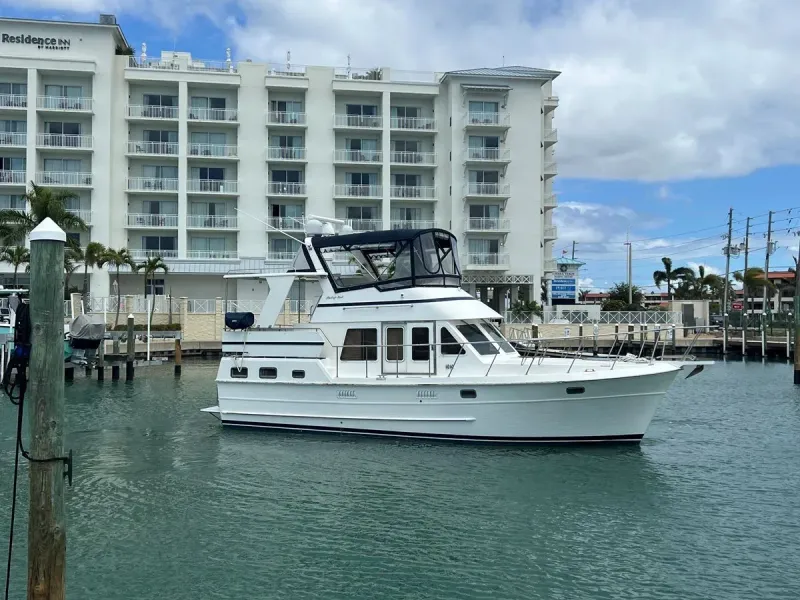

Learn more on the “N/A”
To learn more on the “N/A” or to get advice on how to buy or sell a yacht or get a great price for a yacht charter
please call +1 (954) 274-4435 USAOnly deal with professionals!

