
 Licensed Yacht BrokersSales and service of yachts and ships
MAKAI YACHTS - For Sale
Makai Yachts
Company History
Makai Yachts is a contemporary yacht brand focused on high‑performance cruising power catamarans. The company emerged in the early 2020s, at a time when power multihulls were rapidly gaining ground among private owners for their efficiency, volume, and seakeeping advantages over comparable monohulls. From its inception, Makai positioned itself to combine the comfort and lateral stability inherent to catamaran platforms with the responsive handling and acceleration expected of sportier powerboats.
The brand’s first production model, the Makai M37, marked its public arrival. Developed through an extended research-and-development program with repeated sea trials on the Adriatic, the M37 introduced Makai’s design brief: a stylish, performance‑oriented power cat with generous interior volume for couples or small families, while remaining efficient and manageable for owner‑operators. The M37’s launch drew attention because it leaned into diesel inboard/sterndrive propulsion on a catamaran hull—an approach aimed at delivering a quiet, long‑range, fuel‑sipping ride with strong punch out of the hole and cruising economy at midrange speeds. The brand’s philosophy since has been to maintain this balance between pace, comfort, and practicality, using hydrodynamic refinement to lower fuel burn and improve ride quality rather than relying solely on adding horsepower.
From the outset, Makai Yachts assembled an international team of marine professionals with experience across composite manufacturing, naval architecture, and yacht interiors. The company’s development path has included iterative prototyping, careful weight management, and close attention to structural stiffness and vibration damping—key details that influence how a power cat feels underway. The Adriatic’s varied sea states provided a natural proving ground for fine‑tuning hull entries, tunnel geometry, spray control, and balance at different speeds and loads. In parallel, the brand built out supply relationships within the European marine cluster, emphasizing repeatability in production and serviceability for owners.
With the M37 establishing the marque’s identity, Makai Yachts has signaled its intent to broaden the range to meet different owner profiles and cruising styles, continuing to leverage the same core principles: efficient twin‑hull platforms, contemporary styling, and owner‑friendly systems. While model introductions are paced to ensure build quality and after‑sales support keep step with demand, the brand’s trajectory reflects a clear commitment to performance cruising cats that are easy to live with and enjoyable to drive.
Country of Origin
Croatia.
Manufacturing Locations
Makai Yachts builds on the Adriatic coast of Croatia, a region recognized for its skilled composites workforce, mature maritime supply chain, and convenient access to sea‑trial grounds. Locating production in this environment allows the company to benefit from regional expertise in resin‑infused laminates, precision tooling, and yacht finishing, while also providing immediate access to open water for testing each hull and validating quality before delivery.
The Adriatic setting is particularly well suited to the development and refinement of power catamarans. Local sea conditions range from calm summer chop to brisk shoulder‑season winds and wind‑against‑current scenarios, which helps the shipyard evaluate how a hull tracks, turns, and lands, and how it carries speed and efficiency at varying loads. For Makai, proximity to such conditions has supported practical improvements in tunnel clearance, spray deflection, and helm ergonomics, ultimately feeding back into production boats.
Beyond the lamination and assembly lines, Makai works within a European network of marine suppliers, including propulsion, electrical, and navigation systems that have proven global service footprints. The objective is to ensure owners can access parts and qualified service in the Mediterranean, Northern Europe, and beyond, while keeping the core build centralized to maintain consistency. Final commissioning, sea trials, and quality‑assurance protocols are carried out on local waters before handover, allowing the yard to deliver boats that are dialed‑in to factory specifications.
Reputation and Quality
As a relatively young builder, Makai Yachts has built its reputation around the real‑world performance of its first model and the clarity of its design brief. Enthusiast and professional coverage has highlighted the M37’s blend of speed, tracking stability, and efficiency, especially in comparison with monohulls of similar length and interior volume. Prospective owners are often drawn to three perceived advantages: the ride comfort offered by a twin‑hull platform, the generous deck and cabin footprint enabled by the beam of a power cat, and the potential for lower fuel consumption over a broad cruising envelope.
Quality at Makai centers on modern composite techniques, careful weight control, and systems integration that simplifies ownership. The brand emphasizes clean, serviceable installations—positioning filters, seacocks, and electrical components where they are accessible—and aims to use widely supported equipment to keep maintenance straightforward. Interior fit and finish reflect contemporary European design cues, with light, open layouts and attention to natural light and ventilation. Materials and fabrication methods are chosen to resist the wear typical of active cruising, and to maintain a pleasant acoustic experience under way, with the twin‑hull form and structure working to minimize drumming and vibration.
A core part of Makai’s reputation is the on‑water experience: how the boat accelerates, how it feels through turns and across chop, and how predictably it handles docking maneuvers with twin screws. The M37’s setup is designed to make these everyday tasks intuitive, whether the owner is stepping up from a monohull or moving from an outboard platform to diesel inboards. By delivering predictable handling and efficient cruise numbers, Makai aims to reduce the “stress cost” of boating, encouraging owners to use their boats more often and go farther with confidence.
Customer feedback has also focused on the practicality of the layouts—galley and social zones placed where owners actually spend time, storage that suits longer weekends or coastal hops, and cabins that avoid the compromises sometimes found on narrow monohull footprints at this length. The brand’s approach is to keep the living spaces feeling generous without creating a boat that demands a crew. Ease of owner operation is a recurring theme.
While Makai Yachts is still in the early stages of its brand lifecycle, its strategy—narrow focus on performance power catamarans, measured rollout of models, and a production base in a region steeped in boatbuilding—has positioned it well among buyers who want modern styling and efficient, confidence‑inspiring performance. The company’s continued presence at major European and international shows, combined with sea‑trial opportunities in the Adriatic, has helped it reach a global audience of multihull‑curious owners.
Makai Yachts (Español)
Historia de la empresa
Makai Yachts es una marca contemporánea especializada en catamaranes a motor orientados al rendimiento para el crucero. Nacida a principios de la década de 2020, la compañía surgió cuando los multicascos a motor empezaban a consolidarse entre los armadores privados por su eficiencia, estabilidad y volumen interior. Desde el inicio, Makai buscó combinar la comodidad y la estabilidad transversal del catamarán con la respuesta y el carácter deportivo que se espera de una embarcación rápida y agradable de gobernar.
Su primer modelo de producción, el Makai M37, supuso la carta de presentación de la marca. Desarrollado con extensas pruebas en el Adriático, el M37 introdujo la propuesta de valor de Makai: un catamarán a motor estilizado, de comportamiento vivo y con un interior generoso para parejas o familias, manteniendo a la vez eficiencia y facilidad de uso para armadores sin tripulación. La filosofía de la marca consiste en usar la optimización hidrodinámica—en vez de depender solo de más potencia—para ofrecer menor consumo, mejor suavidad de marcha y un manejo predecible.
Para ello, Makai formó un equipo internacional con experiencia en laminados compuestos, arquitectura naval e interiorismo náutico. El desarrollo se ha apoyado en prototipos iterativos, control de pesos y atención a la rigidez estructural y a la reducción de vibraciones. El Adriático, con sus condiciones variables, ha sido el banco de pruebas ideal para ajustar entradas de casco, geometría del túnel y control de rociones, afinando el balance del barco en diferentes velocidades y cargas.
País de origen
Croacia.
Ubicaciones de fabricación
Makai Yachts fabrica en la costa adriática de Croacia, una zona reconocida por su mano de obra especializada en compuestos, su cadena de suministro marítima consolidada y su acceso inmediato al mar para pruebas de mar. Esta localización permite a la empresa beneficiarse del saber hacer regional en laminación avanzada y acabados, y al mismo tiempo validar cada casco antes de la entrega con ensayos en condiciones reales.
El entorno adriático facilita el desarrollo de catamaranes a motor: desde mares en calma hasta vientos de temporada y situaciones de ola corta, lo que ayuda a evaluar el trimado, el viraje y la eficiencia en distintos escenarios. Además, Makai se apoya en proveedores europeos de propulsión, electricidad y electrónica con servicio posventa global, con el objetivo de garantizar soporte al armador tanto en el Mediterráneo como en otros mercados internacionales.
Reputación y calidad
Como astillero joven, Makai Yachts ha cimentado su reputación en el rendimiento real de su primer modelo y en la claridad de su enfoque. Las pruebas y reseñas han destacado la combinación del M37 de velocidad, estabilidad direccional y eficiencia frente a monocascos de eslora y volumen equivalentes. Los armadores valoran especialmente el confort en marcha del multicasco, el espacio disponible y el potencial de menor consumo en un amplio rango de velocidades de crucero.
La calidad se apoya en técnicas modernas de composites, control de pesos e integración de sistemas pensada para facilitar el mantenimiento. Las instalaciones se diseñan para ser accesibles y utilizables por el propietario, con equipos de marcas de amplia cobertura de servicio. Los interiores siguen líneas contemporáneas europeas, con distribución luminosa, ventilación cuidada y materiales resistentes al uso intensivo. El comportamiento en el agua—aceleración, virada, cruce de ola y maniobra en puerto—es un foco constante, buscando que el barco sea intuitivo tanto para capitanes con experiencia como para quienes dan el salto al multicasco.
Aunque la marca aún está en las primeras etapas de su ciclo de vida, su estrategia—concentración en catamaranes a motor de altas prestaciones, ampliación medida de la gama y producción en una región con tradición náutica—la sitúa favorablemente entre quienes desean estilo moderno, eficiencia y confianza en navegación.
Makai Yachts (Français)
Historique de l’entreprise
Makai Yachts est une marque contemporaine dédiée aux catamarans à moteur orientés croisière et performance. Apparue au début des années 2020, la société s’est positionnée sur un segment en plein essor, celui des multicoques à moteur, appréciés pour leur efficacité énergétique, leur stabilité et leur volume habitable. Dès l’origine, Makai a cherché à marier le confort d’un catamaran avec le dynamisme et la réactivité d’un bateau à caractère sportif.
Le premier modèle de série, le Makai M37, a officialisé l’entrée de la marque sur le marché. Fruit d’un développement intensif et d’essais répétés en Adriatique, le M37 expose la philosophie Makai: un catamaran élégant, performant et facile à prendre en main, avec des aménagements pensés pour la croisière en couple ou en famille. La marque privilégie l’optimisation hydrodynamique pour réduire la consommation et améliorer le confort de navigation, plutôt qu’une course à la puissance.
Makai s’appuie sur une équipe internationale experte en composites, architecture navale et aménagements intérieurs. Le processus de développement met l’accent sur la maîtrise des poids, la rigidité structurelle et le confort acoustique, des éléments essentiels pour la qualité de navigation d’un catamaran à moteur.
Pays d’origine
Croatie.
Sites de production
La construction a lieu sur la côte adriatique croate, un bassin industriel reconnu pour sa main‑d’œuvre qualifiée en composites, sa chaîne d’approvisionnement maritime et son accès direct aux zones d’essais en mer. Ce positionnement permet à Makai de valider chaque unité en conditions réelles et d’assurer une cohérence de qualité du lamination jusqu’à la mise au point finale.
La diversité des conditions en Adriatique—mer plate, clapot, vent et courant—offre un terrain idéal pour ajuster tenue de cap, comportement en virage, contrôle des projections et efficacité aux différentes allures. Makai collabore avec un réseau européen de fournisseurs (propulsion, électricité, électronique) disposant d’un support mondial, afin de sécuriser maintenance et pièces pour ses clients où qu’ils naviguent.
Réputation et qualité
Jeune chantier, Makai Yachts a rapidement attiré l’attention pour l’équilibre de son premier modèle entre performance, stabilité et sobriété. Les retours d’essais soulignent la capacité du M37 à offrir une navigation confortable et efficiente, avec des espaces de vie généreux par rapport à un monocoque de longueur comparable.
La qualité s’exprime dans l’usage de techniques composites modernes, la gestion fine des masses et une intégration des systèmes pensée pour la facilité d’entretien. Les choix d’aménagement privilégient la luminosité, la ventilation et des matériaux durables. Sur l’eau, la priorité est donnée à une conduite intuitive: accélération franche, trajectoires prévisibles, comportement rassurant dans le clapot et manœuvres facilitées au port grâce à la bi‑motorisation.
Même si la marque en est à un stade de développement précoce, sa stratégie—focalisation sur les catamarans à moteur performants, montée en gamme maîtrisée, et ancrage industriel en Adriatique—la place comme un acteur crédible pour les plaisanciers recherchant style contemporain, efficacité et sérénité de navigation.
Makai Yachts (Hrvatski)
Povijest tvrtke
Makai Yachts moderna je marka usmjerena na brze, ali praktične katamarane za krstarenje. Pojavila se početkom 2020‑ih, u razdoblju kada su motorni multitrupci privlačili sve više vlasnika zbog učinkovitosti, stabilnosti i prostranih interijera. Od samih početaka Makai nastoji spojiti udobnost katamarana s upravljivošću i temperamentom sportskijeg glisera.
Prvi serijski model, Makai M37, predstavio je DNK brenda: elegantan, dinamičan katamaran s obiljem korisnog prostora, optimiziran za upravljanje od strane vlasnika. Razvoj je uključivao opsežna testiranja na Jadranu, što je omogućilo finu prilagodbu geometrije trupova, ulaznih kuta, tunela i upravljivosti u različitim uvjetima i opterećenjima.
Zemlja podrijetla
Hrvatska.
Proizvodne lokacije
Proizvodnja se odvija na hrvatskoj obali Jadrana, u okruženju poznatom po vještini rada s kompozitima, razvijenoj pomorskoj industriji i neposrednom pristupu akvatoriju za probne vožnje. Takva lokacija omogućuje provjeru svake jedinice u realnim uvjetima te osigurava konzistentnost kvalitete od laminacije do završne isporuke.
Jadranske vremenske prilike—od mirnog mora do tramontane i kratkog vala—idealne su za razvoj motornih katamarana. One pomažu brodogradilištu da usavrši držanje pravca, učinkovitost i ponašanje u zavoju. Uz to, Makai surađuje s europskim dobavljačima pogonskih, električnih i navigacijskih sustava s globalnom servisnom podrškom, čime se vlasnicima olakšava održavanje i dostupnost dijelova.
Reputacija i kvaliteta
Kao mlađi proizvođač, Makai Yachts gradi reputaciju na stvarnim plovidbenim svojstvima i jasno definiranoj filozofiji dizajna. Vlasnici i testovi ističu kombinaciju brzine, stabilnosti i ekonomičnosti, kao i velikodušan raspored prostora u odnosu na jednorumpaše iste duljine.
Kvaliteta se temelji na suvremenim kompozitnim postupcima, pažljivom upravljanju masom i integraciji sustava koja olakšava vlasničko održavanje. Interijeri su svijetli i praktični, s naglaskom na ventilaciju, dugotrajne materijale i akustičnu ugodu u vožnji. Upravljačke karakteristike i predvidivost manevriranja—od ubrzanja do pristajanja—ostaju prioritet, kako bi plovidba bila što opuštenija.
Iako je marka u ranoj fazi razvoja, fokus na performansne motorne katamarane, postupno širenje ponude i proizvodna baza u regiji s bogatom brodograđevnom tradicijom, pozicioniraju Makai Yachts kao atraktivnu opciju za nautičare koji traže moderan stil, učinkovitost i sigurnost u vožnji.
Makai Yachts
Main Competitors
Makai Yachts operates in the power catamaran segment, particularly in the midsize premium range where buyers are seeking a combination of comfort, efficient cruising, and driver‑friendly handling. Its most direct competitive set includes established multihull specialists and a growing cohort of monohull brands that have launched multihull lines. The following are the primary competitors that prospective buyers typically cross‑shop with Makai:
-
Fountaine Pajot Motor Yachts (France): A major player in cruising power cats, with models such as the MY4.S, MY5, and MY6. FP is known for volume, range, and a strong international dealer network. Buyers often compare Makai to FP for interior space, fuel economy at cruising speeds, and the practicality of layouts for owner‑operators.
-
Leopard Powercat (South Africa/France): The powercat arm of the Robertson & Caine/Leopard brand offers models like the Leopard 40 PC and larger variants, widely used in private ownership and charter. Leopard is recognized for rugged, charter‑proven build practices and efforts to make systems accessible for owners. Comparisons frequently focus on living space versus dynamic performance and handling feel.
-
Aquila Power Catamarans (Global/Asia): Aquila’s range spans from the 36‑foot day cruising/touring segment up through 40‑ to 50‑plus foot cruising cats. The brand has strong penetration in North America and is known for versatile layouts and broad dealer support. Buyers cross‑shop Aquila with Makai when prioritizing cockpit sociability, cabin volume, and sea‑state comfort at family‑friendly speeds.
-
Prestige M‑Line (France): Prestige (part of Groupe Beneteau) introduced the M48 and M8, bringing a monohull luxury brand’s sensibilities into the multihull space. The M‑Line is a benchmark for owners who value bright, apartment‑style interiors and large living platforms. The comparison with Makai often comes down to driving dynamics and target size; Makai is oriented to sportier handling in a more compact size bracket.
-
World Cat (USA): A leading name in outboard‑powered powercats focused on day boating, coastal cruising, and fishing. While World Cat’s mission differs from Makai’s diesel, cruising‑oriented approach, they compete for buyers who prize stability, predictable handling, and economical operation in a manageable size.
-
Aspen Power Catamarans (USA): Aspen uses an asymmetric catamaran hull concept (one primary hull with a smaller outrigger hull) and inboard power, appealing to efficiency‑minded cruisers. Aspen competes philosophically with Makai on fuel economy, quiet ride, and owner‑operator simplicity, though the hull technology and feel are distinct.
-
Invincible, Freeman, and other offshore performance fishing cat builders (USA): These brands produce high‑speed, outboard‑powered multihulls designed primarily for offshore anglers. They overlap with Makai in hull form (twin hulls) and sea‑keeping priorities but diverge on mission: Makai emphasizes cruising comfort, diesel efficiency, and family‑friendly accommodation rather than hardcore fishing layouts.
-
Aventura Power, Bali Catspace MY, and other European builders of compact motor cats: These brands target accessible, space‑efficient cruising with European styling and practical layouts. They are often considered alongside Makai by buyers focused on interior volume and price‑to‑space value.
-
Horizon Power Cat and Sunreef Power (Taiwan/Poland): These brands sit above Makai in size and luxury (50–100+ feet), but they define the aspirational end of the powercat spectrum. Some buyers with future upsizing plans benchmark Makai’s smaller, sportier models against these larger, long‑range luxury platforms for design philosophy and multihull behaviors.
-
Silent Yachts (Austria/Italy): A leader in solar‑electric multihulls. While Silent’s propulsion concept differs substantially from Makai’s diesel approach, both compete for clients seeking quiet operation, long‑range efficiency, and modern multihull living. Silent’s focus on renewable energy places it in a specialized niche, but it remains a noteworthy reference point in multihull discussions.
How Makai differentiates within this group:
- Size and mission: Makai places emphasis on sporty handling and efficient, owner‑operated cruising at lengths that fit into popular berths and lift/transport constraints. This is distinct from charter‑optimized layouts or ultra‑luxury platforms.
- Propulsion philosophy: By foregrounding diesel inboard/sterndrive propulsion on a catamaran hull, Makai targets quiet running, efficient mid‑range cruise, and straightforward serviceability—an alternative to the outboard‑dominated segment.
- Ride and efficiency: The focus is on hydrodynamic refinement, stiffness, and vibration control to achieve the comfort and economy many buyers expect from multihulls, while preserving a driver’s‑boat character.
For many buyers, the final decision comes down to priorities: cockpit and salon volume versus driving feel; outboards versus diesel; charter‑friendly layouts versus private‑owner ergonomics; and the balance of price, finish level, and service access. Makai competes well with brands known for family cruising efficiency while offering a more sporting identity than many volume‑maximized platforms.
Current Production Status
Production of Makai’s inaugural model, the M37 power catamaran, is ongoing. The company builds on the Adriatic coast of Croatia, which provides both a skilled composites labor pool and immediate access to sea‑trial waters. This setting allows Makai to conduct thorough on‑water validation for each hull and to implement iterative improvements as feedback is gathered from sea trials and early owners.
Key points regarding current production:
- Series production: The M37 has moved from prototype/development stages into serial production, with customer deliveries underway. The model has been actively demonstrated to the public and press via sea trials, highlighting the brand’s focus on predictable handling, efficient cruising, and practical owner operation.
- Build approach: Makai’s production emphasizes resin‑infused composites, weight management, structural stiffness, and acoustic refinement to deliver a quiet, solid ride. System installations are laid out for access and serviceability, reflecting the brand’s owner‑operator focus.
- Commissioning and trials: Boats are commissioned locally with factory sea trials carried out on the Adriatic. This approach ensures each unit is tuned to specification before handover, offering a consistent experience in real‑world sea states rather than solely relying on tank or simulation data.
- Options and specification: Within the model’s core platform, Makai provides specification options to suit varied cruising profiles, including equipment packages aimed at extended weekend cruising, Mediterranean day boating, or seasonal coastal passages. The propulsion concept centers on inboard diesel/sterndrive for a balance of efficiency, torque, and quiet running.
Lead times and delivery windows can vary depending on specification and order timing. As with most boutique multihull builders, production slots tend to be planned in firm sequences to maintain quality control rather than scaled rapidly at the expense of consistency. Prospective buyers generally engage early to secure a build slot and align equipment choices with anticipated delivery dates.
Operationally, Makai maintains a measured ramp‑up posture typical of focused, single‑model programs: the priority is to sustain repeatable quality, reliable systems integration, and strong after‑sales support while gradually expanding capacity as the supplier base and workforce cadence mature. This approach reflects the broader market trend among specialized multihull builders, where controlling production tempo helps preserve brand reputation and owner satisfaction.
Production Volumes
[No reliably published, model‑specific annual production quantities are available in the public domain. The company does not routinely disclose unit counts. As a result, detailed numerical production volume data are not provided here.]
Latest News
Recent developments around Makai Yachts have centered on the public rollout and continuing refinement of the M37, ongoing customer deliveries, and active demonstration programs that underline the model’s performance and efficiency brief. While the company maintains a deliberately focused communications strategy, several noteworthy themes characterize the latest phase of activity:
-
Public launch and continued demonstrations: The M37’s introduction established the brand’s identity as a builder of sport‑minded cruising power cats. Since launch, Makai has emphasized extended sea trials in the Adriatic and beyond, giving prospective owners and media a direct feel for the boat’s acceleration, tracking, and behavior in variable sea states. This demo‑led approach complements the brand’s technical narrative—structural stiffness, vibration control, and hydrodynamic efficiency are best appreciated under way.
-
Ongoing customer deliveries: With production in stride, Makai is delivering M37 units to private owners. Each delivery cycle has provided opportunities for incremental improvements—common in the early life of a new model as real‑world use refines details in systems routing, ergonomics, and options packaging. Owners typically highlight the balance of space and handling, a core Makai promise.
-
Iterative product enhancement: Feedback loops from factory trials and owner usage inform modest updates in specification choices, ergonomics, and optional equipment. Rather than implementing wholesale redesigns, Makai’s approach favors targeted adjustments that reinforce reliability, ease of maintenance, and the clarity of the owner experience. Examples include the refinement of storage solutions for longer weekends aboard, optimization of helm ergonomics for extended runs, and attention to acoustic comfort under typical cruising loads.
-
Presence at international events and sea‑trial programs: Makai has maintained visibility through appearances at prominent European shows and organized sea‑trial opportunities in the Adriatic. For a performance‑leaning powercat, meaningful exposure comes from time spent underway; accordingly, Makai prioritizes test‑drive programs where conditions permit buyers to experience the ride and economy differences compared with similarly sized monohulls and outboard‑powered cats.
-
Market positioning and buyer profile: The brand continues to attract interest from monohull owners looking to transition to multihulls without giving up a driver’s‑boat feel, as well as from families who want the inherent stability and deck volume of a cat without moving into larger, crew‑dependent sizes. Makai’s diesel inboard/sterndrive proposition resonates with owners prioritizing quiet running, torque at displacement and semi‑planing speeds, and straightforward dockside service procedures.
-
Supply chain and serviceability emphasis: In line with the broader marine industry’s lessons of recent years, Makai places emphasis on specifying equipment with robust global service footprints. The latest updates from the brand continue to stress accessible installations and standardized components that support predictable maintenance cycles—an important consideration for owners planning seasonal cruising in the Mediterranean and other destinations.
-
Orderbook dynamics and planning: As a specialized builder, Makai aligns production slots with confirmed orders and supplier lead times. The latest guidance to prospective owners highlights the benefits of early engagement to finalize specifications and secure preferred delivery windows. While not disclosing unit volumes, the company’s communications reinforce a quality‑first cadence rather than rapid scaling.
-
Media coverage and independent trials: Ongoing sea‑trial coverage by marine reviewers has focused on the M37’s ride quality, fuel efficiency at realistic cruising speeds, and interior volume relative to length. These independent assessments contribute to Makai’s brand narrative and help prospective buyers understand where the M37 sits versus leading competitors in the 35–45‑foot segment.
Looking forward, the “news” around Makai is less about frequent headline announcements and more about steady execution: building and delivering boats that honor the launch promise, maintaining strong quality control, and continuing to refine the owner experience. This cadence—demonstration, feedback, incremental enhancement—is typical of successful specialist builders in the multihull space. It helps establish a reputation based on on‑water performance and owner satisfaction rather than on rapid model proliferation or aggressive volume targets.
For buyers tracking the brand, the practical takeaways from the latest phase are:
- The M37 is in active production with deliveries taking place.
- Demonstration and sea‑trial opportunities remain a primary engagement path.
- The specification menu continues to evolve in response to real‑world use, with an emphasis on reliability and ease of ownership.
- Makai’s competitive set includes the principal European and American powercat builders; the brand positions itself as a performance‑minded, owner‑operator‑friendly alternative within that field.
In a market where demand for efficient, spacious, and confidence‑inspiring platforms remains strong, Makai Yachts’ recent activity underscores a clear and consistent strategy: deliver a well‑sorted, performance‑leaning power catamaran, validate it repeatedly in real sea conditions, and scale at a pace that preserves quality and service standards.
Makai Yachts
Frequently Asked Questions
Question: What kind of boats does Makai Yachts build?
Answer: Makai Yachts focuses on performance‑oriented cruising power catamarans. The brand’s core idea is to deliver the inherent comfort, deck space, and lateral stability of a multihull while preserving the engaging, driver‑friendly feel that many owners associate with sportier monohulls. In practice, Makai’s designs emphasize efficient twin‑hull hydrodynamics, predictable handling, and layouts that are easy to live with for couples and families.
Question: What sets Makai’s design philosophy apart from other power catamarans?
Answer: Three pillars stand out: a sport‑minded handling brief, an efficiency‑driven hull form, and owner‑operator practicality. Makai aims to tune hull entries, tunnel geometry, and weight distribution so the boat accelerates cleanly, tracks with confidence, and remains composed in chop. In parallel, the brand focuses on systems accessibility, quiet operation, and thoughtful ergonomics so a single owner or couple can comfortably run the boat without a crew.
Question: Where are Makai Yachts built?
Answer: Makai Yachts builds on the Adriatic coast of Croatia. The location provides access to a skilled composites workforce and immediate sea‑trial grounds in varied conditions, supporting iterative refinement in real water rather than solely in simulation. This environment is particularly well suited for validating power‑cat ride quality, spray control, and efficiency across a range of loads.
Question: Why a power catamaran instead of a similarly sized monohull?
Answer: Power catamarans generally offer superior initial stability, a wider platform for social areas, and more volume relative to length. At comparable cruising speeds, well‑designed cats can deliver lower fuel burn. They also distribute accommodations in each hull for privacy and often provide a quieter ride thanks to reduced slamming and controlled spray. The tradeoffs are increased beam (which may affect slip availability) and different handling characteristics that require a short acclimation period.
Question: What propulsion approach does Makai favor?
Answer: Makai emphasizes twin diesel inboard/sterndrive propulsion for its core model. This setup targets quiet running, strong mid‑range efficiency, and dockside serviceability, with the torque curve of diesel engines suiting semi‑planing multihull operation. Compared with outboards, the arrangement typically reduces cockpit noise and can improve weight distribution, though owners should plan for the unique maintenance profile of sterndrives.
Question: How does a Makai power cat handle at the helm?
Answer: The handling brief is “predictable and confidence‑building.” Twin screws make low‑speed maneuvering intuitive, and the catamaran’s wide stance stabilizes the boat during turns and in beam seas. Underway, owners can expect clean acceleration, stable tracking, and a composed feel across a working range of sea states. As with any performance‑leaning hull, trim and weight distribution matter; correct loading helps the boat carry speed efficiently with minimal spray.
Question: What kind of speeds and fuel economy are typical?
Answer: Specific numbers vary by engine specification, loading, and conditions. In general, the brand’s 37‑foot class power cat is tuned for efficient cruise in the 20–30‑knot band and a top speed in the mid‑ to high‑30‑knot range with appropriately powered twin diesels. Many owners select a cruise that balances time‑to‑destination with comfort and economy; the appeal of the multihull is that it can maintain a steady, efficient pace in real‑world chop with reduced fatigue.
Question: How noisy are these boats compared with outboard‑powered cats?
Answer: With diesel inboards/sterndrives positioned aft and well insulated, cabin and cockpit sound levels are generally lower than comparable outboard configurations, especially at moderate cruise. Hull stiffness, acoustic isolation, and careful mounting of machinery all contribute. The result is a more relaxed soundscape on board, supporting longer passages and conversation at the helm.
Question: What construction methods are used?
Answer: Makai follows modern composite yachtbuilding practice, with vacuum‑infused laminates and foam‑cored structures where appropriate to achieve strength, stiffness, and weight control. Structural continuity—bulkheads, girders, and crossbeams—is emphasized to reduce flex and vibration. Attention to these details is central to the refined ride quality and the solid feel underfoot that owners notice at speed and in chop.
Question: Is the boat suitable for owner‑operation without crew?
Answer: Yes. The layouts, systems access, and helm ergonomics are tailored for owner‑operators. Twin engines simplify docking, and thoughtful placement of service points reduces maintenance friction. Visibility from the helm and practical deck circulation further support confident single‑ or short‑handed operation.
Question: How many cabins are typical, and what is the general layout?
Answer: In the 37‑foot class, the standard arrangement is two comfortable staterooms—one in each hull—often with generous berths and storage. Depending on the chosen layout, there may be one or two heads and options for additional occasional berths or convertible spaces. Salons are designed to feel open and bright, with galley arrangements that support day boating and weekend cruising.
Question: What are the principal advantages of a diesel inboard/sterndrive on a catamaran?
Answer: Key benefits include quieter operation, efficient torque delivery, lower engine placement for center‑of‑gravity control, and the ability to trim sterndrives for ride and efficiency. Compared with shafts, sterndrives can offer nuanced trim control; compared with outboards, they can free up cockpit real estate and shift noise and exhaust farther aft. Owners should weigh these against the maintenance needs of sterndrives and ensure regular service intervals.
Question: How does the boat behave in rougher conditions?
Answer: The twin‑hull platform, fine bow entries, and tunnel clearance work together to moderate pitching and reduce impacts. In a confused chop, maintaining appropriate trim and moderating speed keeps the ride composed. The boat’s beam enhances roll stability, and the hulls’ spray management helps keep decks drier than many monohulls at similar speeds. As always, prudent seamanship—route planning, weather windows, and load management—applies.
Question: What about maintenance and service access?
Answer: Owner‑operator serviceability is a design priority. Common service points—fuel filters, seacocks, strainers, batteries, and electrical panels—are positioned for access. Choosing widely supported diesel propulsion and mainstream marine systems helps ensure parts availability and familiar service procedures across popular cruising grounds.
Question: Are these boats suitable for extended cruising or primarily for day boating?
Answer: The 37‑foot model is optimized for day boating and extended weekends with the capability for seasonal coastal cruising. With its efficient cruise envelope, generous storage, and quiet running, it suits itineraries that include multi‑day passages between marinas or anchorages. Owners who plan longer trips often select options that reinforce autonomy and comfort tailored to their use patterns.
Question: How does docking compare with a monohull?
Answer: Twin engines and the cat’s wide stance make low‑speed control intuitive. Many owners find that pivoting and lateral movement are easier to judge than on narrow monohulls, particularly in crosswinds. The tradeoff is beam: confirming slip width and approach room is essential. With practice, short‑handed docking becomes routine.
Question: What safety features are emphasized?
Answer: Structural integrity, watertight compartmentalization inherent to twin hulls, reliable fuel and electrical systems, and clear deck circulation are all emphasized. Good sightlines from the helm, predictable throttle response, and stable footing underway contribute to situational awareness and crew safety. Owners typically augment standard gear with equipment aligned to their cruising plans.
Question: Is there room for customization?
Answer: Within the 37‑foot platform, specification choices allow owners to tailor interior finishes, equipment levels, and certain functional options to their cruising style. The guiding principle is to keep systems coherent and serviceable while accommodating how each owner uses space—day entertaining, family weekends, or longer seasonal trips.
Question: How is weight control handled, and why does it matter?
Answer: Careful lamination schedules, foam cores, and structural continuity help manage weight while maintaining stiffness. In a performance‑leaning power cat, weight affects virtually everything: acceleration, top speed, fuel economy, trim, and even dryness of ride. Managing weight also benefits acoustic comfort, because a stiffer, lighter structure can reduce drumming and resonance.
Question: What kind of owner finds Makai a good fit?
Answer: Owners stepping from monohulls who want more stability and volume but refuse to give up an engaging helm feel are a natural match. So are families and couples who value quiet running, efficient cruising speeds, and practical spaces that do not demand a crew. Buyers considering outboard powercats often cross‑shop Makai to compare the diesel inboard/sterndrive proposition.
Question: How do multihulls like these hold value?
Answer: Resale dynamics depend on condition, specification, and market cycles, but demand for efficient, stable cruising platforms has been robust. Boats that demonstrate consistent build quality, sound systems integration, and a comfortable, quiet on‑water experience tend to preserve buyer interest over time. The clarity of Makai’s design brief—performance‑leaning cruising—helps define its position in the secondary market.
Question: What performance tradeoffs should owners consider?
Answer: Compared with high‑horsepower outboard cats, a diesel inboard/sterndrive setup prioritizes quiet, torque, and mid‑range economy over absolute top speed. Compared with broad‑shouldered charter‑oriented cats, a sport‑tuned 37‑footer will usually feel more responsive at the helm but may not chase maximum interior volume. These are deliberate tradeoffs that align with the brand’s performance cruising focus.
Question: What is the learning curve for a first‑time multihull owner?
Answer: It’s typically short. Owners report that once they calibrate to the wider beam and different turn dynamics, the boat feels intuitive. Twin engines make docking approachable, and the stable platform reduces the fatigue that sometimes accompanies longer monohull passages in chop.
Question: Are there known limitations to be aware of?
Answer: Beam management in marinas, thoughtful weight distribution when loading gear, and adherence to sterndrive maintenance are areas to plan for. As with any performance craft, propeller selection, correct engine loading, and regular bottom condition maintenance all influence the boat’s best‑case results.
Question: How does the brand approach continuous improvement?
Answer: Sea trials and owner feedback feed directly into incremental refinements—ergonomics, options packaging, acoustic treatments, and systems routing. Rather than wholesale redesigns, the approach is evolutionary: identify what owners value in daily use and refine the details that enhance reliability, comfort, and ease of operation.
Question: What kind of conditions are ideal for demonstrating the boat’s strengths?
Answer: Real‑world coastal chop and variable breezes showcase the platform well. At efficient cruise, owners can appreciate stable tracking, quiet operation, and the way the boat carries speed with minimal drama. Calm days highlight the expansive social spaces; breezier days underscore the hull’s ability to run comfortably when a monohull of similar length might need to slow more dramatically.
Question: How important is systems accessibility on board?
Answer: Very. The builder prioritizes logical layouts: filters where you can reach them, clearly labeled electrical systems, and thoughtful service clearances for major machinery. This matters for reliability and for ownership satisfaction—simple checks and routine maintenance are more likely to get done when they are easy to do.
Question: What is the typical owner usage profile?
Answer: Day trips with friends or family, weekend overnights along a coast, and seasonal coastal passages are common. The platform is also appealing to owners who split time between marinas and anchorages, value quiet nights aboard, and prefer a helm that remains enjoyable on longer runs.
Question: Does the boat invite upgrades over time?
Answer: Yes. Many owners personalize with equipment aligned to their cruising style—interior refinements, comfort‑oriented systems, or electronics packages. The key is to evaluate upgrades through the lens of weight, power budget, and serviceability so the boat’s performance and quiet demeanor remain intact.
Available Models
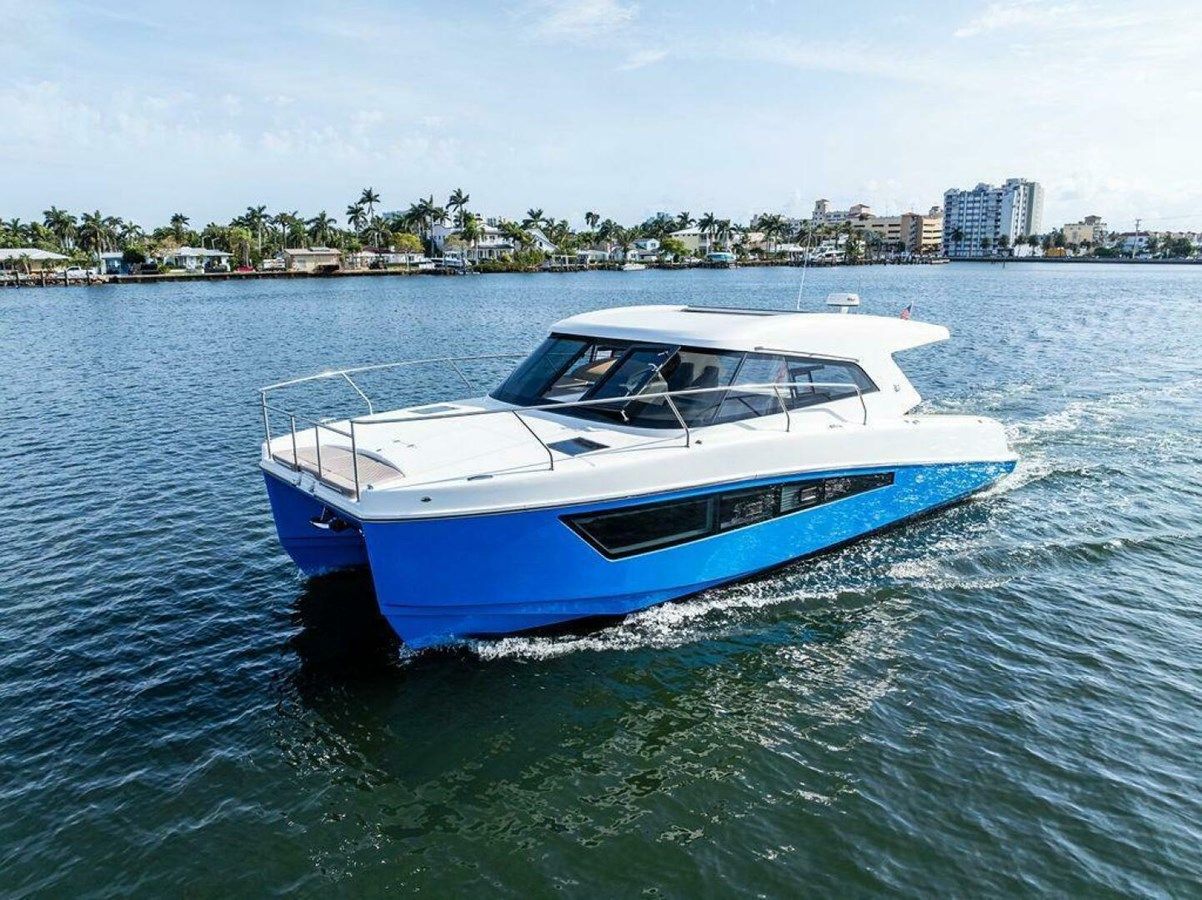
M37 Power Catamaran
- Length overall: 37‑foot class (approximately 11.3–11.5 m), placing it squarely in the midsize owner‑operator segment.
- Beam: Wide multihull stance for excellent stability and generous salon/cockpit footprints typical of this length class.
- Layout and accommodations: Two staterooms as standard (one in each hull), with arrangements that may include one or two heads depending on specification. The salon favors open sightlines, natural light, and practical galley placement to support day boating and weekend cruising. Storage is distributed to keep weight centralized and low where possible.
- Engine type: Twin diesel inboard/sterndrives, selected for quiet operation, efficient mid‑range cruise, and service access. Power outputs vary by specification, typically in the mid‑300‑horsepower class per side.
- Performance envelope: Tuned for efficient cruising in the 20–30‑knot range, with top speeds commonly reported in the mid‑ to high‑30‑knot band depending on load, sea state, prop selection, and engine rating. The emphasis is on maintaining a comfortable, quiet pace in real coastal conditions rather than chasing peak numbers.
- Handling character: Predictable, balanced, and confidence‑building. Twin screws support precise low‑speed control, while the hulls’ fine entries and carefully managed tunnel height help the boat run cleanly in chop with minimal spray.
- Construction: Vacuum‑infused composite laminates with foam‑cored structures where appropriate, focusing on stiffness, weight control, and acoustic damping. Structural continuity through girders and bulkheads supports the solid feel at speed.
- Systems and serviceability: Owner‑operator friendly installations with accessible filters, seacocks, strainers, and electrical distribution. Equipment choices favor widely supported components for predictable maintenance.
- Use profile: Designed for coastal cruising, extended weekends, and confident day runs in a range of sea states. The platform’s stability and quiet demeanor are well suited to families and owners transitioning from monohulls who want more space without stepping into crewed sizes.
Notes on model availability and evolution
- The M37 is the core model anchoring the brand’s portfolio, reflecting the design DNA: a modern, performance‑leaning power catamaran that balances speed, efficiency, and livability.
- Additional sizes or derivatives may be explored over time, but the guiding principle remains consistent—optimize the multihull platform for owner‑driven cruising, emphasize quiet, efficient propulsion, and maintain a high standard of systems integration and build quality.
- Given the nature of bespoke specifications and evolving options packages, prospective owners typically focus first on core layout and propulsion choices and then tailor details to their cruising plans, staying mindful of the weight and serviceability implications of each option.
Why the M37 matters in context
- Compared with monohulls of similar length, the M37 offers a step‑change in usable volume and stability, enabling more social seating, a more comfortable galley/salon relationship, and cabins with generous berths.
- Against other power cats, it differentiates with a sportier driving brief and a propulsion concept that prioritizes quiet running and mid‑range efficiency.
- For owners who value time on the water over time in the engine bay, the serviceability‑first systems layout is a practical advantage that pays dividends across an entire season.
Owner impressions and operational highlights
- Stability at anchor and under way reduces fatigue on long days.
- Predictable low‑speed control eases docking in tight marinas.
- Quiet operation encourages conversation at cruise and comfortable interior living while under way.
- Practical storage and weight management help preserve the boat’s performance as cruising gear accumulates.
- The combination of range, comfort, and speed makes “there and back in a day” runs feasible even when the forecast suggests modest chop.
In sum, the Makai Yachts M37 stands as a modern power‑cat expression for owner‑operators who want multihull advantages—space, stability, efficiency—without losing the driver’s‑boat satisfaction that makes every outing enjoyable. Its construction methods, propulsion philosophy, and systems integration reflect a thoughtful focus on real‑world cruising, comfort, and ease of ownership.

Learn more on the “MAKAI YACHTS”
To learn more on the “MAKAI YACHTS” or to get advice on how to buy or sell a yacht or get a great price for a yacht charter
please call +1 (954) 274-4435 USAOnly deal with professionals!