
 Licensed Yacht BrokersSales and service of yachts and ships
N/A - For Sale
Hargrave Custom Yachts
Company History
Hargrave Custom Yachts traces its lineage to one of the most influential American yacht designers of the 20th century, Jack B. “Jack” Hargrave. For decades, Hargrave’s design office in Florida shaped the look, performance, and practicality of American motor yachts, producing designs for noted builders and becoming closely associated with seaworthy, comfortable, owner-friendly craft. After Jack Hargrave passed away in the mid-1990s, the legacy of the studio’s extensive design portfolio and its deep bench of naval-architecture knowledge formed the foundation for a new chapter under the Hargrave name.
Hargrave Custom Yachts emerged in the late 1990s as a dedicated yacht-building brand designed to carry forward this legacy. Guided by industry veteran Michael “Mike” Joyce, the company set out to deliver semi-custom and fully custom motor yachts that translated the Hargrave design DNA—pragmatic engineering, generous interior volume, and practical seakeeping—into modern composite yachts tailored for American owners and global cruising. Joyce and his team built the business on a simple idea that resonated with customers: pair a seasoned American design and project-management nucleus with skilled, high-quality partner shipyards overseas, and then obsess over the owner’s brief to produce a yacht that feels thoroughly custom without the runaway cost or schedules sometimes associated with full one-off builds.
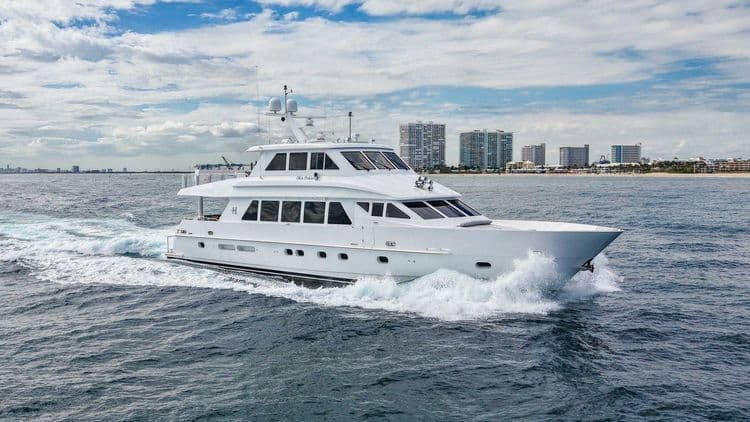
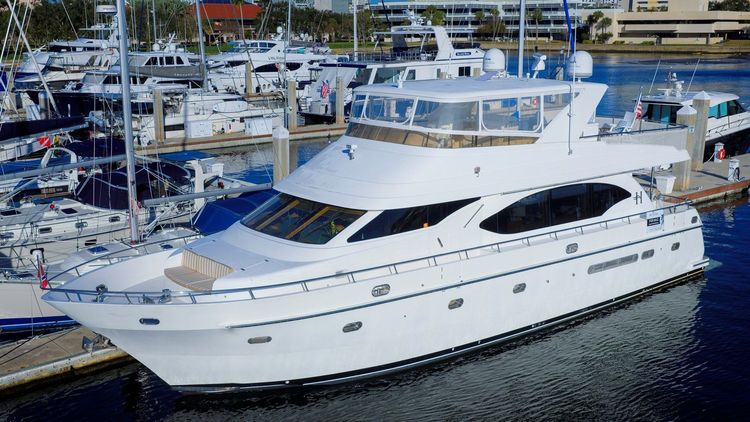
From its earliest deliveries, Hargrave Custom Yachts gravitated toward the 80- to 120-foot range—yachts large enough to offer proper long-range comfort, private and charter-ready layouts, and sophisticated onboard systems, yet still approachable for family use with a professional crew or, in some series, by highly experienced owner-operators. Hargrave prioritized raised-pilothouse and skylounge configurations popular with American clients, developing multiple series and custom variants to suit individual lifestyles, whether an owner needed a country kitchen and generous crew accommodations for extended cruising, or a formal dining area, skylounge, and party-centric deck spaces for entertaining and charter.
As market tastes evolved, so did Hargrave’s model cadence and technical approach. The design office embraced incremental innovation—engineering refinements to reduce noise and vibration, increased reliance on resin-infused composite structures where appropriate, and systematic improvements in systems redundancy and service access to support private and charter use alike. The brand’s model updates reflected feedback loops with owners, captains, and brokers, and with the craftsmen at partner yards. Hargrave also paid close attention to the commissioning process, sea-trial protocols, and after-delivery support, turning the handover phase into a hallmark of the company’s client experience.
By the 2010s, Hargrave Custom Yachts expanded its build partnerships to address broader client preferences in styling, fit-out, and delivery timelines, while maintaining centralized design leadership and quality oversight from its U.S. base. The company introduced new series and one-off projects that incorporated contemporary exterior profiles, up-to-date mechanical packages from established engine suppliers, and a host of owner-specified amenities—from beach clubs and sport-deck toys to advanced stabilization and hotel-grade climate-control systems.
Although specific model names and one-off project nicknames have come and gone, the throughline in Hargrave’s history remains consistent: an American-led custom and semi-custom yacht builder that leverages trusted international manufacturing partners to deliver yachts with generous volume, practical layouts, and tailored interiors, all supported by a hands-on, relationship-driven approach to ownership.
Country of Origin
United States of America. Hargrave Custom Yachts is headquartered in South Florida, an epicenter of the American yachting market and a natural base for design leadership, project management, sales, commissioning, and after-sales support. The U.S. origins are not only geographic; they are embedded in the brand’s design ethos—emphasizing owner comfort, long-legged cruising, serviceability, and layouts that reflect how American owners and charter guests tend to use their boats.
Manufacturing Locations
Hargrave Custom Yachts uses a proven build model that blends American design and project control with construction executed at select partner shipyards known for high-quality composite yacht building. This approach offers several advantages: the cost efficiency and craft specialization of the partner yard, the production flexibility to tailor each project, and the centralized quality and specification control of the Hargrave team.
-
Taiwan (Kaohsiung): For many years, a significant portion of Hargrave’s composite yachts have been constructed in Taiwan, a global hub for high-end GRP yacht building. In particular, Hargrave has had a longstanding relationship with Kha Shing Enterprise Co., Ltd. in Kaohsiung. Kha Shing is an established yard with deep expertise in hand-laid and resin-infused composite construction and a track record that includes building for multiple premium brands. This partnership allowed Hargrave to keep tight control over engineering and specifications while relying on a yard practiced in high-quality interiors, meticulous systems installation, and repeatable lamination standards.
-
Turkey (Antalya Free Zone): In more recent years, Hargrave has also collaborated with select Turkish partners in the Antalya Free Zone, a major yacht-building cluster that has become known for both composite and metal construction. One such partner, HSY Yachts, has built Hargrave-branded projects that reflect the company’s evolving styling and systems choices. The Antalya ecosystem offers robust supply chains, skilled labor, and modern infrastructure that align with Hargrave’s expectations for schedule discipline and quality.
-
United States (Fort Lauderdale and South Florida for commissioning and support): While hull and superstructure construction typically occur at partner yards abroad, the final stages of commissioning, sea trials, warranty setup, and owner-orientation are centered around South Florida. This puts Hargrave close to its core client base and the services tapestry of the broader Fort Lauderdale marine industry. Hargrave’s close involvement during commissioning is a signature of the brand, ensuring that system calibrations, interior punch lists, and crew training receive focused attention before the yacht’s first season.
Across all manufacturing locations, Hargrave maintains consistency in specifications, materials selection, and systems layout by using unified design documents, checklists, and inspection regimens managed by the company’s U.S.-based team. This centralized methodology—combined with long-standing relationships at the partner yards—helps retain the “Hargrave feel” across yachts built in different facilities.
Ownership and Management
Hargrave Custom Yachts is a privately held American company led by its long-time principal, Michael “Mike” Joyce. Joyce’s leadership has spanned the brand’s modern era, from establishing the company’s semi-custom build strategy in the late 1990s to nurturing its network of partner yards and vendor relationships. Under his guidance, Hargrave has kept the program intentionally focused: build within a size range where the company can control quality and schedule, maintain optionality for meaningful customization, and deliver a high-touch client experience before, during, and after delivery.
The management framework at Hargrave emphasizes:
-
Centralized design and engineering: Concept work, naval-architecture coordination, and specification control originate from the U.S. team. This ensures continuity with the Hargrave design legacy and the ability to align a build’s technical details with the intended cruising profile and owner lifestyle.
-
Project management continuity: Hargrave assigns dedicated project managers who act as the owners’ representatives from concept through handover. The PMs coordinate day-to-day issues with the chosen yard and manage vendor integrations for engines, stabilization, navigation electronics, air conditioning, and audiovisual systems.
-
Owner advocacy: The company’s leadership has long prioritized transparency in change orders, documentation, and progress reporting, with milestone reviews that line up design intent, build progress, and owner expectations. This advocacy role is one reason Hargrave enjoys repeat business and referrals—hallmarks of a relationship-led builder.
While the company partners with a range of naval architects, stylists, and interior specialists as needed for each project, its business structure keeps strategic control in-house with the Florida-based management. This hybrid approach—fixed leadership with flexible external collaborations—allows Hargrave to fine-tune talent to the brief, whether the owner prioritizes a quieter yacht, a lighter interior palette, enhanced crew separation, or specific charter certifications.
Reputation and Quality
Within the American yachting community, Hargrave Custom Yachts is widely regarded as a builder that delivers robust, comfortable, and highly livable composite motor yachts tailored to the way owners actually use them. Rather than chasing extremes in speed or avant-garde styling, the brand has cultivated a reputation for getting the fundamentals right: predictable handling, good range for coastal and near-offshore passages, spacious interiors with practical storage, and systems arranged for serviceability. This balance appeals to experienced owners who value function, comfort, and customization over headline-grabbing specifications.
Key elements underpinning Hargrave’s reputation and perceived quality include:
-
Design heritage and continuity: The Hargrave name carries real weight in U.S. yacht design history, and the modern company has leveraged that credibility without being trapped by it. Buyers recognize that Hargrave yachts tend to feel “American” in the best sense—big, bright salons; sensible galley arrangements; generous staterooms; and social deck spaces that work in South Florida, the Bahamas, and the broader Caribbean. The company’s raised-pilothouse and skylounge formats, in particular, are admired for practical cruising.
-
Semi-custom ethos that feels truly custom: In practice, Hargrave owners often specify significant changes to layouts, interior finishes, and technical options, and the company has shown a willingness to accommodate those requests as long as they align with structural and regulatory requirements. That flexibility helps owners end up with yachts that feel like one-offs, yet with the price certainty and build cadence of a semi-custom platform.
-
Partner-yard craftsmanship: Both Taiwan’s Kaohsiung shipbuilding community and Turkey’s Antalya Free Zone are recognized globally for their composite yacht craftsmanship. Hargrave’s long relationships in these regions help ensure high standards in joinery, fairing, painting, systems installation, and structural work. Many Hargrave owners comment that the fit-and-finish and low noise/vibration levels compare favorably with more expensive European builds in the same size range.
-
Commissioning and after-sales culture: Hargrave’s South Florida base supports a commissioning process that is methodical and owner-centric. Sea trials are used not only to confirm performance and build quality, but also to teach crews and owners’ teams how to get the best out of the yacht. Post-delivery, the company’s accessibility—especially for U.S.-based owners—has been a differentiator. Having management and vendor networks nearby helps resolve punch-list items quickly and supports smooth first seasons.
-
Owner community and repeat business: Hargrave benefits from a loyal owner base. Many have built more than one Hargrave or have referred friends into the brand. While not a formal “club,” this informal community contributes to the company’s market presence at major American shows in Fort Lauderdale, Miami, and Palm Beach, where Hargrave often exhibits multiple brokerage and new-build examples. Positive word-of-mouth from captains and crew—who appreciate sensible machinery spaces, labeled systems, and accessible service points—also reinforces the brand’s reputation.
-
Media recognition: Although the company is better known for consistent delivery than for collecting high-profile international trophies, Hargrave yachts have been regularly reviewed and profiled in leading American yachting publications and featured at prominent boat shows. Coverage typically highlights the generous interior volumes relative to LOA, pragmatic layout choices, and the value proposition compared with European and American competitors in the same size bracket.
In terms of quality philosophy, Hargrave focuses on:
-
Structural integrity and finish: Solid or heavily reinforced hull bottoms in composite; topsides and superstructures that take advantage of cored construction to save weight while retaining stiffness; fairing and paintwork to a high cosmetic standard.
-
Proven machinery and systems: Main propulsion typically from established engine makers, with stabilization packages, bow/stern thrusters, and hotel systems specified for redundancy and serviceability. The company strives for quiet operation through careful isolation of machinery vibrations, extensive sound insulation, and attention to exhaust routing.
-
Human-centered design: Crew flow, guest privacy, and circulation patterns are mapped early in design so that yachts work equally well for family use and for charter. Hargrave often prioritizes comfortable crew accommodation and thoughtful service routes, recognizing that happy crew are central to a happy owner experience.
-
Lifecycle support: From documentation packages and spare-parts provisioning to warranty responsiveness and refit planning, Hargrave treats the yacht as a long-term relationship rather than a one-time sale. That perspective shows up in better-maintained fleets and, according to many brokers, resale values that benefit from strong upkeep and brand reputation.
Taken together, these attributes give Hargrave Custom Yachts a distinctive place in the market: an American-led builder offering genuinely customized composite motor yachts, executed at respected partner yards, and finished with a hands-on commissioning and support culture. For buyers who value livability, personalization, and a collaborative build process backed by seasoned project management, Hargrave has earned a durable reputation for delivering yachts that feel tailored, capable, and well thought out from keel to masthead.
Hargrave Custom Yachts is an American yacht brand built around the legacy of legendary naval architect Jack Hargrave and stewarded by industry veteran Michael Joyce since the late 1990s. Rather than operate a single, vertically integrated shipyard, the company functions as a designer, specifier, and project manager that partners with proven builders to deliver semi-custom composite motor yachts tailored to their owners’ cruising ambitions. Headquartered in Fort Lauderdale, Florida, Hargrave is best known for graceful raised-pilothouse and skylounge designs typically ranging from roughly 70 to 125 feet, with a strong emphasis on practical American-style systems, generous interior volume, and the kind of owner-centric ergonomics that make extended East Coast, Bahamas, and Caribbean cruising both comfortable and straightforward. The brand’s philosophy stresses flexibility: using a proven hull form as a platform, Hargrave encourages clients to rework interior arrangements, décor, and technical specifications so that each yacht emerges genuinely one-off, yet benefits from the reliability and ride characteristics of an established design.
A hallmark of Hargrave’s approach is the way it blends design office discipline with on-the-water sensibilities. From machinery access to crew flow and owner privacy, a Hargrave tends to be engineered around serviceability and long-term ownership, not just first impressions at the dock. The company pays notable attention to specifying widely supported machinery and equipment—engines, stabilizers, generators, air-conditioning, and electronics—from brands with deep service networks in North America and popular cruising grounds. That philosophy—paired with a client-service model that begins at concept and continues well into the yacht’s commissioning and early seasons—has helped the brand cultivate a strong following among experienced American owners who want the latitude of custom choices without the risk and cost of a clean-sheet, one-off build.
Historically, many Hargrave yachts have been constructed in Taiwan, where the brand has long-standing relationships with high-quality composite builders and craftsmen recognized for their fit-and-finish and value-to-quality ratio. Depending on the model, Hargrave has also utilized additional partner shipyards to match project requirements, capacity, and owner timelines. This distributed-building model allows the company to scale up or down, maintain momentum through changing market cycles, and keep a close focus on the parts of the process that most directly shape the owner’s experience: naval architecture, specifications, interior planning, quality assurance, and delivery support. To potential buyers, the result is a consistent identity—styling, livability, and systems thinking—that remains recognizably Hargrave across multiple sizes and configurations.
Within the American yachting landscape, Hargrave is frequently described as a “semi-custom specialist”: a brand that takes the risk out of custom by anchoring each project in a dialed-in hull and machinery package, then opening up the interior to collaboration with the owner and the owner’s chosen designer. Numerous Hargraves over the years have reflected very different personalities—family-centric layouts with country kitchens and wide-beam salons; entertaining-forward skylounges; larger crewed formats with tri-deck arrangements—yet all share the same underlying DNA of the brand: seaworthy manners at 10–12 knots and the ability to run comfortably at higher cruise speeds when desired, thoughtful machinery spaces, and owner-friendly maintenance planning. In the brokerage market, Hargrave yachts maintain a reputation for strong volume, practical layouts, and a specification level that often includes big-boat amenities—stabilization, redundancy, tender handling capacity—at sizes where those features are not always a given.
Main Competitors
Hargrave Custom Yachts operates in the semi-custom composite motoryacht category between roughly 70 and 125 feet, a segment with several well-established international brands. Key competitors include:
-
Ocean Alexander (Taiwan/USA): A direct competitor in size, material, and market orientation. Ocean Alexander offers raised-pilothouse and skylounge yachts in the 70–120-foot range with strong North American representation, similar emphasis on equipment support, and robust build quality. Buyers comparing OA and Hargrave often weigh the benefits of Hargrave’s more open interior customization versus OA’s heavily engineered, series-based platforms.
-
Horizon Yachts (Taiwan): Another major Taiwanese builder with a comprehensive semi-custom program and multiple series (E, FD, etc.). Horizon’s breadth of hull forms and in-house capabilities can appeal to clients who value a near-production build cadence with room for personalization. Hargrave competes by offering a more boutique, design-led experience, especially for owners who want to rework space planning around specific family or crew needs.
-
Hatteras Yachts (USA): Though Hatteras has refocused at times on sportfishing and certain motoryacht sizes, its heritage overlaps with Jack Hargrave’s own design legacy, and the brand remains a touchstone for American-style, seakindly fiberglass yachts. For buyers prioritizing a US-manufactured option and a storied name, Hatteras is a comparator; Hargrave typically counters with deeper customization and value per cubic foot of interior volume.
-
Westport (USA): Positioned at the upper end of the composite, semi-custom market, Westport’s 112 and 125 series intersect with larger Hargrave offerings. Westport benefits from a repeatable, finely tuned build process and a reputation for turnkey reliability. Hargrave competes by offering broader interior latitude, a wider spectrum of sizes, and the ability to tailor specifications in ways that are atypical for strict series production.
-
Johnson Yachts (Taiwan): Focused on large-volume layouts, Johnson provides semi-custom fiberglass motoryachts from roughly 80 to 115 feet. Clients evaluating Johnson often cross-shop Hargrave when interior beam utilization and owner-operator ergonomics matter.
-
Cheoy Lee (Hong Kong/China): With composite and metal capability and a history of commercial-grade engineering, Cheoy Lee’s Bravo and Global series sometimes overlap Hargrave’s target sizes. The comparison usually turns on styling preferences and the owner’s appetite for custom options versus a more pre-prescribed series approach.
-
European semi-custom brands (Princess, Sunseeker, Azimut Grande, Ferretti Custom Line): These builders offer sophisticated industrial design, strong performance, and high build cadence. They dominate the Mediterranean market and have extensive dealer networks in the US. While they are formidable competitors in terms of brand recognition and short lead times, Hargrave often appeals to US clients seeking more granular customization, American systems, and layouts optimized for extended US/Bahamas cruising patterns rather than predominantly Med day-boat usage.
-
Burger Boat Company (USA, aluminum custom): While Burger tends to work in aluminum and at a more bespoke/cost-intensive tier, potential Hargrave clients looking for deep customization sometimes consider Burger when prioritizing full custom metal construction. Hargrave’s counterpoint is its cost and schedule efficiency from starting with proven composite hulls and leveraging partner yards with strong series experience.
-
Outer Reef and Marlow (USA/Asia): Oriented toward long-range performance and traditional or expedition aesthetics, these brands sometimes vie for the same owner who prizes reliability, interior volume, and owner-operator friendliness. The divergence typically arrives at hull form and cruising profile: Hargrave’s designs generally favor planing or semi-displacement performance with higher cruise speeds, whereas long-range brands emphasize displacement efficiency and ocean-crossing range.
In practical terms, Hargrave competes by emphasizing three differentiators: a highly collaborative design/specification process, American-style systems integration with accessible service networks, and value per square foot of usable interior and exterior space. Owners who want a yacht built around their lifestyle—specific galley arrangements, guest stateroom priorities, crew separation, tender and toy plans—will often find Hargrave’s semi-custom canvas more accommodating than series-production alternatives. Conversely, owners who prioritize the shortest possible delivery timelines or the cachet of a large production brand may lean toward the European giants or one of the largest Taiwanese builders. The competitive landscape, in other words, is not a single “head-to-head” rival but a matrix of compelling choices; Hargrave’s niche remains the boutique, design-forward path within a proven composite framework.
Current Production Status
Hargrave Custom Yachts continues to operate as an active semi-custom yacht brand, accepting new-build commissions and overseeing construction through established partner shipyards. Rather than promoting a fixed annual production number, Hargrave scales its orderbook to client demand and available build slots at its partner yards. This approach allows the company to maintain consistent quality control while aligning project timelines with owner schedules and shipyard capacity, a particularly valuable attribute in a market where demand has varied significantly in recent years.
In practice, a Hargrave new build begins with a conversation around size, hull series, and intended use—seasonal family cruising, charter, owner-operator versus fully crewed, and preferred performance envelopes. From there, the design office refines general arrangement options and begins the iterative selection of propulsion, stabilization, electrical systems, and hotel loads. Throughout, one of Hargrave’s distinct contributions is practical systems planning: engine room access, component service clearances, and the routing of piping and wiring are engineered not just to meet yard standards but to simplify ownership and reduce the lifetime cost of service. For experienced owners, this can be as persuasive as aesthetic design.
Construction has historically been anchored in Taiwan, where Hargrave has collaborated with leading composite builders recognized for their craftsmanship in fiberglass laminates, joinery, and finish. Depending on the design and client brief, the company has also worked with additional partner yards to meet slot availability and to match the build culture to the project’s goals. This distributed production model is a strategic choice: it allows Hargrave to pair a specific yacht concept with a yard whose capabilities and pipeline align with the owner’s expectations for schedule, complexity, and budget.
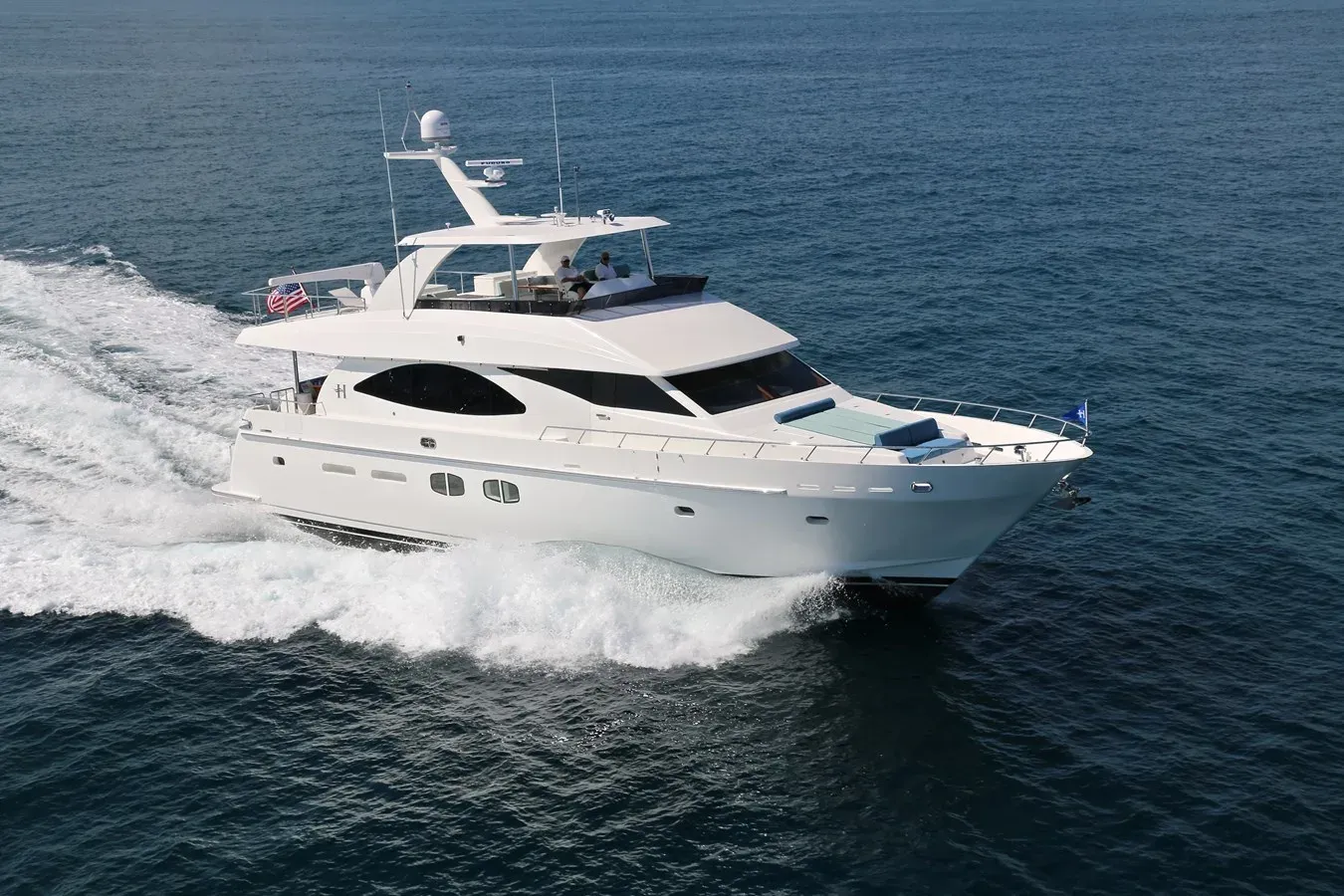
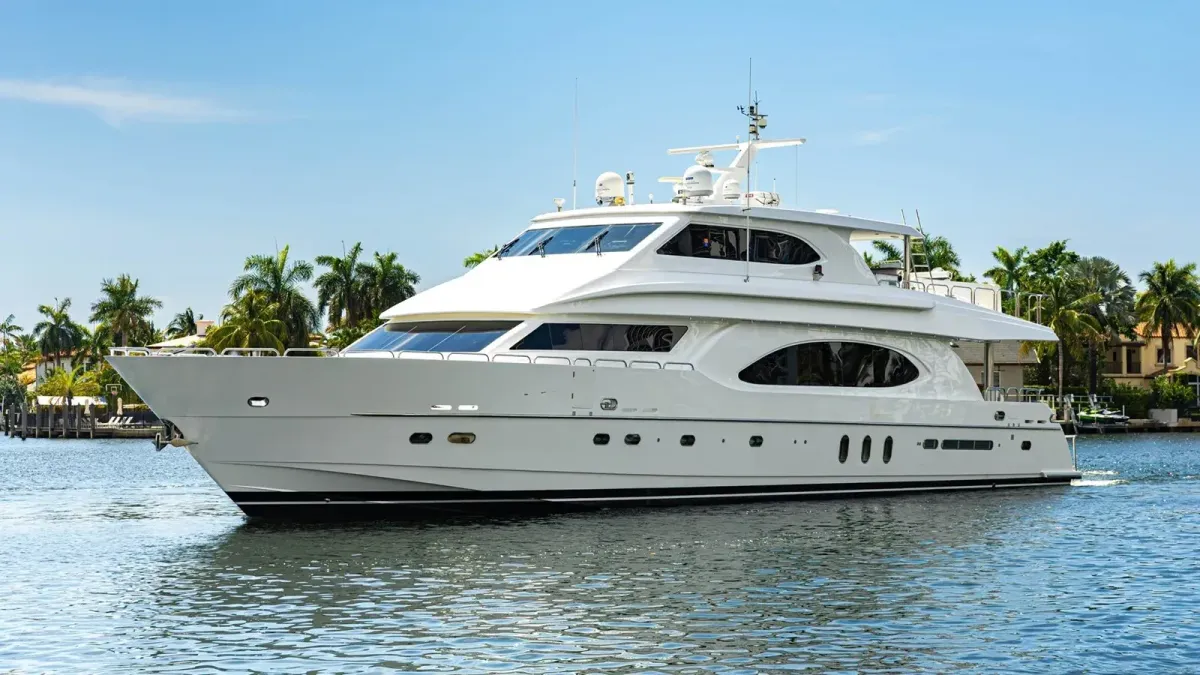
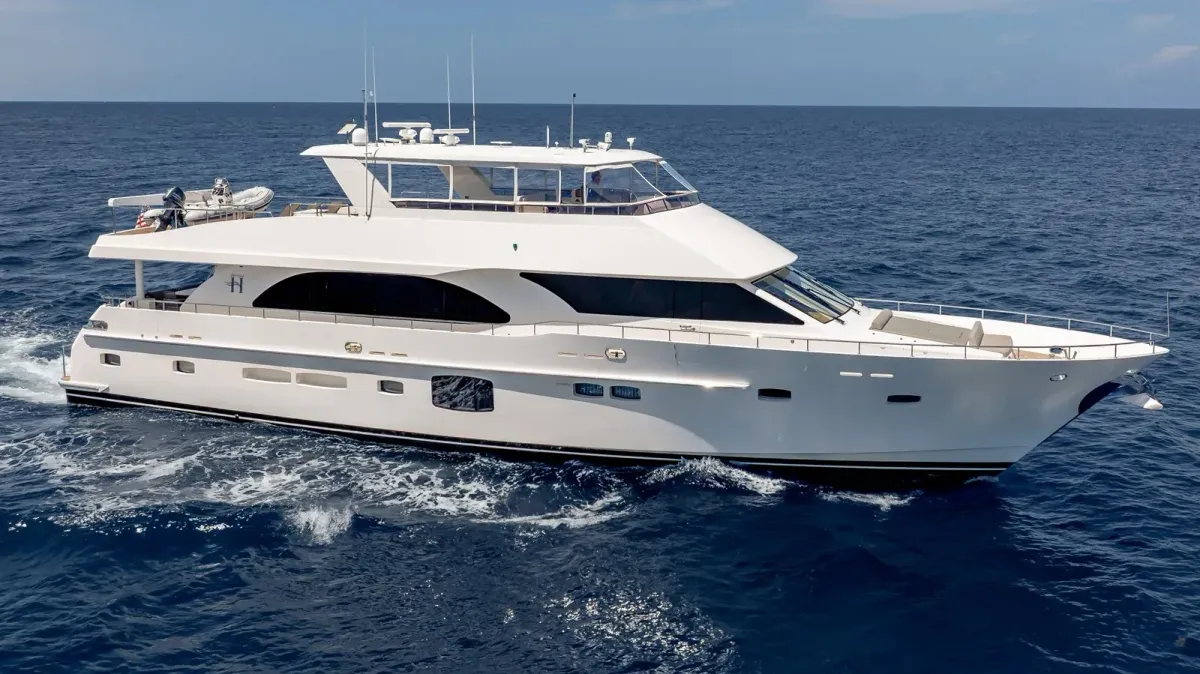
The model range remains focused on GRP motoryachts in the approximate 70–125-foot bracket, including:
- Raised pilothouse and skylounge configurations tuned for owner-operator or minimal crew usage.
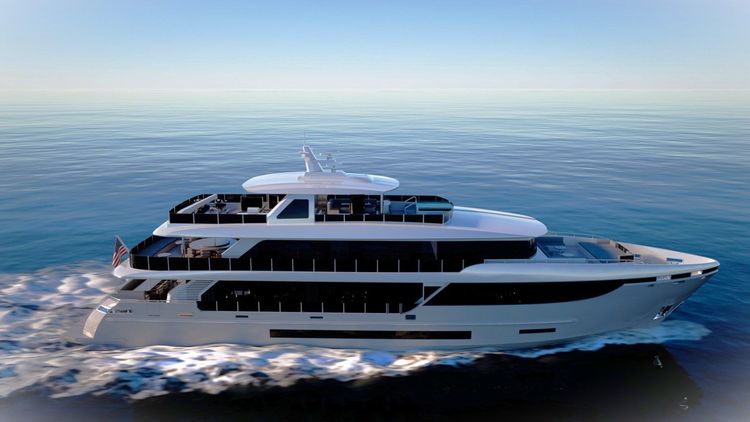
- Larger tri-deck arrangements intended for fully crewed programs and extended seasonal cruising.
- Open-bridge and enclosed-bridge variants tailored to the cruising climate and the owner’s desire for year-round climate control.
Customization extends well beyond décor. Owners typically adjust the stateroom mix (e.g., VIP forward versus amidships, convertible staterooms for family flexibility), galley placement (country kitchen formats versus enclosed for crewed programs), and the definition of outdoor spaces (foredeck lounges, beach club features, hardtop designs, and tender handling solutions). Technical customization can involve alternative engine packages from mainstream suppliers, bespoke stabilizer and thruster selections, and redundancy schemes calibrated to how and where the yacht will run. The result is that two Hargraves of the same nominal length can present very different personalities: one oriented toward casual family cruising with maximum salon volume and social areas, and another designed for a professional crew with dedicated service pathways and heightened systems autonomy.
Hargrave provides end-to-end support, from contract and specification through onsite build supervision, quality inspections, shipment logistics, and commissioning in the United States. After delivery, the brand stays engaged with warranty coordination and can assist in maintenance planning, refit advice, and upgrades as the owner’s program evolves. Because Hargrave specifies widely supported components and aims for service-friendly layouts, most owners find it straightforward to secure parts and expertise across popular US and Caribbean cruising grounds, an important consideration for minimizing downtime during peak seasons.
While yacht market cycles and global supply chains can influence lead times, Hargrave’s project-managed production model is inherently adaptable. The brand can calibrate its intake of new commissions to the availability of high-quality yard slots and the pacing that ensures proper design and QA attention. For buyers, this typically translates into a realistic path from concept to launch, with transparency around schedule milestones, specification lock-in points, and decision dates tied to the build sequence. In a segment where a yacht is often as much a life project as a product, that balance of flexibility and discipline is central to Hargrave’s ongoing presence in the market.
Frequently Asked Questions
Question:Who is Hargrave Custom Yachts?
Answer:Hargrave Custom Yachts is a North American yacht brand known for building semi-custom and fully custom composite motor yachts, most commonly in the 76–125 ft (23–38 m) range. The company draws its design DNA from the legendary naval architect Jack Hargrave, whose studio helped shape the modern American motor yacht through work with marquee builders and numerous successful series. Today, Hargrave focuses on owner-centric yachts that blend proven naval architecture, efficient build techniques in advanced composites, and highly personalized interior layouts. The result is a portfolio of raised-pilothouse, skylounge, and tri-deck yachts tailored to private ownership or charter, with an emphasis on livability, serviceability, and long-term reliability.
Question:Where are Hargrave yachts built?
Answer:Hargrave manages design, engineering standards, and owner liaison directly, while construction is carried out at select partner shipyards known for high-end composite work. Historically, many projects have been completed in Asia (notably Taiwan), and on select larger builds in recent years, in the Mediterranean region as well. Each project is overseen by the Hargrave team and independent surveyors to align with the chosen specification, whether that’s private use, charter compliance, or specific classification requests.
Question:What sizes and types of yachts does Hargrave typically build?
Answer:The sweet spot for Hargrave is roughly 80–125 ft. Within that band, the brand offers:
- Raised-pilothouse motor yachts with either open bridges or enclosed skylounges
- Tri-deck configurations above roughly 110 ft
- Semi-displacement or planing hull forms optimized for efficient cruise and confident handling Layouts are semi-custom or custom, allowing the stateroom count, crew areas, and service spaces to be tailored to the owner’s program.
Question:What is the construction approach and which materials are used?
Answer:Hargrave yachts are typically built in advanced fiberglass composites. Resin infusion and vacuum-bagging methods are commonly employed to achieve high fiber-to-resin ratios, reduce weight, and improve structural consistency. Hulls and superstructures are generally cored (often with foam) to enhance stiffness and dampen noise and vibration. Structural bulkheads, stringers, and local reinforcements are engineered for long-term durability. The brand’s approach balances robust, proven composite techniques with finishes and joinery more often associated with bespoke, one-off builds.
Question:What propulsion and performance should an owner expect?
Answer:Hargrave typically specifies twin diesels from premium manufacturers such as Caterpillar (C18 and C32 families) or MTU (12V/16V 2000 series), matched to direct-drive shafts. On most planing and semi-displacement models:
- Top speeds often range from the high-teens to the mid-20-knot bracket depending on size and engine choice
- Economical cruise speeds commonly sit around 10–12 knots for long passages, with mid-teens to low-20s available on demand for faster transits Stabilization (zero-speed fins or gyros), bow/stern thrusters, and robust hydraulic systems are typically specified for comfort and maneuverability.
Question:How customizable are Hargrave yachts?
Answer:Customization is a core pillar. Beyond choosing between raised-pilothouse, skylounge, or tri-deck configurations, owners routinely personalize:
- The general arrangement (e.g., on-deck master vs. full-beam master below, four vs. five guest cabins)
- Galley placement (country kitchen vs. crew-service galley), pantry and service areas
- Interior style, finishes, and materials
- Systems packages (stabilizers, watermakers, tender handling, digital switching, energy management)
- Engine and generator selections This flexibility lets owners tailor the yacht for private family cruising, mixed private/charter use, or more formal entertaining.
Question:Are Hargrave yachts suitable for owner-operators?
Answer:Many Hargrave yachts in the 76–95 ft range are configured for owner-operators or couples who cruise with a small professional crew. As you move above 100 ft and into tri-deck territory, professional crew becomes the norm, with dedicated captain’s cabins, crew messes, and service routes to support hospitality and charter operations.
Question:What interior comforts and noise/vibration controls are typical?
Answer:Interior quietude and comfort are achieved through a combination of cored composite panels, sound-deadening insulation, resiliently mounted machinery, noise barriers around engine rooms, and careful isolation of vibration paths. High-capacity chilled-water air-conditioning, thoughtfully zoned, is standard in this class. On the joinery side, Hargrave yachts are known for refined woodworking and bespoke cabinetry, matched with durable finishes suited to saltwater environments and frequent use.
Question:What is the typical range and fuel efficiency?
Answer:Range is a function of displacement, fuel capacity, and cruise speed. As a general guide:
- Sub-100 ft planing models: often several hundred nautical miles at fast cruise, extending well beyond 1,000 nm at displacement speeds
- 100–125 ft semi-displacement/tri-deck yachts: commonly 1,500+ nm at economical cruise, subject to the exact specification Owners who prioritize extended passages can request enlarged tankage, long-range engine calibrations, and propeller optimizations to stretch range.
Question:Can Hargrave yachts be built for charter and to classification?
Answer:Yes. Builds can be specified to meet prevalent charter standards and regulations, including structural fire protection, lifesaving appliances, and crew/service arrangements. Upon request, projects may be constructed in line with relevant classification society guidelines and flag-state rules (for example, MCA LY3 for applicable sizes). Electrical systems are routinely configured for regional compliance, and CE certification is pursued as required for European deliveries.
Question:What deck arrangements and tender handling options are common?
Answer:On raised-pilothouse and skylounge models, the primary tender is often stowed on the boat deck with a hydraulic crane. Larger tri-deck models may incorporate tender wells, wing cranes, and dedicated toy storage. Beach-club transoms, hydraulic swim platforms, and passerelles are frequent requests, improving water access and Mediterranean mooring flexibility.
Question:Which stabilizer systems are typically used?
Answer:Zero-speed fin stabilizers are common on Hargrave builds above roughly 80 ft, and gyro stabilizers are specified where owners prefer internal solutions or supplemental damping. Many yachts combine fins for underway and zero-speed mode with careful weight distribution and hull design to minimize motion across sea states.
Question:What electrical and hotel systems are standard?
Answer:Expect twin generators sized for redundancy, digital monitoring of tankage and power loads, seamless transfer switches, and shore-power conversion appropriate to the cruising region. Watermakers, large-capacity hot-water systems, LED lighting, and comprehensive AV/IT networks are the norm. Digital switching can be incorporated, though many owners prefer conventional breaker panels for serviceability.
Question:How does Hargrave address serviceability and maintenance access?
Answer:Engine rooms and technical spaces are typically arranged with clear access to pumps, filters, strainers, valves, and primary machinery. Thoughtful routing of plumbing and wiring looms, labeled harnesses, and service clearances around stabilizer actuators and air handlers help reduce maintenance time. Finish materials and coatings are selected for durability, and many yachts are delivered with detailed technical documentation and spares packages.
Question:What distinguishes Hargrave’s design language?
Answer:Hallmarks include practical, seaworthy profiles; generous house and window geometry that floods interiors with natural light; wide side decks for safe line handling; and social exterior decks that complement open-plan salons. The brand tends to prioritize real-world cruising utility—ample storage, ergonomic galleys, functional crew areas—over fleeting styling trends, while still delivering contemporary lines and refined detailing.
Question:How does the brand approach sustainability and emissions?
Answer:Composite construction by resin infusion limits material waste, and modern Tier 3-compliant engine packages reduce NOx and particulate emissions compared with earlier generations. LED lighting, advanced HVAC controls, and optional lithium-hybrid hotel power solutions can lower generator runtimes. Anti-fouling choices and propeller/hull optimization also contribute to more efficient passages.
Question:What is the typical resale outlook?
Answer:Hargrave occupies a well-recognized niche in custom and semi-custom composite yachts. Resale values are influenced by condition, maintenance history, interior appeal, and spec (stabilizers, engine brand/hours, crew layout, etc.). Yachts with versatile layouts, proven charter track records, and updated soft goods often command stronger interest on the secondary market.
Question:What is the delivery and commissioning experience like?
Answer:Builds proceed through concept, preliminary design, technical specification, and engineering before composite layup. Owners typically approve interior mood boards and materials early, then confirm details during milestone inspections. Sea trials validate performance, noise/vibration, and systems integration. After delivery, a shakedown period and warranty support address fine-tuning while the owner and crew settle into routines.
Question:Can an owner request unusual features or experimental technology?
Answer:Within the constraints of safety, weight, and classification, Hargrave is accustomed to tailoring unique features—be it specialized dive lockers, expanded beach clubs, convertible media rooms, or specific galley equipment for culinary programs. Early engineering involvement is essential when considering advanced options (e.g., alternative fuels, hybrid drives, or extensive battery systems) to ensure feasibility and long-term serviceability.
Question:What crew accommodations are typical?
Answer:In the 80–95 ft range, expect 2–4 crew in compact but well-appointed quarters, usually aft with separate access. Yachts above 100 ft commonly carry 4–7 crew, with a dedicated crew mess, laundry center, and service routes that keep crew circulation discreet relative to guest areas—important for both private hospitality and charter service.
Question:What makes a Hargrave a good candidate for charter?
Answer:Broad deck spaces, flexible guest cabin counts, stabilizers, reliable hotel systems, and generous storage for toys all suit charter operations. Efficient galleys and thoughtful service pantries enable professional-level hospitality. Additionally, the brand’s semi-custom ethos means a layout can be optimized from the outset for charter, including convertible cabins, enhanced audiovisual systems, and child-friendly features where desired.
Available Models
Note: Hargrave builds semi-custom and custom yachts; specifications vary by project and year. The series below represents commonly offered sizes and configurations in recent years, with typical characteristics for guidance.
-
Hargrave 76 Open Bridge / RPH
- Length: Approx. 76 ft (23.2 m)
- Typical guest layout: 3–4 cabins (often full-beam master, VIP forward, and two guest cabins)
- Crew: 2–3
- Engines: Twin diesel, commonly Caterpillar C18 series
- Performance: Top speed roughly 20–23 knots depending on load and spec; economical cruise near 10–12 knots
- Notes: Owner-operator friendly size with generous salon and country-kitchen options; ideal for coastal and near-offshore cruising with occasional passages.
-
Hargrave 80 Open Bridge / Flush Deck
- Length: Approx. 80 ft (24.4 m)
- Typical guest layout: 4 cabins
- Crew: 2–4
- Engines: Twin Caterpillar C18 or similar; stabilizers typical
- Performance: Top speed often in the low-20-knot range; efficient displacement cruise around 10–11 knots
- Notes: Popular series for families; versatile flybridge with boat-deck crane for tender and toys.
-
Hargrave 92–95 Raised Pilothouse
- Length: Approx. 92–95 ft (28–29 m)
- Typical guest layout: 4–5 cabins; options for on-deck master on some layouts or expanded skylounge
- Crew: 3–5
- Engines: Twin Caterpillar C32 or MTU 12V2000 series
- Performance: Typical top speed 20–24 knots subject to power; comfortable cruise in the mid-teens; extended range at 10–12 knots
- Notes: A flagship size for many owners, balancing private operation with small professional crews; strong charter candidate with generous deck spaces.
-
Hargrave 101/102 Skylounge or RPH
- Length: Approx. 101–102 ft (30.8–31.1 m)
- Typical guest layout: 4–5 cabins; full-beam master plus VIP and twin/convertible guest cabins common
- Crew: 4–6
- Engines: Twin Caterpillar C32 (various ratings) or MTU equivalents
- Performance: Top speed commonly around 20–23 knots; long-range cruise in the 10–12 knot band
- Notes: Offers the volume and separation of spaces prized for longer itineraries, with skylounge options enhancing all-weather usability.
-
Hargrave 116 Tri-Deck
- Length: Approx. 116 ft (35.4 m)
- Typical guest layout: 5 cabins, often including an on-deck master; generous crew quarters with dedicated mess
- Crew: 5–7
- Engines: Twin Caterpillar C32 or MTU 12V/16V 2000 series; zero-speed fins typical
- Performance: Top speed often high-teens to low-20s depending on rating; substantial range at displacement speeds
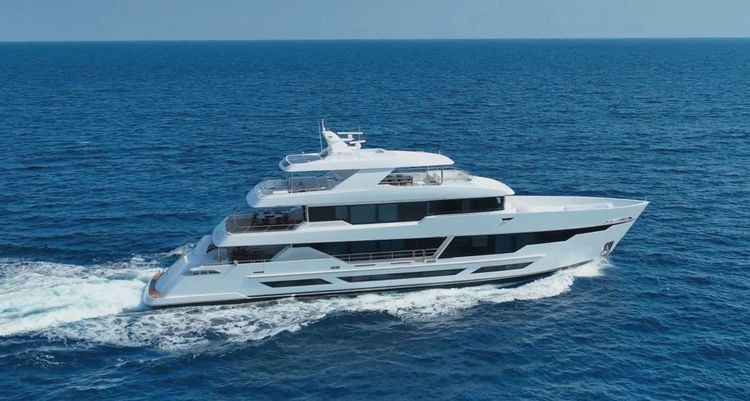
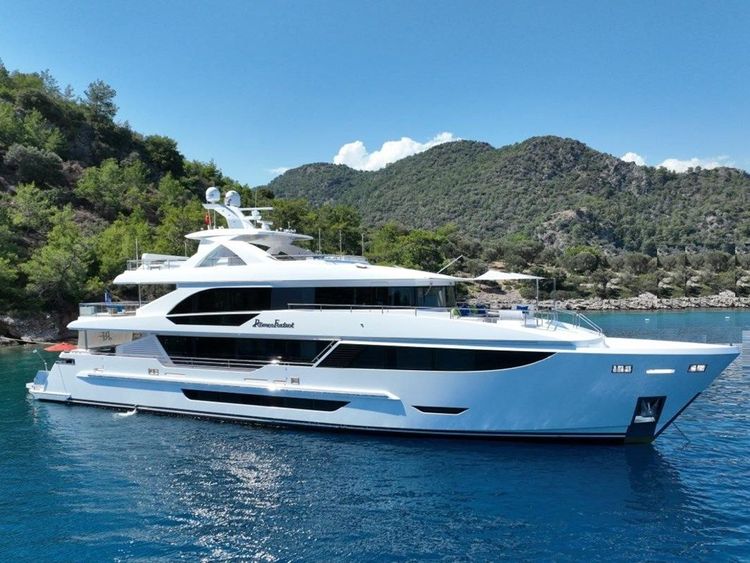
- Notes: True tri-deck platform enabling distinct guest, crew, and service flows; strong platform for charter and extended seasonal cruising.
-
Hargrave 120 / G120 Series
- Length: Approx. 120 ft (36.6 m)
- Typical guest layout: 5 cabins with multiple VIPs; on-deck master available
- Crew: 6–7
- Engines: Twin MTU 16V2000 or Caterpillar C32 (ratings per spec); advanced stabilization
- Performance: Typically around 20–24 knots at the top end when specified for higher speed; efficient long-range displacement cruise around 10–12 knots
- Notes: Contemporary styling with expanded beach and lounge zones; suitable for global itineraries with appropriate classification and systems.
-
Hargrave 125 Tri-Deck
- Length: Approx. 125 ft (38.1 m)
- Typical guest layout: 5 staterooms; formal and informal dining; large sky lounge and sun deck
- Crew: 6–8
- Engines: Twin Caterpillar C32 or MTU 2000-series options; hotel loads supported by twin generators
- Performance: Top speeds typically in the high-teens to low-20-knot range; extended range at economical cruise
- Notes: Flagship scale in composite construction, delivering superyacht comforts with efficient systems, ample tenders/toys capacity, and robust service areas.
Because Hargrave is a semi-custom and custom builder, each yacht can deviate meaningfully from the above in layout, machinery, and performance. The figures and descriptions here reflect common configurations seen across multiple deliveries and should be treated as indicative rather than prescriptive. For a specific project, engineering, tankage, weight studies, and sea-trial data will define the final performance envelope and accommodation details.

Learn more on the “N/A”
To learn more on the “N/A” or to get advice on how to buy or sell a yacht or get a great price for a yacht charter
please call +1 (954) 274-4435 USAOnly deal with professionals!